
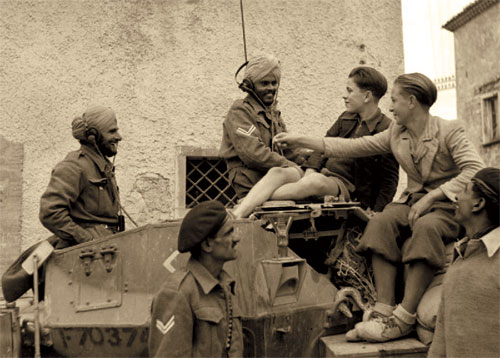
In the header: Sikh troops from a reconnaissance unit of the 4th (Indian) Infantry Division chat with Italian boys during the Italian campaign.
Introduction:

20 Indian divisions would fight in World War 2, across all of its major theatres of war. They would fight in the ceaseless, gorgeous and brutal Western Desert in Africa, the wet and torturous jungles of South East Asia and the beautiful plains of Europe. These Indian divisions would be of all types – armour, infantry and airborne – and would fight in some of the war’s great campaigns and battles. At the time, and immediately after, they were hailed as heroes – both at home and abroad. Their stories of valour and courage were published in books, magazines and newspapers across the English-speaking world and beyond. But now, as World War 2 and the immense sacrifices it demanded fast fade out of living memory and the public eye, their stories are forgotten.
To be sure, not all stories are lost – such as the great battles that engulfed the Indian towns of Imphal and Kohima during the Japanese invasion, the landings at Normandy, the fighting on Okinawa, the fall of Singapore or the bravery of outnumbered RAF pilots during a storm of Luftwaffe attacks. But there are those stories that no longer command the gaze of history as perhaps they should. One of those stories is the journey of the 4th (Indian) Infantry Division across Africa, Italy and Burma. Known now as 4 Mountain Division, it is among the most decorated divisions of the Indian Army. The legendary British Field Marshal, Archibald Wavell, said of the division “The fame of this division will surely go down as one of the greatest fighting formations in military history: to be spoken of with such as the Tenth Legion, The Light Division of the Peninsular War [or] Napoleon’s Old Guard”. Yet this unit has been relegated to the footnotes of history – a history overtaken by twisted and falsified narratives.
It is my goal in this article, and in however many follow, to tell the story of this great division. It fought in some of World War 2’s greatest and grittiest battles – Sidi Barrani, El Alamein, Wadi Akarit, Tobruk, Benghazi, Cassino, Greece – and across its over 24,000-kilometre-long journey, it won true glory.
In this, the first article of the series, I will introduce the division, go over some of their achievements and – most importantly – talk about the sources available to us to cover such a history. Unsurprisingly, for a division so decorated (we will get into that later), great histories on it have been produced by British, Indian and American officers who served in or with the division during the war. There is much to be said and a long, glorious history to be covered.
Sources:
The best available sources for this endeavour are not, strictly, primary sources. Though some function as memoirs and all include accounts of the war by the Division’s veterans, the sources themselves have intended to create a large, overarching history instead of a personal one. In the instance of Major K. C. Praval’s Red Eagles: A History of the Fourth Division of India, for example, Major Praval rarely draws upon his own service with and in the 4th during the war, and instead relies on the accounts of other officers.[1] Lt. Col. G. R. Steven’s Fourth Indian Division relies entirely on personal accounts of the enlisted and officers and, since it was produced in 1947, it is the closest we have to a printed primary source on the topic. The third major source is The Tiger Triumphs – The Story of Three Great Divisions in Italy. This book is a collaborative work and covers the exploits of the 4th, 8th and 10th Indian Infantry Divisions during the Allied advance across Italy. For its retelling, it relies greatly on American officers’ accounts of the action, though British and Indian officers do also feature. There are some other sources, such as a pamphlet (of 17 pages!) produced by the Indian government in 1946, but these are the primary ones that I will consult as they are – by far – the most credible.
Egypt, Giza and the Sparks of War:

The Division had arrived in Egypt and camped in the shadows of the Pyramids of Giza about a week before World War 2 began. Major Praval recalls this moment – “I felt a strange exhilaration in the thought that I stood on ground – every inch of which was linked with Egypt’s history. Greek, Roman and French armies had camped [exactly] here and so many others. … Italy had not yet entered the war and it was fun mingling with crowds of sight-seers from Cairo who came to see the Pyramids on Sundays.” But while the division took in the sights of that ancient land, they also worked hard at restructuring themselves.
Indian units had, between World War 1 and 2, been reorganised for the tasks they now needed to fulfil – counter insurgency on the border with Afghanistan. As such, Indian infantry units (the 4th, at this point, was made up of 2 infantry brigade groups) were not equipped with anti-tank weaponry, their field artillery was limited to medium range guns, and their motorisation was sufficient only for short hops. Furthermore, Indian infantry companies, platoons and sections excelled at operating alone – such were the demands of warfare in the mountains of Afghanistan. For a conventional war, they needed to retrain themselves and become used to operating as part of a rigid corps, division and brigade structure. Thus, the fact that Italy did not enter the war until June of 1940 would prove to be a blessing for the Indian units that were retraining, reorganising and refitting at Cairo, Alexandria and Giza. Among these was the 4th Division – the men of which would be made acquainted with QF-2pdr anti-tank guns, hand held anti-tank weapons, combined arms tactics (Indian troops had rarely had to coordinate with armour and aircraft before, given the nature of warfare in Afghanistan) and how to function as motorised units rather than foot infantry. Lt. Col. Stevens says of the 4th Division’s efforts at mechanisation:
“The keenness and adaptability of all ranks was so marked, that in a remarkably short time, Fourth Indian Division was in shape to take [to] the field as a mechanised formation.”
In fact, Major Praval records that the Division was considered to be fully retrained, reequipped and battle ready by the end of October – despite having only arrived in Egypt in late August. On the 12th of December of that year – 1939 – they received the division formation sign for which they would be forever famous – a red eagle, wings spread wide open and its posture ready to grab its prey, on a plain black background. Both Lt. Col. Stevens and Major Praval record that no one really knows where this formation sign came from – though Stevens believes that it likely was the result of a drawing in a newspaper ad.

By May of 1940, it had taken up defensive positions in the western desert and was placed under the command of the Western Desert Force. At that point, its order of battle was as follows:
4th (Indian) Infantry Division – Major General Phillip Neame, VC
- 11th Infantry Brigade Group (Brigadier R. A. Savory, MC)
- 1/6 Rajputana Rifles
- 2 Cameron Highlanders (British)
- 4/7 Rajput
- 4 Field Regiment (Indian + British)
- 5th Infantry Brigade (Brigadier T. J. Ponting)
- 1 Royal Fusiliers (British)
- 3/1 Punjab
- 4/6 Rajputana Rifles
- 1 Field Regiment (Indian + British)
- Divisional Anti-Tank Regiment
- 1 x Machine Gun Battalion
- 1 Royal Northumberland Fusiliers (British)
- 3 Royal Horse Artillery (British)
Their Record of War:

The 4th Division would serve, as previously mentioned, across all major theatres of war. While doing so, they would take over 150,000 Axis soldiers as prisoners of war. They would themselves suffer roughly 25,000 casualties – most of which were wounded. General Mark Clark of the US Army remarked:
“[The 4th’s] fighting record in Italy is a splendid one. The achievements in combat of these Indian soldiers are noteworthy. They have carried on successfully in grim and bloody fighting against a tenacious enemy helped by terrain particularly favourable for defence. No obstacle has succeeded in delaying these Indian troops for long or in lowering their high morale or fighting spirit.”
But perhaps what speaks for itself is the decorations awarded to soldiers of this unit throughout World War 2. They are given below. A (P) denotes a posthumous award. Some notes: Subedar is a rank equivalent to a Warrant Officer, a Havildar is a Sergeant and Company Havildar Major is roughly equivalent to a US 1st Sergeant, Sowar is a rank used only in cavalry units and is the same as Private.
Victoria Cross:
- Subedar Richpal Ram (P), 4th Battalion of the 6th Rajputana Rifles
- Subedar Lalbahadur Thapa, 1st Battalion, 2nd Gurkha
- Company Havildar Major Chhelu Ram (P), 4th Battalion of the 6th Rajputana Rifles
- Rifleman Sher Bahadur Thapa (P), 1st Battalion, 9th Gurkha
George Cross: (Awarded for gallantry in non-combat situations, such as accidents, fires etc.)
- Lieutenant St. J. G. Young (P), Central India Horse
- Sowar Ditto Ram (P), Central India Horse
- Subedar Subramanyam (Indian Distinguished Service Medal) (P), Madras Engineer Group
Other Awards:
- Croix de Guerre – 11
- Bronze Star – 7
- Distinguished Service Order (DSO) – 67
- Bar to DSO – 12
- Indian Order of Merit (IOM) – 82
- Military Cross (MC) – 210
- Bar to MC – 13
- Distinguished Conduct Medal (DCM) – 25
- Bar to DCM – 2
- Indian Distinguished Service Medal (IDSM) – 240
- Bar to IDSM – 1
- Military Medal (MM) – 269
- Bar to MM – 2

The 4th Division’s Battle Honours:
World War 2
- Sidi Barrani
- Tobruk
- Mareth Line
- Cassino
- Keren
- Benghazi
- Wadi Akarit
- Gothic Line
- Syria
- El Alamein
- Enfidaville Greece
1962 Sino-Indian War
- Namka Chu
- Se La
- Thembang
1965 Indo-Pak War (2nd Indo-Pak War)
- Asal Uttar
- Chima
1971 Indo-Pak War (3rd Indo-Pak War)
- Jibannagar
- Suadih
- Harding Bridge
- Uthali
- Jhenida
- Darsana
- Kushtia
- Madhumati
[1] He mentions being part of the division only in passing, not talking about his unit or his own experience at all during this work. Though he has drawn upon his own experience in some of his other work, it is only to demonstrate his credibility and does not function as a history.
Leave a Reply