
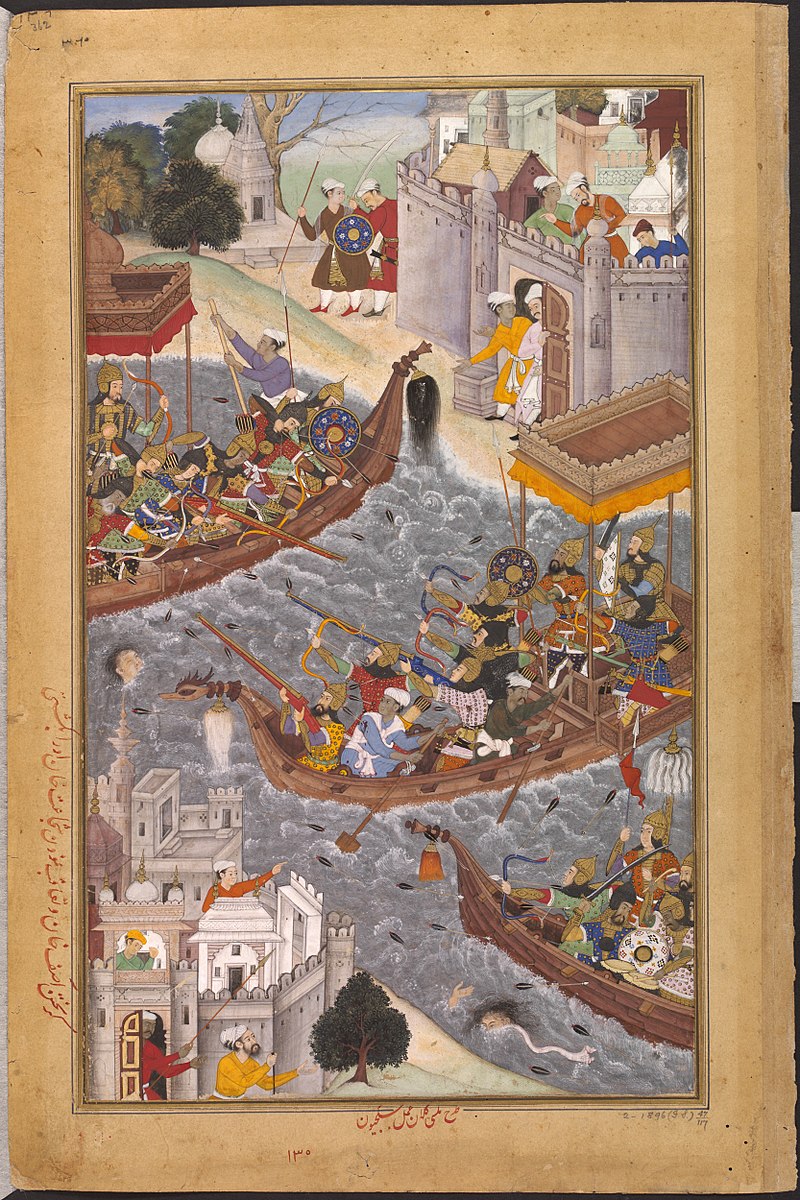
What is a Military Revolution?

The term “military revolution” is still hotly debated by academics today. Introduced in the 1950s to describe the social and military changes brought about in Europe through the introduction of gunpowder weaponry in the 16th and 17th Centuries, it is still not a term that can be precisely defined. In essence, a military revolution took place throughout Asia and Europe in the late 15th to 16th and mid-16th to 17th Centuries respectively. These periods saw the widespread introduction of gunpowder weapons (both, cannons and hand-held pre-muskets), the creation of new siege tactics which led to the creation of new fortifications and cities which led to a total overhaul in the way armies were maintained, led and supplied. These military revolutions saw the old dominant powers usurped (eg: Babur routs the Delhi Sultanate) and replaced by newer empires and kingdoms wielding the best weaponry of the time.
Introduction:
In this article and the next, we will look at the beginning of the Indian subcontinent’s supremacy in gunpowder weaponry with the First Battle of Panipat and the decline of Indian artillery and guns with the advent of the British Empire in the Battle of Plassey. This will take us on a journey spanning 2 centuries (1526 to 1757) but it is a journey well worth exploring. You, the reader, will come to understand – if you don’t already – how the cannon conquered India.
“I also send your highness a Goan master gunsmith; they make guns as good as the Bohemians and also equipped with screwed in breech plugs. There he will work for you. I am sending you some samples of their work with Pero Masquarenhas.”
– Afonso de Albuquerque, viceroy of the Estado da India, writing from Goa to King Manuel I
Babur and His Cannonade:
When Babur’s army rode across the great, wide plains of North India to confront the Delhi Sultanate and conquer India, one of their greatest obstacles were the great forts that the Delhi Sultanate had sprinkled around North India. For the armies that the Delhi Sultanate was used to fighting, these forts were a serious problem. But Babur had an ace up his sleeve; Ottoman artillery.
In this period, nobody had better artillery weapons than the Ottoman Empire. Ottoman gunsmiths were the best in the world and were proficient in making cannons, mortars and field-artillery. Babur had amassed a number of these fine weapons while he was campaigning around Central Asia.
The chief among these was the tof. Though “tof” now means cannon in a number of Indian languages, it initially described a mortar. The mortars of the 1510s were very different to the mortars we are today familiar with. Instead of a small tube that can be carried by one man that fires shells the size of small bottles, the mortars of the 1510s were as wide as a bath-tub and as tall as a human, capable of firing a rock (purpose built shells and rounds were not yet invented) at ranges of over 1km. They were typically made of bronze or brass and their whole purpose was to destroy fort walls, which up until then were made to withstand traditional sieges of catapults. Given their size and the effort required to pull these across great distances (dozens of oxen or horses per piece), such siege weapons were built in very few numbers, rarely crossing 10. Often, they would be built at the site of the siege instead of being brought to the siege before-hand.


Alongside these, he also had the tofi-firangi or “Frankish Cannon”, once again provided by the Ottomans. This was a piece of field artillery (guns fired straight at enemy forces during open battle) capable of firing rocks that weighed over 100kg at fairly short distances. His soldiers were also equipped with tufengs. The tufeng was a matchlock weapon (a predecessor to the famous European muskets, which were predecessors to the modern rifle) meant for infantry use and were widely disseminated among his troops (called tufengchi) before the Battle of Panipat. But, perhaps the greatest weapon in Babur’s arsenal was the zarbozan.

The zarbozan was the name of the famous horse or camel or wagon mounted swivel guns that allowed Babur’s cavalry – the mobility element of his army – to dominate the enemy completely. These were made of brass and were likely designed by an engineer serving under Babur, inspired by similar Ottoman designs. And they were, by far and away, the most potent weapon in Babur’s army. While the tof reduced enemy forts to rubble and the tofi-firangis and tufengs brought the enemy to their knees, this all happened at very short distances. With the exception of the tof, the remaining two weapons could have easily been outranged by enemy archers. But the zarbozan fired a projectile of similar weight to the one fired by the tofi-firangi at over 5km – a range that no contemporary weapon could hope to match. These were employed in great number by Babur and his successors, with Humayun maintaining a force of 700 zarbozans. For context, the current Indian Army maintains a force of 410 of the famous “Bofors” howitzers (though the total number of artillery maintained by the IA is 4,000+).

By comparison, Ibrahim Lodi fielded an army that would have been formidable in the 1450s. He had no artillery of any form and his cavalry, all of which wore light armour and formed the bulk of his army, was especially vulnerable to the cannons brought by Babur. The sound produced by the terrific cannonade shocked Ibrahim Lodi’s horses and elephants and very quickly his army was routed.
Thus begins the era of the Mughals.
The 17th Century, the Mughal Empire and the Indian Gunpowder Age:
Emperor Akbar, aka Akbar the Great, had inherited a very strong army made of infantry, cavalry and artillery from his father Humayun. But, it was not well organised. Throughout his reign, Akbar greatly reformed the army and brought completely the military revolution to India. He instituted the “Mansabadar system”. The system was a series of ranks that defined how a commanding officer could hire soldiers, how he was required to train them and what was expected of them. As a point, these men were not under the direct control of the Emperor – this was still a feudal system. The official Mughal Imperial Army was only 24,000 strong by the time of Akbar’s death, divided equally between cavalry and infantry. But, with the forces of the various Mansabadars included, by the time Akbar died, the Mughal Empire could field a professional army of (theoretically) 911,000. And this was almost a century before the wars with the British and Marathas. Abu al-Faizal, author of the Ain-I Akbari, says that Akbar’s Mughal Empire could field a force of over 4 million infantry and 350,000 cavalry. These numbers are certainly fanciful (if they were true, 10% of the Mughal Empire’s population would be serving) but are indicative of the real strength wielded by Akbar. And these huge numbers had to be backed up by the latest and best artillery.

The city of Calicut (modern-day Khozikode), was the Mughal Empire’s – indeed all of India’s – market for guns. The best engineers and metal casters from Portugal migrated here to sell their skills and expertise to the Mughals and other Indian powers. The best weapons from China, the Ottoman Empire and the Europeans found their way here to be sold to the Mughals or used as inspiration to design new pieces. In the late 16th and early 17th Centuries, light artillery began to replace heavy siege artillery, such as the tof mortar or the tofi-firangi that Akbar had inherited. He quickly realised that the mobility and firepower afforded by light-artillery would render his army irrelevant if they continued to use slow-to-load and expensive-to-fire heavy artillery.
He therefore began to purchase hundreds of light artillery pieces, similar in design to the zarbozans used by Babur 80 years ago, from the merchants and factories in Calicut. While we don’t have exact numbers, it is believed that a Mughal Field Army in the 17th Century (50,000 cavalry and 10,000 musket-infantry) had about 200 light artillery guns with them. And these guns were complemented by the bandukchi.
Under Aurungzeb, the bandukchi became a militia of musket-wielding men. But, when they were founded in the late 1590s under Akbar, they were a professional force. Initially, they were tiny in number, numbering only 25,000 but they grew to over 400,000 under Shah Jahan and Aurungzeb. By the time of Aurungzeb, the Empire also maintained a force of 500,000 trained and professional musketeers. The musketeers were not limited to the infantry. In the early 1600s, under Jahangir, the Mughal Army began to experiment with the barqandaz concept – or cavalry-musketeers. Initially, they were only experimental but quickly came into their own after seeing a few battles. When the heavy cavalry, artillery and infantry would smash apart an enemy force, these light cavalry units equipped with fairly-accurate muskets were perfect for creating a total rout in the enemy’s ranks.

The reforms instituted by Akbar ensured that the Mughals would have total military domination over any other Indian power or European power in India for the entire 17th Century.
But, with the death of Aurungzeb and the slow dismantling of the Mughal Empire that followed, there rose an Empire that – while powerful – could not maintain the superiority that the Mughals enjoyed. The Maratha Empire did its best. They acquired Portuguese artillery, Ottoman and European artillery officers and event set up a centralised factory system to provide a constant stream of cannons and muskets. They did well.
But they were no match for the expertise, training, equipment and brand new military system that the British brought to bear.
Conclusion:
The cannon – in its many forms – was vital for the conquest of India. The concerted effort put into maintaining the firearm superiority over the rest of India by the Mughal Emperors all the way from Babur to Aurungzeb, resulted in an Empire too powerful to fight on fair ground. Conversely, the Marathas’ failure to acquire a similar level of expertise resulted in an Empire too weak to face the artillery experts of the British East India Company. The cannon, under the British, would once again prove vital in conquering India.
Sources:
Iqtidar Alam Khan, “Firearms in Central Asia and Iran during the Fifteenth Century and the Origins and Nature of Firearms Brought by Babur”, in Proceedings of the Indian History Congress, 56 (1995), pp. 435-446
Iqtidar Alam Khan, “Nature of Gunpowder Artillery in India during the Sixteenth Century – a Reappraisal of the Impact of European Gunnery”, in Journal of the Royal Asiatic Society, 9:1 (1999), pp. 27-34
Iqtidar Alam Khan, “Gunpowder and Empire: Indian Case”, in Social Scientist, 33:3 (2005), pp. 54-65
Pradeep Barua, “Military Developments in India, 1750-1850”, in The Journal of Military History, 58:4 (1994), pp. 599-616
R. Eaton, P. Wagner, “Warfare on the Deccan Plateau, 1450-1600: A Military Revolution in Early Modern India?”, in Journal of World History, 25:1 (2015), pp. 7-50
Abu al-Faizal, Ain-I Akbari Vol. I (1542-1551), ed. H. Blochmann (Harvard; 1873)
Abu al-Faizal, Ain-I Akbari Vol. II (1551-1602), ed. H. Blochmann (Harvard; 1873)
Leave a Reply