
Introduction:
In 2022, 89% of the world’s material goods trade passed through the Indian Ocean. In the same year, over 80% of the world’s oil and mineral trade passed through the Indian Ocean. Today, everything of any importance that is being used in our modern mercantile system passes through the Indian Ocean. And in the 1600s, things were no different.

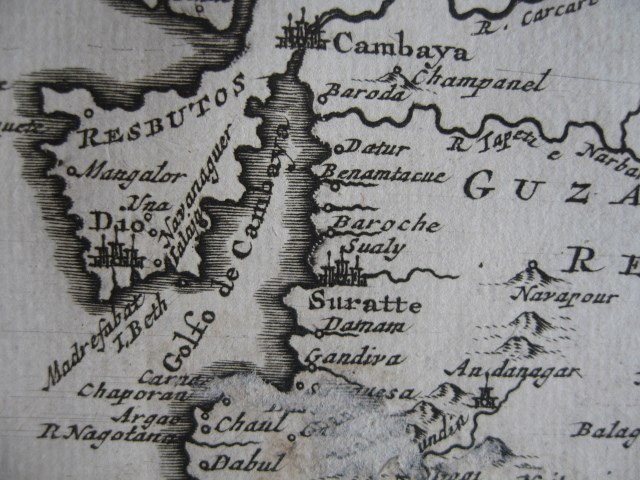
It is perhaps a commonly known fact that at this point, the Indian subcontinent in the 1600s had a GDP of 120 billion USD to the rest of the world’s 35 billion. The Mughals were wildly rich and a lot of this material wealth was traded Westwards to Persia, the Ottoman Empire and – of course – Europe, through the Arabian Sea. The Arabian Sea then, especially the trade routes connecting Surat and the Mallabar Coast to Egypt, Arabia and Persia, was the centre of attention for all merchants, the world over. To, once again use the quote by Niccolao Manucci:
[Talking about Surat] “It is a great delight to take a seat on the bank of the river and behold the numerous boats which shoot to and fro like arrows. It is the largest port in India … thus it is resorted to by a great number of ships from … Europe, Persia, Arabia, Mecca, Bassora, … Malabar and Choramandal, Machhlipatnam, Bengal, Siam, Acheen, Queddah, the Maldives, Malacca, Batavia, Manilla, China and many other parts of the world.”
In short, he who controlled the trade coming out of and going into India, controlled one of the most – if not the most – lucrative sea lanes in the world to exploit as he wished. This promise of unimaginable wealth drew, in equal measure, the Portuguese, French, Dutch and English to India’s West Coast where they sought to establish an absolute monopoly over the wealth that flowed through the Arabian Sea.
In 1615, the Mughal Emperor Jahangir gave Sir Thomas Roe – the ambassador of King James I of England, sponsored by the East India Company – permission to set up a Factory for the East India Company in the Port City of Surat. And with that, as we know through the looking glass of history, the die was cast and the East India Company would rise to become the richest corporation in the world by the time it was dissolved.
But it had a long way to go and many opponents to quash. In this article and the next, we will be looking at the EIC’s slow rise to prominence in India and how they overcame the many naval powers (first, the Europeans and later the Marathas) that stood in their way.
The Arabian Sea in the Early 17th-Century:
At the start of the 17th Century, the trade that passed through the Arabian Sea was dominated chiefly by three European powers: the East India Company, the Dutch Verenigde Oost-Indische Compagnie (VOC) and the Portuguese Casa de India (India House). The reason that no Indian power had any presence in the Arabian Sea at the time is simply because they never felt the need to. All the threats to the sovereignty of the Mughals or the Deccan Sultanates came from other land powers. These kingdoms and their rulers had never thought to invest in a Navy or any reason to consider doing so. Aside from the Siddis of Janjira, no Indian Navy sailed the Arabian Sea.
Of the three European powers, the EIC and the VOC conducted their business mainly in the North (along the coast of Gujarat) and with the Mughal Empire. The Portuguese remained in the South, along the Malabar Coast and Goa, preferring to deal with the many powers that populated the Deccan. This was the perfect recipe for some old-fashioned competition. But, despite the allure of endless riches, the competition that arose among these three mercantile organisations rarely devolved into warfare.

Up until the 1700s, there would be very little fighting amongst the European powers. In fact, the first half of the 17th Century (as pertains to the Arabian Sea) belonged to the Portuguese, in a sense. They, having been in India for a century longer than either of their competitors, managed to establish a monopoly on the Arabian Sea trade early on. Simultaneously, the French – settled along India’s East coast – had a monopoly on that trade. The VOC had all but conquered the “East Indies” (Malaysia, Indonesia and Papua New Guinea) and the spices therein. When the EIC set up their Factory in Surat, they were very much the underdogs in that war of enterprise.
To get ahead, they needed to play smart.
The Slow Rise of the EIC:
Knowing that they were very much the latecomers to the trade with India, they knew they couldn’t play fair. They knew they could not out-trade the other Companies, as they simply didn’t have the money or connections it required. They knew they couldn’t beat the Portuguese – or the French – into submission, because their ships were greater in number and likely better armed.
And so, they decided on a very difficult plan of action – curry favour with the Mughals. This was because, despite everyone else having arrived early on, they had not managed to be seen by the Indian powers as anything more than merchants. They did not have special privileges, exclusive trading rights or the ears of local rulers. They were seen, especially in the case of the Portuguese, as little more than a source of foreign goods and mercenary officers.
But, the British changed that. As both Peter Mundy and John Ovington record, the EIC – especially at Surat – spent considerable amounts of money on bribing local Mughal officials. In fact, they would regularly send envoys to Agra – the Imperial Capital – who would receive private audiences with the Mughal Emperor. Many of these envoys would develop close working relationships with the Emperor. For example, Sir Thomas Roe was apparently a favourite drinking partner of Emperor Jahangir. And a friendship with the Mughal Emperor was far more useful than a large navy or a century of experience.
According to Ovington, when the EIC started to pursue the course of “lobbying” the Empire, other European powers immediately clocked on and attempted to do the same. But now the advantage was the EIC’s. Local Mughal officials began to treat the EIC with a degree of warmth that they did not extend to the others. This “warmth” went all the way up the chain, to the Emperor. And soon, these good relationships began to yield tangible results.

They were given more trade concessions and permission to open Factories across the Mughal Empire. As long as they kept the money flowing into the Empire, the Mughals would remain cold towards the Dutch and Portuguese. This coldness should not come as a surprise, however. As early as 1573, the Portuguese were seen as an inferior people by the Mughals, with Emperor Akbar calling them a “savage race”. And, as for the Dutch, their focus was never the Indian subcontinent, which they saw as a side-show to their operations in South East Asia.
Given these conditions, the East India Company grew richer and richer. When they began exporting English cannons to the Deccan, they grew richer still. The Deccan Sultans, especially those of Bijapur, considered the English cannons to be the best ones available at the time, even better than those of the Portuguese (though they invariably hired Portuguese, rather than English, officers to command their artillery). As they brought more money into both India and England, the Factors (officers) of the East India Company received a perk that was unavailable to anyone else at the time. Their personal wealth could not be taxed, in either nation.
This made the Factors of the East India Company richer than any of their European contemporaries. Most of those who joined the EIC were sons born to middleclass or working class parents. When they retired, they would be great Lords presiding over Great Houses in the English countryside. Peter Mundy, for example, was born to a family of fish salesmen. He retired from the East India Company as one of the most famous writers and richest people in England at the time.
Throughout the first half of the 17th Century, the EIC would climb very slowly but very definitely up the ladder in India. Their Presidents, envoys and Factors would gain ever more importance in the Mughal Court and the influence of the Portuguese or the French would begin to decline. But, in 1650, all that would change almost overnight.
Conclusion:

In 1650, Chhatrapati Shivaji Maharaj would raise the Maratha Navy. He would be one of the first Indian rulers to recognise the requirement for a Navy that would wrestle away control of the Arabian Sea from the Portuguese and secure India’s maritime links to Europe. His navy – though it remained small for the entirety of its existence – would come to control the entire Arabian Sea, destroy Portuguese maritime power in the region and force European merchantmen to pay ever increasing taxes for the privilege of sailing in the Arabian Sea. It would take the East India Company Marine and the Royal Navy over 100 years of constant defeat to destroy the Maratha Navy. But – in classic Royal Navy fashion – when they did defeat them, they destroyed the entire Navy in one battle.
Sources:
J. P. Guha (ed.), J. Ovington, A Voyage to Suratt In The Year 1689 (Vol. I) (Associated Publishing; 1984)
P. Mundy, Travels in Asia (Vol. II) (Hakluyt Society; 1914)
M. N. Pearson, “Portuguese India and the Mughals”, in Proceedings of the Indian History Congress, 59 (1998), pp. 407-426
J. Flores, “The Sea and the World of the Mutasaddi: A profile of port officials from Mughal Gujarat (c. 1600—1650)”, in Journal of the Royal Asiatic Society, 21:1 (2011), pp. 55-71
R. Maloni, “Europeans in Seventeenth Century Gujarat: Presence and Response”, in Social Scientist, 34:4 (2008), pp. 64-99
Leave a Reply