
Introduction:
In the previous article, we looked at the slow but steady rise of the EIC in the Arabian Sea, despite fierce mercantile opposition by the likes of the Dutch VOC or the Portuguese India House. Using a mix of bribery, lobbying and the cultivation of relationships with the Mughal Emperors, the EIC began to pull clean ahead of their rivals and – by the middle of the 17th Century – they were in a position to become the dominant trading power in India. But, just as things were looking up for them, a band of rebels in the heart of India – the Deccan – began upsetting the balance created by the Mughals.
The Maratha War of Independence saw the Konkan and Malabbar coastlines, the hub of the Portuguese business, ravaged by the nasty business of warfare. As more and more sea-forts along the coastline came into the control of Chhatrapiti Shivaji Maharaj, he realised that there was a crying need for defending his nascent and infant nation from the maritime designs of the Europeans and Mughals. He had no Navy that could repel a potential attack from the sea and this, he calculated, needed to be remedied immediately.
The Birth of the Maratha Navy and Its Immediate Objectives:
As Dr. Apte, the world’s pre-eminent scholar on the Maratha Navy, notes; when Shivaji began his “career of independence”, the Konkan coastline was filled with powers that were alien to the Deccan. By 1650, the Konkan coastline was inhabited by the Siddis of Janjira (the naval arm of the Mughal Empire and Africans by blood) and the Portuguese India House and the Portuguese Navy. The British, though present, were considered to be a minor player along the Konkan coastline.
As Shivaji came into control of more and more territory along Konkan, Mawal and Kolaba he realised that the sovereignty of the sea did not rest with him. And so, he decided to raise the Maratha Navy – to establish Maratha maritime armed dominance over the Konkan coastline and seize the sovereignty of the sea away from the Portuguese and Mughals.
But, before we proceed, we must define this very vague term, “sovereignty of the seas”. The definition is simple; it is the ability of a nation or state to control the maritime access to its ports, the seas that are immediate to its coastline and to exert its will on the seas unopposed. This “sovereignty of the seas” belonged, at this time, to the Portuguese. Not even the Siddis of Janjira had been able to rest the control of the Arabian Sea from them. And, despite Shivaji’s plans of dismantling Siddi naval power and establishing a Maratha Navy that dominated along the whole west coast of India, his primary focus was snatching away the control of the Arabian Sea from the Portuguese. Alongside his obvious military goals, he also wanted to establish a firm sea link and dominate the trade between the Konkan and East Africa and Arabia.
Therefore, it can be concluded that at the beginning of the Maratha naval story, the Maratha Navy’s objectives were thus:
- Protect the infant Maratha kingdom from the sea
- Defeat Siddi naval power
- Check growing European influence in the Arabian Sea
- Establish trade routes from the Konkan to the East of Africa and Arabia
In the late 1650s (specifically 1657 and 1658), the first Maratha Navy Ships were “commissioned” into service. The first Maratha shipyards were built at Bhiwandi and Kalyan and, within 3 years, they had created 85 warships for the Navy. Overtime, though mostly in the 1660s, the Marathas also built new shipyards in Thane, Alibaug, Vijaydurg and Malvan.
The 1660s were the golden age for “Shivaji’s Navy”. Shivaji embarked upon many raids on Mughal, Portuguese and British ports up and down the west coast of India. Though the Navy was still a few decades away from commanding the whole of the Arabian Sea, they had become the terrors of the coastal waters. If ever they found themselves outgunned, as was often the case when faced with much larger and much better European warships, they would retreat inland where massive Maratha fortress guns would reduce those European warships into flotsam. And by the time of Shivaji’s death, everyone in the region accepted the hegemony of the Maratha Navy over the Konkan Coastline.

Though the Maratha Navy would be far more successful under Admiral Kanhoji Angre and his sons, the 1660-1680 period was the only time when the Maratha Navy and Maratha Army were a unified and coherent force. After the death of Shivaji, the Maratha Navy split with the Maratha Army and became an “independent wing” of the Maratha State, taking orders form neither Chhatrapiti nor Peshwa.
The “Angrian” Navy and Maratha Dominance of the Arabian Sea:
Kanhoji Angre had joined the Maratha Navy at a very early age. It is not possible to say just how early, but he was 18 when he was made Commander of Suvarnadurg in 1685, an important Maratha sea-fort. Over the next 14 years, the Maratha Navy maintained its course and kept a firm grasp on the Konkan Coastline. However, upon becoming the Admiral of the Maratha Navy (sarkhel)in 1698, Kanhoji Angre set his sights well beyond the brown waters of the coast.

He was, it must be noted, an excellent sailor and commander. But, he had a vital flaw that he shared with probably everyone of any note or authority in the Maratha Empire at the time. He could not see beyond the destruction his enemies and the enlargement of his own personal power. He did not envision the Navy as a tool of commerce, as had Shivaji. He did not bother with setting up manufacturing facilities for his guns and instead settled on purchasing them. He saw the Maratha Navy as only a machine with which to vanquish the Portuguese, English and Mughals. He never intended to create a network of commerce to feed the Maratha state. But, these flaws mixed with his singular focus on victory meant he was exceptional at battle.
Despite being the commander of a professional Navy, he immediately began to engage in what can only be called acts of piracy. His ships began to seek out lone East Indiamen (merchants sailing under the EIC flag) with the goal of either taking the ship and her crew captive to ransom later or to sink her entirely after taking as much of her cargo as possible. The Bombay was one of Angre’s first targets. The Bombay was the flagship of the East India Marine, stationed at her namesake city, Bombay. She was set upon by Angre’s ships in 1707 and sunk, with all hands.

Kanhoji’s piracy, which perhaps can be called commerce raiding in modern maritime parlance, began to hurt the East India Company’s profits. They expended a significant amount of money, time, capability and war-fighting resources into containing this new marauder. However, for the first 2 decades of the 18th Century, they remained under the proverbial thumb of Angre and his Navy. Between 1707 and 1721, the East India Marine with some support from the Royal Navy mounted perhaps 6 expeditions against the Maratha Navy, with 3 of them launched between 1718-1721. All 6 of these expeditions would fail to destroy the Maratha Navy or significantly damage their ability to wage war. Despite their failure to dissuade their enemy from their designs against the EIC, they had managed to gain control of the trade routes from Arabia and East Africa to India… partially.
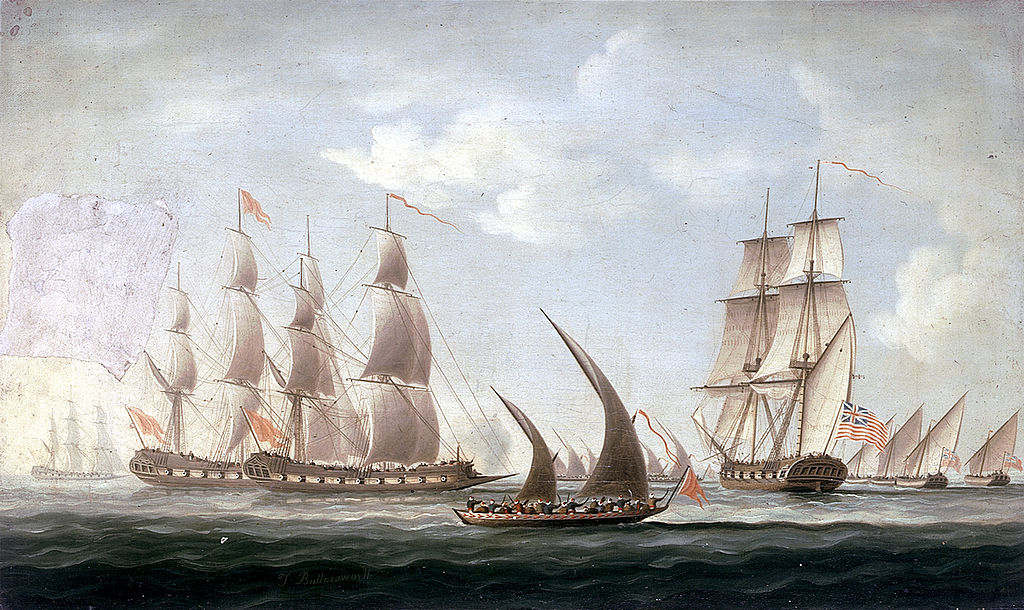
The Maratha Navy had been unable to maintain its control over the shipping lanes in the deep seas. The Maratha ships – a topic too vast to go into detail about in this article – were not ideal for ocean travel, much less ocean combat. They were best suited for the shallow waters of the coast and to harness the many inlets that dotted the Konkan for either quick getaways or ambush attacks, with Maratha coastal batteries providing the fire support that the ships sometimes lacked. The much larger, heavier and sturdier European “Ships of the Line” or “Men of War” were – near as makes no difference – invulnerable to the Maratha Navy’s much smaller “gurabs” and “gallivats”. As such, following 2 decades of constant warfare, the Maratha Navy withdrew to the coast and focused on where it was strongest; coastal warfare. Because it didn’t matter if the EIC controlled the deep sea shipping lanes given that all ships had to get close to the coast to sail into port.
Up until 1729, the Maratha Navy was unchallenged along the West Coast of India, with every European power paying tax to ensure the safe passage of their ships and the assurance that the Maratha Navy would protect lone merchantmen from pirates. In 1729, however, with the death of Kanhoji Angre, that would all begin to slowly crumble.
Civil War, the Siege of Vijaydurg and the Fall of the Maratha Navy:

The Maratha’s medieval system of governance would see that all of Angre’s successes were turned to dust within 30 years of his death. The causes for the ultimate and total defeat of the Maratha Navy in 1756 at the Siege of Vijaydurg are complex – but the short-sighted and factional politics that brought the Maratha Empire to a very early end are the chief reasons.
Firstly, it is vital to note that Angre had, for all intents and purposes, split with the Maratha government during the Maratha Civil War, declaring his support for Tarabai over Shahu. Though histories of the Maratha Civil War focus on the armies of the opposing factions fighting it out for control of the Maratha throne, multiple times did Shahu try to subdue the Maratha Admiral. Angre, proving to be as skilled at land warfare as he was on the waves, overcame these small raids sent out to arrest him and continued operating independently of the Maratha administration. What this meant was that when he died, he trusted no one but his own family to run the Navy. Therefore, he split the Navy equally between his 4 sons, hoping that they would carry on his work. However, that was not the case. While they saw some success against the EIC and the Portuguese, they spent the majority of their time fighting each other for ultimate control of the Maratha Navy. This gave the EIC the time it needed to collect itself and prepare for another expedition.
Secondly, given the strength of the Maratha Navy (Angre had direct control over more forts than the Maratha Army had forts in total), the Maratha administration began to view it as an active threat to the Peshwas and the Chhatrapiti, despite the fact that the Navy had not come into conflict with the Army since the first years of the 18th Century. The British, sly as ever, sought to deepen this wound and drive a wedge between the two, with promises of weaponry, peace and money made to the Maratha Peshwas in exchange for military support against the Maratha Navy. This deal, once struck, would prove to be the nail in the coffin for the Maratha Navy, because, in 1756 a fleet of 20-30 Royal Navy warships descended on Vijaydurg – the HQ of the Maratha Navy – carrying with them roughly 1,500 men of the Maratha Army.

By 1756, the Maratha Army had swept through the Konkan region and had taken by force every fort commanded by the Navy. Vijaydurg was the last bastion of that once proud force. It had withstood 3 sieges before and repelled every attack made on it. But this time, no such luck. The Maratha Navy outnumbered the British ships 10 to 1 but there was a fatal flaw in Tulaji Angre’s plan. He sailed out his entire fleet to destroy the British, without taking into consideration the close quarters of the geography and the fact that the British outranged his ships by a considerable range. The Maratha ships became bunched up at the opening of the creek; when the British ships fired, they set ablaze the Restoration, a captured EIC ship pressed into Maratha service. The fire aboard the Restoration spread from ship to ship, turning into an inferno. No Maratha ship survived that battle. Simultaneously, the Maratha Army launched an amphibious attack on Vijaydurg, with British ships providing withering fire support.
In one fell swoop, the British had managed to remove the last obstacle to their total domination of the Indian Ocean.
Sources:
Phillip MacDougall, Naval Resistance to England’s Growing Power in India, 1660-1800 (Boydell & Brewer: Boydell Press)
B. K. Apte, ‘Sovereignty Of The Sea As Practiced In The Maratha Period’, Proceedings of the Indian History Congress, 29 (1967), pp. 255-261
B. K. Apte, A History of the Maratha Navy and Merchantships (State Board for Literature and Culture; Bombay/Mumbai, 1973)
Anirudh Deshpande, Limitations of Military Technology: Naval Warfare on the West Coast, 1650-1800, Economic and Political Weekly, 27: 17 (1992), pp. 900-904
Sachin Pendse, ‘Maratha Sea Power’ in Christian Buchet (ed.), Gerard Le Boudec (ed.), The Sea in History – The Early Modern World (Boydell & Brewer: Boydell Press), pp. 635-647
Ed Cumming, A Compendium of Incidents Incurred by the Major Ships used by the English (later British) East India Company c.1600 to c.1834 (2016)
Leave a Reply