
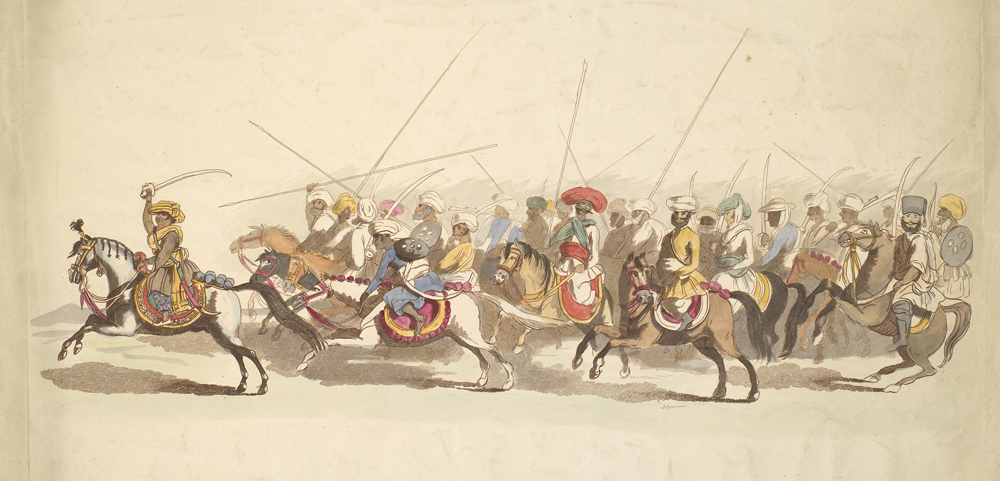
Some Context
Recently, in an online forum I was asked “Why did the Mughal Armies not destroy the Maratha forces?” and this launched me down one my most favourite research rabbit holes in the past year or so (the question and my answer can be found here). In doing so, I realised that not many people know that there were two Mughal-Maratha Wars. In fact, even Google fails to show the distinction between the two separate wars, with Wikipedia only recognising the 1680-1707 war as the Mughal-Maratha War.
The 1680-1707 conflict, known then as the 27 Years War, was Emperor Aurungzeb’s attempt to recapture the territories liberated/conquered/invaded (your choice of verb, really) by Chhatrapati Shivaji Maharaj in – what I am calling in this article – the First Mughal-Maratha War, or the Maratha War of Independence. Let’s clarify the dates for both wars before we proceed.
1657 to 1680: Maratha War of Independence or the Frist Mughal-Maratha War. This saw Maratha forces, led by Shivaji, carve out an independent Maratha State in what had previously been the Sultanate of Bijapur, which was a client state of the Mughal Empire (in 1686, the Bijapur Sulatanate would be formally absorbed into the Mughal Empire).
1680 to 1707: The 27 Years War or the Second Mughal-Maratha War. Following the death of Shivaji in 1680, Emperor Aurungzeb launched a massive campaign to overwhelm Maratha forces and recapture the territory they had taken.
In today’s article, I will not be giving you, the reader, a boring and dreary date-by-date, month-by-month account of either war. Instead, this article will focus on how Shivaji led his army in the First Mughal-Maratha War and will present an analysis of his tactics and his strategy.

The Maratha Army – Its History before Shivaji and its Structure at the Time of his Death
Almost all of the information in this part of the article comes from Surendra Nath Sen’s brilliant book The Military System of the Marathas. Despite being almost 100 years old (it was published in 1928), it is one of the best books written on the topic and is still cited to this day and explains the Maratha’s military requirements, strategy and organisation almost perfectly.
To start with, we must understand what military challenges the Marathas faced in the 1650s. They faced:
- An overwhelmingly superior force in the Mughals
- The treacherous terrain of the Sahyadris (better known as the Western Ghats) and Satpuras
- A long series of hill and cliff forts
- An enemy with an intimate and specific knowledge of gunpowder, siege warfare and the requisite technology to carry out that warfare with the best possible efficiency
- The absence of a supply chain or logistic support whereas the enemy could rely on multiple different routes of supply with a steady and constant stream of lethal and non-lethal materiel
- Poorly trained Bijapuri soldiers (from whom Shivaji would recruit) who spent 6 months of the year as farmers
How was Shivaji to deal with these challenges?
He had to fight in the mountains, so he could not maintain heavy cavalry or a large force of light cavalry. In its stead, he needed a force that was highly mobile in the mountains. In order to fight against a larger enemy formation, he had to have a well-trained force and not rely on the ill-trained Bijapuri soldiers. He had to have the ability to capture Mughal hill forts without resorting to siege warfare as the Mughals were proficient in that form of war. And finally, he had to have a small army that would put no strain on his non-existent logistics.
These pre-conditions impacted how Shivaji re-structured his force. Firstly, he abolished the practice of soldiers returning to their fields for 6 months to help with the harvest. This practice would have left the Marathas utterly defenceless for 50% of the year. Instead, he instituted a “standing army”. A standing army is defined as a force that is made up of professional soldiers; i.e a force of soldiers that is regularly paid and is ready for war at any time in the year. Most modern armies are standing armies. Secondly, he revised the tactics that were to be used in battle. The focus was now put on ambushes, night-fighting, mountain fighting and surprise attacks. After these changes, by the time of Shivaji’s death and the end of the First Mughal-Maratha War, the Maratha Army had the following structure:

- Cavalry: ~15,000
- Infantry: ~30,000
- Artillery: 128 Portuguese and French light cannons, 2-4 English “heavy” cannons, ~40-50 “Indian” cannons (these were old designs common throughout India at the time, though they were outdated and outmoded by the time Shivaji bought them)
- Forts and fortified towns: 34
His army’s fighting formations (for both cavalry and infantry) were organised into regiments. One regiment had under it two battalions and each battalion was made up of 2 companies, each of 200.
But, it was not enough for his army to be reorganised. It had to fight well.
The Maratha Army’s Tactics and Strategy
Before we proceed, it is a good idea to enumerate the forces that Shivaji would be facing. As you may remember from the article on the Anglo-Mughal War, the Mughal Army at the time was absolutely massive.
They had:
- ~500,000 professional infantrymen
- ~400,000 bandukchi (untrained armed militia)
- ~50,000 heavy cavalry
- ~30,000 elephant cavalry
They also had the geographic advantage. The majority of all population centres, all logistics centres and all farms and fields were located in the Deccan Plateau. Since access to the Deccan Plateau was controlled by mountains on all 3 sides of the plateau (the Western and Eastern Ghats in the obvious directions and the Satpura Range to the North), the control of the plateau and its people rested with anyone who could control the mountain roads that led to it. To this end, the Mughals had built a long series of cliff and hill forts overlooking these mountain roads. In other words, they were the absolute masters of the region.
Shivaji knew that his force was too weak to engage Mughal garrisons in the towns they occupied or fight the massive Mughal Southern Field Army. So he focused on the forts. These were very sparsely occupied by combatants and all their defences were oriented towards siege warfare. Shivaji’s forces never had the ability to conduct siege warfare and had very little experience with artillery. So he never attempted to besiege the forts.
Instead, he would send handfuls of light infantry on night-time cliff-assaults which would overwhelm the fort defenders from the direction they least expected an attack and at a time when no one fought in the night (up until the final military collapse of the Mughals, night fighting was considered to be ungentlemanly in India). This gave Shivaji’s forces the advantage for two reasons. Firstly, the obvious element of surprise. Secondly, Shivaji had put a great emphasis on training with sword and shield and had given training with gunpowder weaponry a lower priority. By contrast, the Mughal infantry trained extensively with musket and pistol. At the close quarter ranges of a fort, a slow-to-load musket or pistol was not a great weapon and the Mughal infantry had to rely on their poor (by comparison) melee skills.
It was through these means that Shivaji slowly carved out an independent nation. But that wasn’t enough. He would have to defend it against the massive Mughal Southern Field Army. Now, as I have mentioned previously, he simply could not face them head on. So he fought wisely.
The light and mobile Maratha forces would shadow Mughal wagon trains. These wagon trains were lightly guarded and were supplying the Mughal field army with all the food and war materiel they needed to keep fighting. When these wagon trains entered the valleys and mountain passes that the Marathas commanded, the Maratha forces would open fire. They would fire with muskets and pistols and rain down great amounts of lead on Mughal forces from the shrubbery and foliage. But the greatest weapon in their arsenal was the rocket.
Developed first in China, these rockets spread throughout Asia quickly and were famously perfected by Tipu Sultan in the “Mysore Rocket”. But they saw very effective combat almost a century before Tipu Sultan was born. Maratha rockets would create havoc in the Mughal wagon trains and slowly, the Mughal garrisons were being starved of supplies.
In the end, they had no choice but to retreat. They were unable to evict the Marathas from their forts and were being choked out of supply. And so they returned north of the Satpuras, waiting for their moment to strike. A moment that would arrive in 1680, with the death of Chhatrapati Shivaji Maharaj.
Sources:
S. N. Sen, The Military System of the Marathas (Orient Longmans; 1928)
Maj. James Grant Duff, History of the Mahrattas, Vols. 1-3 – any edition
Hunt, Margaret, “The 1689 Mughal Siege of East India Company Bombay: Crisis and Historical Erasure”, History Workshop Journal of the Oxford University, 84:14 (2017), pp. 151-169
A Message
If you, dear reader, have a question on the military history of India between 1680 and 1999 that you’d like answered, please feel free to contact me below! I will do my best to answer every question and will even post the best one here!


Leave a Reply