
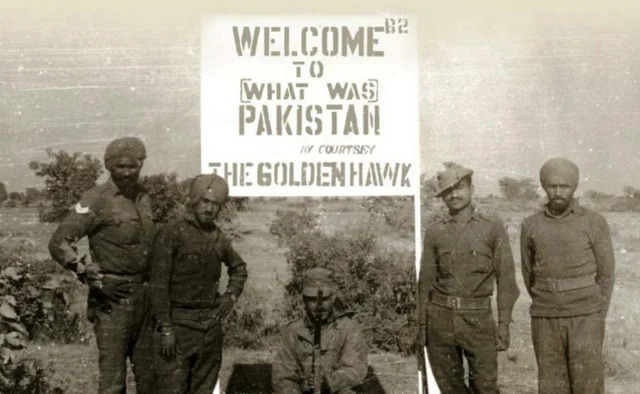
For a better understanding of the war, the following article and many of the terms below used, please consult this article on how the war began or either of these (here or here) articles on early battles in the war.
Introducing the Opposing Forces

On 3rd December, 1971, India declared war on Pakistan. As you may know, this was nothing short of a formal declaration and ownership of a process that had begun over a month prior, with Indian forces advancing into East Pakistan as early as November in order to set up bridgeheads for further advances. With this declaration on the 3rd, the Indian Armed Forces began a proper invasion of East Pakistan.
In defence of East Pakistan, the Pakistan Army’s Eastern Command (Headquartered in Dhaka) had under its command 3 Infantry Divisions (the 9th, 14th and 39th), all of which were severely understrength, an ad-hoc Infantry Division (the 36th) and a large body of ragtag militia, the “Razakars” – Bengalis loyal to the Pakistani cause. Facing them, the Indian Army had arrayed 7 Infantry and Mountain Divisions (4th Mountain, 6th Mountain, 8th Mountain, 9th Infantry, 20th Mountain, 23rd Mountain and 57th Mountain) along with another Division-strength force, the 101st Communication Zone Area (101 CZA).
The Pakistan Air Force in East Pakistan had 16 F-86 Sabres in a single squadron (No. 14 Squadron) against 11 Indian Air Force fighter squadrons totalling between 144 and 192 aircraft, along with a squadron (No. 16 Squadron) of English Electric Canberra heavy bombers.
The Pakistan Navy in the East had 4 purpose-built patrol vessels, 12 purpose-built gunboats and 35 fishing boats that had been fitted with guns. Facing them, was the Indian Navy’s Eastern Fleet. The Eastern Fleet had under its command, the following:
- 1 aircraft carrier, INS Vikrant (R11)
- 1 submarine, INS Khanderi
- 1 destroyer, INS Rajput
- 2 frigates, INS Beas and INS Brahmaputra
- 2 Antisubmarine Warfare Corvettes, INS Kamorta and INS Kavaratti
- 1 Landing Ship (Tank), INS Magar
- 2 Landing Craft (Tank), INS Gharial and INS Guldar
- 4 patrol boats, INS Akshay, INS Pulicat, INS Panvel and INS Panaji
INS Vikrant, originally the British HMS Hercules, entered Indian service in 1961. She would take part in the annexation of Goa but would be in for a refit during the 1965 India-Pakistan War and would not take part in it.
In 1971, her aircraft raided East Pakistan constantly, paving the way for the Indian Army. Her aircraft sunk almost the entire Pakistani “fleet” in East Pakistan and destroyed all their fuel reserves. She was critical in the East.

The Pakistani Strategy
Lt. Gen. A. A. K. Niazi, the General Officer Commanding in Chief of the Pakistani Eastern Command, was not a fool. Ever since the Indian incursions began in November of 1971, he began to consider the defence of East Pakistan against truly overwhelming odds. Furthermore, his forces were already exhausted – since March of that year, they had been fighting a gruelling and increasingly bloody campaign of counterinsurgency against the Mukti Bahini, and the campaign – due to Indian support for the Bengali rebels – had not been going well. Major (later Brigadier) Siddique Salik narrates multiple accounts of times when the Bengali rebels would eliminate entire companies of Pakistani infantry or raid bases and headquarters with the sole aim of slaughtering the commanding officers and their families, to shake the Pakistani Eastern Command to its core. As such, when the hostilities began, the Pakistani troops were already demoralised, understrength and exhausted, with almost none believing that they could hold out against the Indian Army, which was fresh, better equipped and had spent the past 6 months planning and training for this offensive.
Given these circumstances, Lt. Gen. Niazi would settle on the only course of action that – in his mind – would allow him to stall the Indian offensive long enough for peace talks and a ceasefire to materialise. He called his plan the “Fort Strategy”, and to his credit, as to the credit of the Pakistan Army, he executed this plan perfectly. The plan was thus:
- Identify and fortify villages and towns on critical roads and in critical locations to deny the Indian Army a quick advance, these became the “Forts”
- The Forts would be stocked with enough food and ammunition to last 14-20 days of siege warfare
- The Forts were forbidden from surrendering, being ordered to fight to the last man
- If all else failed, each unit would conduct a coordinated withdrawal to Dhaka where they would form 2 lines of defence for the city, the Outer and Inner
- Wait for the Pakistani offensive in the West (targeting Amritsar, Pathankot and Jodhpur) to achieve its goals and draw forces away from East Pakistan
- The Navy and Air Force would render every possible support to the Pakistan Army until the Navy and Air Force were knocked out
As Major Salik, who was then on Lt. Gen. Niazi’s staff, points out, multiple other strategies were suggested to Niazi. One of them was the “Mobile Defence” in which the Pakistani forces would remain mobile, on the roads and highways and deploy quickly to counter Indian advances while counterattacking swiftly. This was rejected because there simply weren’t enough trucks, Infantry Fighting Vehicles or helicopters for this. The third was the “Gradual Defence” strategy in which Pakistani defenders would put up token resistance at the border and gradually withdraw to heavy defences which would annihilate the invading Indians. Indian air superiority and lack of heavy weaponry as well as not enough men on the Pakistani side made this impossible. The third was “Dhaka Fortress”, in which every available unit would converge on Dhaka and turn it into a fortress that would take huge numbers to breach. This was quickly dismissed as there was simply no guarantee of it working and it essentially surrendered East Pakistan save for Dhaka.
The Indian Strategy
The Indian Army had every conceivable advantage. As early as October, the Army began to send in Special Forces soldiers into East Pakistan to conduct covert reconnaissance on Pakistani positions. They began to train and supply the Mukti Bahini and ordered them to soften Pakistani positions on the borders and on the roads leading to Dhaka. In November, the Indian Air Force knocked out 3 of Pakistan’s 16 F-86 Sabres. The Indian Navy’s blockade and the IAF’s ban on civilian flying meant that East Pakistan could not be sent reinforcements from the West. India had more modern tanks (the T-55s and PT-76s fielded by the Indian Army were essentially brand new as compared to the 20 year old tanks of the Pakistanis), better equipped infantry. They had an overabundance of helicopters and motorised units. The November offensives had given the Indian Army some understanding of the strength, capability and morale of Pakistani defences and defenders. But, more than anything, they had 6 months to plan and train for the offensive.
And that is where Lt. Gen. A. A. K. Niazi’s “Fort Strategy” failed him. As was demonstrated to Indian commanders during the Battle of Hilli, attacking the Pakistani forts would have been suicidal whereas circumventing them, as was done during the Battle of Garibpur, rendered them helpless. And so, a mobile and fluid offensive, in which individual units would have constantly changing objectives and would not spend any time trying to breach Pakistani Forts was adopted. The plan was thus:
- Identify and locate Pakistani Forts, as well as isolated Pakistani units
- Identify and locate smaller roads and paths that would allow for these Forts to be surrounded
- Bypass all Pakistani strongpoints using mobile forces, use IAF air superiority to clear the way if need be
- Chase down and destroy retreating Pakistani units
- Reach and surround Dhaka, force a Pakistani unconditional surrender
Conclusions

In the end, Lt. Gen. Niazi had planned for a set-piece offensive, where large units would fight it out over forts and population centres. Like in World War 1, the 1965 India-Pakistan War or – more recently – the ongoing Russo-Ukraine War. But the Indian Army did not oblige. It had a clear and present superiority in manoeuvre elements which it knew would spell doom for the static defences they faced. They used successful air assaults (infantry using helicopters to surround enemy formations), airborne assaults (paratroopers), armoured breakthroughs and air attacks to carve a way straight to Dhaka. Had it not been for the order to slow the advance on Dhaka (as peace-talks were materialising) on December 11th, the Indian units would have surrounded Dhaka on the 12th of December, a full 4 days before they actually did. The Indian Army’s combined arms assault, mirroring those of World War 2, would secure East Pakistan and India’s victory.
Sources
Brig. Siddique Salik, Witness to Surrender (Oxford University Press; 1979)
History Division, MoD, Official History of the 1971 Indo-Pak War (Chapters 12 to 15)


Leave a Reply