
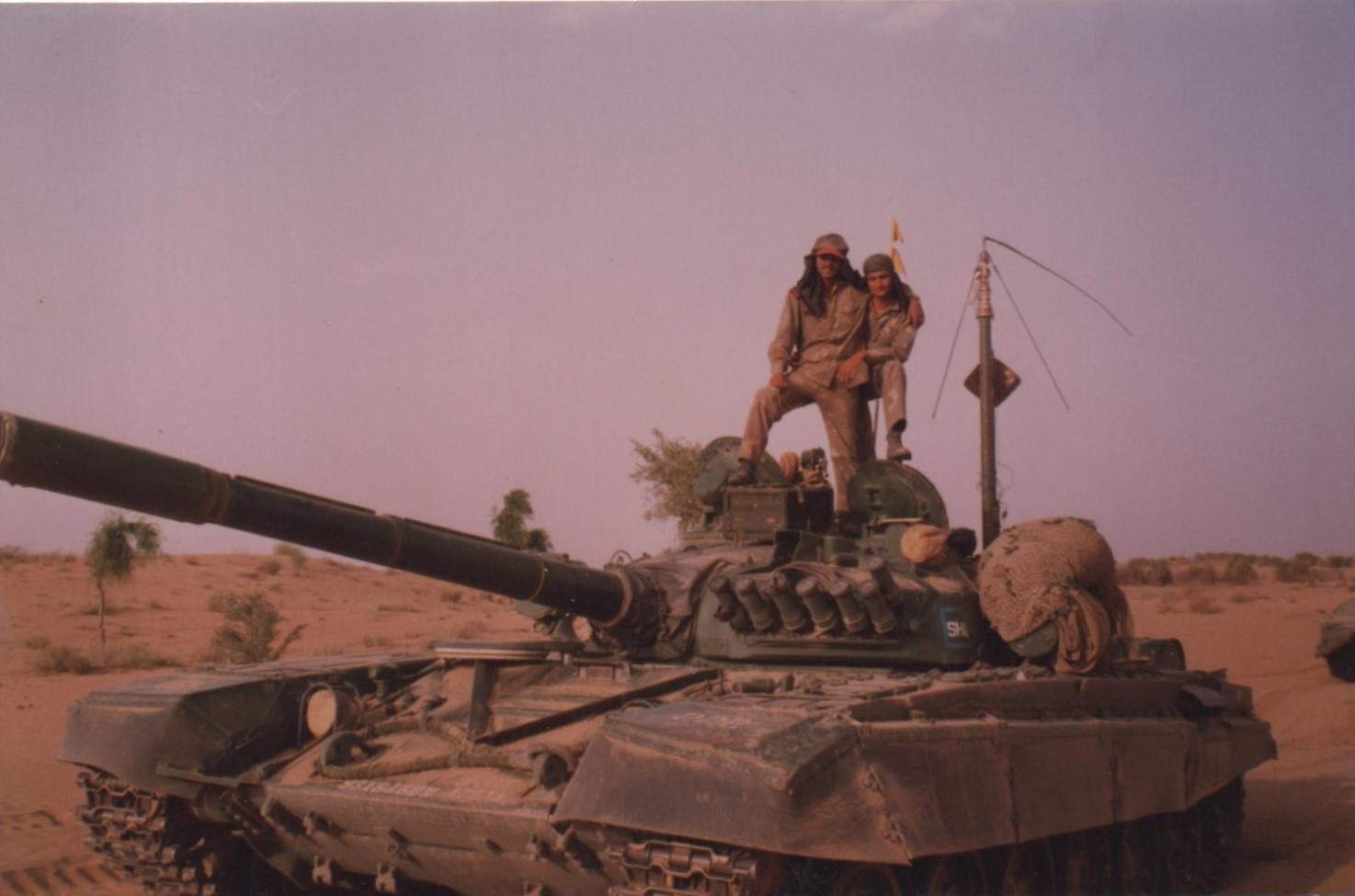
Introduction:
On the 20th of November 2024, I had the opportunity and the privilege to sit down with Major Abhijit Joshi. Major Joshi retired from the Indian Army in 2007, having spent his career with 76 Armoured Regiment. In 2007, when he left, he was the Squadron Commander of “A” Squadron of the Regiment. With a career spanning 1997 to 2007, Major Joshi served in the Indian Armoured Corps during a time of immense change.
He experienced, first hand, the change-over from the old Vijayantas, Centurions and T-55s (his Regiment had Vijayantas) to the new T-72s. His Regiment was mobilised as part of Operation Parakram. He also spent 2 years as an Instructor at the Officers’ Training Academy in Chennai. His recounting of his Regiment’s conversion and mobilisation plug an important gap in the literature surrounding the Indian military at the turn of the century. The literature that does exist is often from the perspectives of generals or those in equivalent civilian posts – such as General V. P. Malik’s account of the Kargil War – and very little insight has been offered (if any) on Indian armoured and mechanised formations from these decades.
In this article, I will narrate the story of 76 Armoured Regiment between 1999 and 2004 – as told by Major Joshi. We will cover how an Indian Army armoured regiment converted to new tanks, what the regiment did during the Kargil War, what mobilisation for Operation Parakram was like and why was that mobilisation so delayed.

76 Armoured and its Vijayantas:
Major Joshi was commissioned into the Indian Army in 1997 as a 2nd Lieutenant. In July of the same year, he would join his regiment – 76 Armoured – at Amritsar. At this time, like much of the Indian Armoured Corps, 76 was equipped with the Vijayanta MBT. The Vijayanta was a further developed and more modernised version of the British-designed Vickers MBT. The base design of the Vijayanta, however, dates back to 1963.
Heavy Vehicles Factory Avadi (HVF Avadi) would build over 1,800 Vijayantas for the Indian Army (some sources note the number as 2,200) and they would serve with distinction in the 1971 India-Pakistan War. Armed with the legendary British-designed Royal Ordnance L7 105mm gun, it was more than a match for Pakistani M47 Pattons (American-made) and Type-59s (Chinese-made). By the 90s, most of the Vijayanta fleet had been upgraded to the Mk.1A standard. This saw over 60% of the fleet outfitted with new sights – the AL4420 – made by Bharat Electronics Limited (with a few hundred being equipped with the improved AL4421) among other improvements. At this stage, the Vijayanta was a truly Indian tank.
These upgrades – the Mk.1A, Mk.1B, Mk.1C, Mk.2 – were initially designed to keep the Vijayantas in service until they were replaced by the new Indian MBT – the Arjun. However, by the mid-90s it became clear that the Arjun simply would not be ready. Plans were discussed to upgrade the Mk.1As (the most numerous variant at the time) to the Vijayanta “Bison” standard – a program which would see them fitted with new 1100bhp engines, modern ERA, newer sights and electronics – but they were shelved in favour of bringing the T-72M1 into service. By the late 90s, these T-72M1s (known in Indian service as the T-72 Ajeya Mk.1) began to arrive in great quantities.


They were better protected than the Vijayantas and employed a more powerful – if less accurate – gun, the Soviet/Russian 2A46M 125mm.[1] Most importantly, they were equipped with modern (for the time) sights and had a more powerful engine. It was in May of 1999 that 76 Armoured began to convert to the T-72M1s.

1999:
In April of that year, Major Joshi – then a Lieutenant – had departed for Ahmednagar to undertake his Armament Instructors’ Course at the Armoured Corps Centre and School (ACC&S). When he returned to the Regiment in May, it had just begun its conversion. Originally, the Regiment was part of the 16th Independent Armoured Brigade under I Corps and was located at Mamun. However, for the purposes of conversion, it was shifted to Hissar where a large and spacious cantonment was available.
This space was required as, stationed with them, were 20 Lancers. 20 Lancers had finished converting to T-72s some time ago and had been, for that reason, chosen to tutor the men of 76 Armoured Regiment on the T-72s. Colonel Anil Verma, an officer from 20 Lancers, was also made the Commanding Officer of 76 Armoured Regiment in order to further smoothen the transition. By this time in May, the fighting in Kargil had developed into an organised Indian offensive – Operation Vijay. Despite this, 76 Armoured was not mobilised to the border as their conversion was given full priority.

In the first phase of the conversion, lasting from May to August, 76 Armoured was given classroom instruction and its crews familiarised themselves with the T-72 – though there was no firing, manoeuvring or driving. In this period, only 60% of the Regiment was present at Hissar at any given time. The rest were collecting the newly made T-72s either at Khadki in Pune or in the city of Chennai, while others were handing over their old Vijayantas at Khadki. The classroom instruction, while at Hissar, consisted of:
- Systems familiarisation
- Armament familiarisation
- Driving & Maintenance (D&M) theory training
- Radio Operations
In July, the Kargil War had been concluded with a resounding Indian victory. By the end of August, the Regiment had collected all its new T-72s and handed over all of their old Vijayantas. They were then deployed near the Pakistani border in the Indian state of Rajasthan – specifically to Pokhran. This was for two reasons. Firstly, there was a real chance that the political fallout from the Kargil War could ignite a larger conflict. Therefore, if 76 was given the order to invade Pakistan – they had to be near the border. The second, and perhaps most important reason, was that Pokhran is also the location of the Pokhran Field Firing Range.
Here, 76 could finally put that theory into practice. Over the course of September, October and November, the Regiment’s new T-72s and their freshly trained crews would be put through their paces. The Regiment would practice everything from ordinary movement drills to assault exercises as well as basic field firing – I.E. firing at a stationary target. In fact, the Regiment would put so much wear and tear on their brand-new T-72s that they did not schedule any exercises for the next year. This could have been for fear of wearing out the barrels, as the Regiment likely fired twice the annual amount of allotted rounds (in a year, they were only allotted ~1,000 rounds to fire).

By December of 1999, they had been demobilised and found themselves back in Mamun.
2000, 2001 and Mobilising for Operation Parakram:
The year 2000 was, in the words of Major Joshi, a “mundane year”. Given the wear and tear that the Regiment had put on their tanks in September-November of 1999, they were not scheduled for their annual exercises (which typically lasted 2.5 months and always took place between May and July). In 2001, however, everything would happen all at once.

In May-July, the Regiment undertook their scheduled exercises and, when they returned, the year looked as if it was going to turn out to be another ordinary year. However, on the 13th of December, terrorists sponsored and trained by Pakistan would attack the Indian Parliament in New Delhi. On the 15th, at 0200hrs, 76 Armoured Regiment – and the Indian Army’s I Corps – would receive the order to mobilise.
The timeframe for mobilisation was as follows:
- Within 1 week, the Regiment should have collected all its tanks, vehicles, and men
- By the end of the first week, it should be at a primary staging area from where it would then reach its forward locations
- By the end of the 4th week, it should be in position and ready to undertake its assigned task
This timeframe was not achieved. When mobilisation was announced, only 50% of 76’s vehicles – A-Vehicles (tanks, ARVs and BMPs) as well as B-Vehicles (trucks, jeeps, etc.) – were road-worthy. The rest were all in various conditions of maintenance. This figure of 50% is roughly accurate for most, if not all, Indian mechanised formations on the border at the time. Furthermore, there was a shortage of critically needed Fuels, Oils and Lubricants (FOLs) – not just in 76, but in all mechanised formations of I Corps. Though the manpower of the Regiment was mobilised within a matter of hours, its vehicles took two weeks to get road worthy.
Despite this, the Regiment could not move out. It lacked its war-time ammunition.
For this, they needed to get ammunition delivered from the massive depot at Mamun. However, the Mamun depot did not contain only the ammunition for the 16th Indep. Armoured Brigade – it contained the war-time ammunition for every single unit in I Corps. This meant that there was an insurmountable delay in the delivery of ammunition. What this delay meant was that I Corp’s mechanised formations could only leave their bases 6 weeks after the announcement of mobilisation.
In the words of Major Joshi:
“The collection of the ammunition itself, took one and a half months given that there was such immense pressure on the depot to distribute the ammunition to all these [units] – and the quantities were vast. … So, our logistics – at that point in time – completely screwed up. Our supply chains, our planning – everything, EVERYTHING – was completely screwed up because the army had never been mobilised at this level post ’71. And, it was a massive kick up the behind.”
The effects of these delays are well known and I need not cover them here. Major Joshi went on to speak about how the mobilisation failures impacted Indian mechanised units in later years – but that is a conversation for another time.
Organisation of an Indian Armoured Regiment in this period:
Note: supporting equipment or personnel – such as artillery, mechanised infantry or engineers – were provided by the Brigade or Divisional HQ as requested by the Regimental HQ.

Annual Exercises:
Note: This information is only for the 1997-2007 period.
As mentioned above, an armoured regiment of the Indian Army – during this period – would exercise for 2.5 months every year. These exercises would take place in the peak of the Indian summer in the Rajasthan desert.
Typically, only 50% of the Regiment’s tanks and B-Vehicles would take part as it would have been too time-consuming to move the entire Regiment. Furthermore, the base needed to be maintained. Though only 50% of the vehicles would participate, almost all the crews (in fact, everyone in the regiment except those on leave and the admin staff) would take part. This ensured that all gunners, officers and drivers were exercised and could practice even if all available tanks were not present.
During these 2.5 months, the 18 tanks that were mobilised would fire around 1,000 rounds of all types.
The annual exercises would be a mix of static firing – known as Field Firing – and manoeuvre exercises, in which they would practice everything from counter-ambushes to assaults on fortified positions.
[1] Despite this, the penetration performance of the L7 and the 2A46M was roughly the same. This was because, until the mid-2000s, the Indian Army was firing outdated Soviet-made 3BM42 “Mango” APFSDS rounds. However, this was more than enough to defeat all enemy tanks they would encounter. The more modern 3BM46s were available in some number, though both were quickly replaced by the Indian-made FSAPDS Mk.I and Mk.II.
Leave a Reply