
This article was written for Easy History by Hannah Latham.
Introduction:

Mikhail Gorbachev was the General Secretary of the Communist Party of the Soviet Union (CPSU) between 1985 and 1991. Given that his tenure was one of immense change in the USSR, he and his premiership are subjects of great debate. The Brezhnev era that preceded him, left the USSR with economic issues such as stagnation, as well as mounting difficulties with their international relations. Whether Gorbachev failed is an interesting question to ask, as his policies domestically and internationally have had divergent impacts.
Failure for Gorbachev could be considered to be a failure of his reforms – reforms that would have serious unintended consequences. These reforms, both domestically and as relating to foreign policy, were initiated by Gorbachev with the specific goal of modernizing the Soviet Union. In this article I will argue that these reforms were failures and successes – yes, Gorbachev greatly improved the USSR’s diplomatic relations, but his domestic policy could not hold together the flailing country.
To understand his reforms, however, it is important to understand the state of the USSR at the beginning of his tenure. When Gorbachev came to power, the Soviet Union was struggling. The economy was stagnating, corruption was rampant, and Cold War tensions were draining resources. The economic issues created a great decline in the agrarian and industrial sectors. Between 1980-81 the annual growth of the economy averaged a dreary 1.5 per cent a year. Additionally, the Soviet standard of living lagged far behind that of Western Europe.

Internationally and diplomatically, the situation was not much better. Despite the period of 1970-75 marking a high point of superpower detente, the invasion of Afghanistan at the end of 1979 inaugurated a new period of US-Soviet tensions. At the time of Brezhnev’s death in November 1982, it seemed that US-Soviet relations were at their lowest in twenty years. This put pressure on the Soviet Union, as it meant that they needed to devote more funding and resources to the arms-race, which the Soviet Union could scarcely afford. When Gorbachev came to power, he wanted to improve this ailing relationship, due to the peak of Cold War tensions, particularly due to Reagan’s harsh approach towards the Soviet Union. He was also driven by a genuine desire to reduce global tensions and to reshape the Soviet Union.
Gorbachev’s domestic reforms:
One of Gorbachev’s domestic reforms that ended in failure was his attempt to tackle the issues of alcoholism with the introduction of the anti-alcohol campaign. At the time, labour productivity and health were low, with 90 per cent of missed workdays in the Soviet Union caused by drinking. On May 17, 1985, the government launched a campaign against drinking; increasing taxes on alcohol, cancelling most liquor licenses, banning liquor from workplaces and fining drunks found on the street. While it did reduce falling diseases, crimes and accidents involving alcohol in the first two years, it is largely seen as a failure. The Soviet economy relied on alcohol and, given its increasing absence, the Soviet budget was left with a sizeable hole. With the banning of alcohol, black markets were encouraged. Russians had a long-standing tradition of producing samogran, which they did so more vigorously during the campaign. The clear indication of the scheme’s failure came with the official end of the campaign in October 1988, largely due to its unpopularity and the loss of revenue from alcohol sales. Apart from issues such as drunkenness, Gorbachev wanted to domestically reform the Soviet Union through his policies of glasnost (openness) and perestroika (restructuring). These policies were key parts of a reform plan to revive socialism in the Soviet Union.

Gorbachev implemented glasnost to introduce critical public discussion of the Soviet state and economy in order to initiate reform. In February 1986, Gorbachev signalled his intent to relax Soviet censorship. Glasnost promoted political advancement through democratisation and debate. Glasnost was evident in the media through the creation of art, sometimes discussing previously taboo subjects. It allowed for the showcase of Soviet failures and criticism of previous governments for the first time. In a famous example of this criticism, a poster titled “We won’t let this repeat itself!” by Tzik, Stalin is depicted in a Napoleonic pose as a towering fortress figure.
He displays a message of authoritarian power, reflecting the propaganda of Stalin’s era. The slogan of the poster suggests that the Soviet Union has changed and improved from its past mistakes. This heretofore unseen openness created growing public disillusionment as it led to the widespread revelation of deeper problems within the Soviet system, which only further destabilised the Soviet Union.
Apart from social instability, Gorbachev would also end up bringing about economic uncertainty with Perestroika. Perestroika was another of Gorbachev’s programmes: a series of political and economic reforms aiming to modernise the economy though the promotion of greater efficiency and limited political liberalisation. Gorbachev wanted the Soviet Union to match the West economically, focusing on the deep structural transformation of industry to accelerate the growth of machine building. However, by 1987-88 the redistribution of economic management rights in favour of managers and workforces of state enterprises, in practice nullified the possibility of executing a structural shift in the direction of the machine building complex. The growth of the consumer was stimulated at the expense of investment demands. The spike of the budget deficit caused a surge of shortages and inflation that exacerbated the country’s economic difficulties and degraded the government’s authority. This inflation made basic goods unaffordable for ordinary citizens and only increased Gorbachev’s unpopularity.
Posters were used as part of the Soviet campaign to persuade the public to reflect on Gorbachev’s reform program. In the poster “Follow the Path of Development and Progress” (1986), a Soviet star is depicted rising through space with details in the points of the star, with the points highlighting advances in agriculture and industry. It conveyed Gorbachev’s belief in reform as a path to rejuvenate the Soviet Union, conveying a vision of economic revitalisation and social improvement. This poster, like most Soviet propaganda at the time, projected an image of forward momentum that contradicted the rising issues of inflation and hardship. It is an ironic symbol of Gorbachev’s inability to achieve the intended outcome of economic reformation.

Perestroika also included political reformation. Gorbachev proposed to reduce the direct involvement of the Communist Party leadership by increasing the local government’s authority. In March 1989, for the first time since 1918, contested elections to a Soviet legislative body, specifically to a Congress of People’s Deputies (CPD) took place in the Soviet Union. This undermined the Communist Party’s dominance and exposed divided leadership within the Congress, creating a large number of nationalist movements in the Soviet republics. Gorbachev made it clear he wanted to avoid the use of force in Eastern Europe. With the introduction of glasnost, they were able to voice their dissatisfaction with Soviet rule. With nationalist movements creating greater political mobilisation the central control was weakened. The military coup arriving in August 1991, despite its failure, left Gorbachev’s position as leader severely weakened. This led to the rise of Yeltsin who called for Gorbachev’s resignation. Gorbachev resigned on December 25, with Yeltsin replacing him who declared the end of the Soviet Union.
The unintended, but somewhat predictable, effects of Gorbachev’s foreign policy allow us tro draw some conclusion. First, it can be said that Gorbachev failed to stabilise the Soviet Union because due to his poorly executed reforms and efforts at political liberalisation. His reforms, especially with glasnost and democratisation led to stronger nationalist sentiment in the USSR’s republics, increasing the political division that would lead to the collapse of the Soviet Union. With some certainty we can say that Gorbachev’s domestic policies, while good-intentioned, contributed to growing economic and political instability and, eventually, to the dissolution of the USSR.
Gorbachev’s foreign policy:

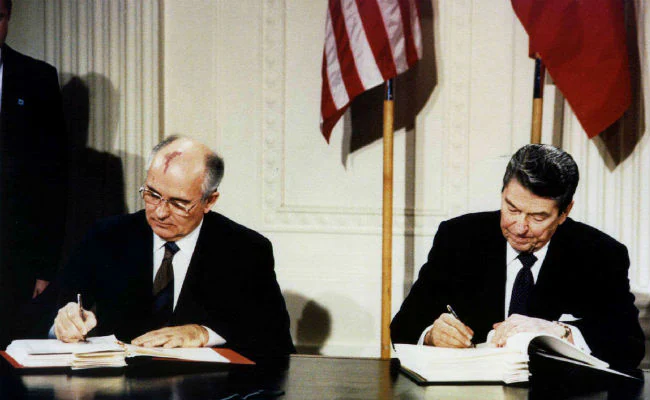
Unlike his domestic policy, Gorbachev’s foreign policy was successful because he understood the need to reduce Cold War tensions and the benefits of becalming and partnering with Reagan. This new order that Gorbachev was ushering in was first evidenced by the West when he announced a unilateral moratorium on the deployment of medium range SS-20 missiles in Europe. Further cooperation was displayed by summits at Geneva, Reykjavik, Washington and Moscow. The signing of the Intermediate-Range Nuclear Forces Treaty in 1987 – which saw both parties agree to destroy MRBMs and LRBMs – dramatically shifted perceptions of the USSR in the West.
There were many benefits from these summits and Reagan and Gorbachev were able to establish a basis for a working relationship. Further success followed, as the Soviet Union withdrew troops from Afghanistan and removed a source of much tension with the US. His abandonment of the Brezhnev Doctrine and allowing the peaceful liberation of Eastern Europe demonstrated a time for change. Gorbachev’s state visits were a success, visiting Britain, West Germany and France as well as meeting newly elected Bush. Famously his international efforts were rewarded with the Nobel Peace Prize. He contributed massively to taking the Cold War from a period of high tension known as the ‘Second Cold War’ to a period of mutual respect and trust.
It is interesting to observe how Gorbachev’s legacy is viewed by Western and Russian interpretations. Russians regularly rate Gorbachev as one of their worst leaders of the twentieth century, only 22% viewing him positively! This is likely due to the economic hardship that Soviet citizens endured as a result of Gorbachev’s failing domestic reforms. The collapse of communism in Eastern Europe would be held against Gorbachev for decades. It is still a popular view that the Soviet Empire was a source of pride and power. Famously Putin referred to the end of the Soviet Union in 2005 as “the greatest geopolitical catastrophe of the century”. Gorbachev is associated with the loss of superpower status, economic hardship and political fragmentation. On the contrary, in the West he is associated with easing Cold War tensions due to his efforts to negotiate with Reagan. The democratisation of the Soviet Union was something the West had long hoped for. Gorbachev’s bestowment with a Nobel Peace Prize demonstrated his reputation in the West with peaceful change, demonstrating the differences in Gorbachev’s legacy between the East and the West.
Conclusion:
It is clear that Gorbachev’s legacy is a complex interplay of significant achievements and undeniable failures. He saw the benefit in changing domestic policy, allowing for greater “openness” through democratisation and sought to economically rebuild the Soviet Union. However, the instability created by the haphazard implementation of the program meant that he lost control over the USSR. However, his role in reducing tensions in the Cold War and the push for greater negotiation with Reagan resulted in a movement towards peace. He successfully moved the Soviet Union from a time of high tension into creating a successful diplomatic relationship with the West. Clearly Gorbachev was successful in his foreign policy approach to the Cold War but evidently failed to domestically stabilise the Soviet Union. This instability led to the collapse of the Soviet Union – an event which he almost certainly contributed to heavily.
Sources:
- Brovkin, Vladimir N., “The Making of Elections to the Congress of People’s Deputies (CPD) in March 1989.” The Russian Review 49, no. 4 (1990)
- Brown, Archie., “The Gorbachev Era”, in The Cambridge History of Russia, edited by Ronald Grigor Suny (Cambridge University Press, 2006).
- Kaiser, Robert G., “Gorbachev: Triumph and Failure” Foreign Affairs 70, (1991)
- Tompson, W.J., The Soviet Union under Brezhnev (Taylor and Francis, 2014)
- Zubok, V., Collapse: The Fall of the Soviet Union (Yale University Press, 2021)
About the Author:
Hannah Latham is a penultimate year student at Queen Mary University of London studying History. She particularly loves researching the Cold War. She enjoys writing in her spare time, aspiring to work in the publishing and journalism industries post-graduation.
Leave a Reply