
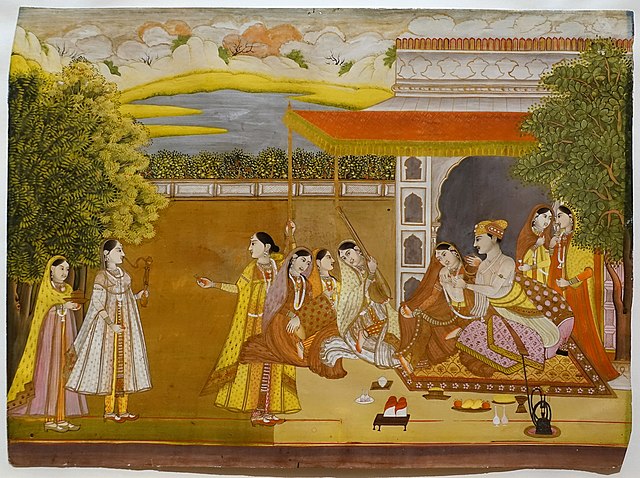
Introduction:
The Mughal and Ottoman Emperors were – by modern definitions and standards – very, very bisexual. It was expected of them, really. The Sea of Virtues, was a 12th Century Islamic text intended as a guide-book for future Muslim rulers. In it, sex with women for any reason other than reproduction was preached to be sinful and, for carnal pleasures, it is advised that ‘beautiful, beardless boys’ be pursued. In another similar 12th Century text, the author recommends ‘boys for the winter and girls for the summer’.

Of the very long list of powerful Mughal and Ottoman Emperors, almost all of them were – at some point or another – madly in love with young boys. And they really were young. Like the women of the harem, many of whom were only 12-14 years of age when they “joined” the harem, the eunuchs (castrated men who were used to protect the harem and also used as sex slaves by the Sultans/Emperors) were boys who were kidnapped during war, often between the ages of 10 and 14. Despite what The Sea of Virtues preached, Mughal and Ottoman Emperors would form relationships with both the men and women in their service. Shah Jahan, famously, built the Taj Mahal in memory of his favourite wife and was a notorious womaniser. Humayan, another one of the “Great Mughals”, is just as notorious for his love of prostitutes.
But, two of the most famous Mughal and Ottoman Emperors – Emperor Babur and Sultan Suleiman the Magnificent – had equally famous love affairs with men. Emperor Babur found himself infatuated with Baburi Andizani and Sultan Suleiman the Magnificent found himself madly in love with a young slave-boy, Ibrahim Pasha. In this article, we will look at each of these relationships in detail and explore what they say about the world in which they took place.
Babur and Baburi:
The young Babur, long before he invaded India and back when he was just a warlord, was probably always gay. The Babur-Nama’s 1589 preface (the 1589 version is the most widely accessible one and is a Persian translation of the original), notes that from a young age he would always have catamites (young male sex-slaves) in his personal entourage. Not only that, every new location he went to or place he conquered, he would have the most ‘handsome, beardless young boys’ brought to him and would do everything he could to turn them into a catamite – from bribing the boy’s father to luring him in with gifts. The preface further says, commenting on the practice, ‘to keep one [a catamite] was thought a merit, not to keep one [was thought] a defect.’
But none of these catamites, Babur himself would admit, were close to the would-be Emperor. In 1499, Babur first laid eyes on Baburi Andizani, in the bazaar of the modern Uzbekistani city of Khujand. Baburi was a slave-boy, working in the bazaar doing odd jobs and living probably in deplorable conditions. This was, as many of you may have noticed, long before Babur invaded India to become the first Mughal Emperor. He was only 17, or perhaps 18, then and modern scholarship believes Baburi to have been either 14 or 15. And, as Babur himself says, ‘I maddened and afflicted myself for [him], … I could never look straight at him; how then could I make conversation or recite [my verses]?’
Baburi Andizani would often visit Babur’s camp as part of his duties as a slave-boy and as Babur interacted with him, he came to fall in love with him. Soon, as Babur’s camp prepared to leave the city of Khujand, Babur bought Baburi off his previous master and Baburi would then accompany Babur all the way until the First Battle of Panipat. Sadly, for Babur, Baburi Andizani would not survive the battle. In fact, the majority of his catamites and followers would either be killed in India or abandon Babur in the summer of 1527. We don’t know for sure why they left but modern scholarship suggests that they left to get away from the oppressive weather of North India and made their way back to the Turkic plains where they could live out the rest of their lives in peace and comfort. During this time, he wrote a number of poems – these poems have come to be called his ‘exile verses’. He expresses longing – longing for his companions and friends and expresses regret that he chose India over love.
A poem from 1526 reads:
I deeply desired the riches of this Indian land;
What is the profit since this land enslaves me?
Left so far from you, Babur has not perished,
Excuse me, my friend, for this is my mistake.
A poem from 1528 reads:
Finally, neither friends nor companions will be faithful.
Like summer and winter, nor will companions remain.
A hundred pities that precious life passes away;
O, alas, that this celebrated time is futile.

Though Babur would father many children with different wives, he would die a deeply unhappy and lonely man. By the time of the reign of Akbar and the year 1589 (which is when the Persian translation of the Babur-Nama is produced), attitudes towards such blatant homosexuality had changed. That is not to say that the Mughals would begin to despise homosexuality, not so. It was still allowed and perhaps even celebrated. In fact, as late as 1857, the last Mughal “Emperor”, Bahadur Shah Zafar, was writing poetry about beautiful men. But, it became common practice that the Mughal Emperor would – at least publicly – choose a woman over a man. Eunuchs would be a significant part of the Mughal Court for centuries to follow but never again would a Mughal Emperor proclaim so publicly his love for another man.
Suleiman and Ibrahim:
Suleiman the Magnificent and Ibrahim Pasha were near contemporaries of Babur and Baburi, with Suleiman taking the Ottoman throne in 1520, 10 years before the death of Babur. Unlike Babur, the story of Suleiman and Ibrahim is, by far and away, less forlorn but there are many common elements. Ibrahim was a young slave-boy working in the employ of pirates before he was bought by a Greek woman and, finally, bought by Suleiman when they were both fairly young and Suleiman formed a bond with the young boy almost immediately.

When Suleiman took the Ottoman throne in 1520, he began to heap responsibility and titles on Ibrahim. At this point, the Grand Vizier (Prime Minister) of the Ottoman Empire was a man called Piri Pasha and Piri Pasha had (for reasons unimportant to this article) greatly displeased Suleiman. In 1523, Piri Pasha was dismissed as Prime Minister and replaced by Ibrahim Pasha making him the second most powerful man in the Ottoman Empire. At this point, it’s a good idea to explain in brief the Ottoman slavery system as you’re probably wondering how a slave-boy rose to become the second most powerful person in the most powerful Empire in the Middle East.
You see, Ottoman slavery – indeed almost all forms of slavery before the African slave trade – gave the slaves a great deal of freedom. There were caveats to this, of course. A slave who was a farm labourer, ship’s rower or any sort of manual labourer had very little in the way of freedom and spent most of his time working. But there were other types of slaves; house slaves, personal slaves etc. And these slaves, which is what Ibrahim Pasha was, were given great amounts of freedom, power and wealth depending on how well they performed and provided they never disobeyed their master.
And so, it was not unheard of for a slave to become a Grand Vizier. Homosexuality was also publicly encouraged for all the men in power and all men of status. In this world, the Sultan was considered to be the metaphorical centre of the universe and no one else could be elevated to that level of authority – by law. A symbol of this authority was the fact that the Sultan – when staying in his palace – would not allow anyone else into his personal chambers and he was absolutely not allowed to share his bed with anyone else – man or woman – when in his chambers. But Suleiman the Magnificent broke this rule. He had Ibrahim Pasha move into his room and had a new bed built for him. This was unheard of. It was inconceivable to the many Ottoman ministers that their universe had two centres – the Sultan and his Grand Vizier. But so it was.
At this point in Sultan Suleiman’s life and at the height of Ibrahim’s power, Suleiman fell in love with another slave. Her name was Hurrem Sultan and she quickly came to supplant Ibrahim in Suleiman’s life. In 1526, Suleiman married Hurrem and in doing so, he completely broke apart tradition. Never before had a slave-girl been lawfully married to an Ottoman Sultan and never before had a Sultan been so completely devoted to one woman, to the point of entering a monogamous relationship with her. Hurrem and Suleiman would continue to break tradition as he invited her to move into his palace and share his chambers. In doing so, he kicked Ibrahim out of the palace.

But Ibrahim was still Grand Vizier – and a very good one at that. He’d had multiple diplomatic and military successes and was quickly becoming the face of Ottoman “foreign policy”. In fact his power reached such a point that many within the Ottoman Empire and abroad, including Ibrahim, began to believe that Ibrahim was the real leader of the Ottoman Empire, not the Sultan.
This began to worry Sultan Suleiman but it worried no one more than Hurrem Sultan. She began to fear for the safety of her 5 sons and her husband and the future of the Ottoman Empire. Convinced that Ibrahim would soon seek to supplant him, Suleiman and Hurrem planned to murder him. In 1536, after an intimate dinner between Suleiman and Ibrahim, the latter returned to his quarters where his eunuchs were waiting to get him ready for bed. But the eunuchs, though they may have been his servants, were under the direct authority of the Sultan. And as Ibrahim got ready for bed, the eunuchs would silently do away with Grand Vizier Ibrahim Pasha.
Did Ibrahim Pasha want to supplant his lover? Did he harbour thoughts of rebellion? We do not know. But historian David Marc Baer believes that he did not and that the assassination of Ibrahim Pasha would be the first of many murders sanctioned by Hurrem Pasha (including the murder of her step-son) in order to secure the future of her own children.
Conclusions:
When history talks about the Mughal and Ottoman Empires, it talks about great battles such as Panipat or Lepanto. It talks of their interactions with European powers or their wars with neighbouring peoples. But this history, a niche and sometimes uncomfortable topic, is equally important. These stories shaped our world and our history because it shaped the people who led armies in the battle of Panipat or Lepanto. And, honestly, more than anything, it’s very, very interesting.
Sources:
J. S. Meisami (ed.), The Sea of Precious Virtues (1991)
A. S. Beveridge, Babur-Nama (New Delhi; 1922)
Ali Anooshahr, ‘The King Who Would be Man: The Gender Roles of the Warrior King in Early Mughal History’, in Journal of the Royal Asiatic Society, 18:3 (2008), pp. 327-340
Rosalind O’Hanlon, ‘Manliness and Imperial Service in Mughal North India’, in Journal of the Economic and Social History of the Orient, 42:1 (1999), pp. 47-93
Shadab Bano, ‘Eunuchs in the Mughal Court’, in The Indian History Congress, 69 (2008), pp. 417-427
S. O. Murray, ‘Homosexuality in the Ottoman Empire’, in Historical Reflections, 33:1 (2007, pp. 101-116
R. B. Merriman, Suleiman the Magnificent (Harvard; 1944)
William Dalrymple, Anita Anand, David Marc Baer, ‘Suleiman the Magnificent’, in Empire (2023)

Leave a Reply