
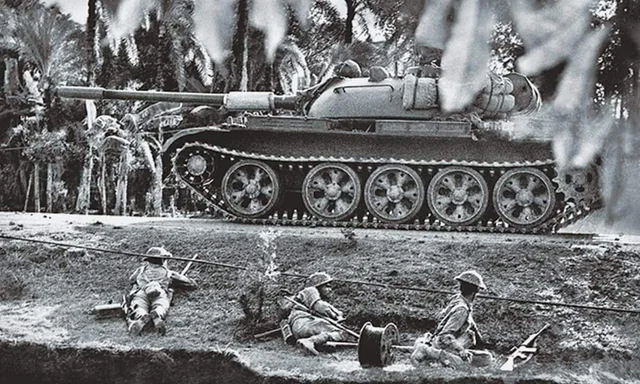
Written by: Colonel M. S. Gill, Edited by: Siddhant A. Joshi
An Introduction:

Given below is an account of the Pakistani offensive against Fazilka and the resulting subsequent defence of Fazilka as well as the Battle of Beriwala Bridge. The account has been written by Colonel Makhan Singh Gill who was, at the time, a company commander (OC Alpha Company) in the 4th Battalion of the Jat Regiment – which played an instrumental role in the fighting. On the Indian side, 67 Infantry Brigade – itself a part of “F” Sector, an ad-hoc division-sized force – was defending the town of Fazilka from an attack by Pakistan’s 105 Infantry Brigade. Rather unlike the fighting on the Eastern Front – which was characterised by rapid manoeuvre warfare – the fighting on the West was very much slow, gruelling trench warfare.

When the Pakistani 105 Infantry Brigade opened its attack on the 3rd, the forward units of 67 Infantry Brigade were immediately ordered to withdraw across the Sabuna Canal and to detonate the “Main Bridge” behind them. They did not detonate Beriwala Bridge – so named for the village situated near it. The Pakistani 6th Battalion of the Frontier Force was able to cross the bridge and take the village of Beriwala. Following a number of failed counterattacks, 67 Infantry Brigade was ordered to contain the enemy there and to conduct flanking attacks across the Sabuna Canal to keep the enemy’s reserve forces engaged. By the time the war ended, 67 Infantry Brigade had suffered 189 dead – most of whom were from “D” Company of 4 Jat – over 400 wounded and around 200 missing. 67 Infantry Brigade conducted 5 counterattacks against Beriwala Bridge, of which 4 were conducted by “D” Company, 4 Jat. All 5 failed. After the war, Major General Ram Singh, who was the General Officer Commanding-in-Charge of “F” Sector, was heavily criticised for how he handled the Fazilka defence. His ordering of repeated rushed counterattacks against Pakistani positions east of the Sabuna Canal, with the barest of armoured support and no air support, is the reason that “D” Company was almost destroyed as a fighting force. The Pakistani offensive here and at Chamb Jorian remain two of Pakistan’s rare successes of the war – aside from a couple of successful defensive actions in the east.
I will now let Colonel Gill tell his own story in his own words.
Prelude
It had been my earnest endeavour to emulate my idol, our CO Lt. Col. U. S. Chada, and his professional competencies. He had “Delta” (that is to say, Distinction) on all his courses, a fact which left an indelible impression on YOs [young officers] like me. In this humble endeavour, I was successful and was able to achieve my goal, following which I worked diligently to obtain instructional grading (i.e., I was allowed to instruct other officers). I had set the compass needle in the correct direction and had achieved my targets. My success in my courses at the Infantry School, Mhow, was soon recognised by the powers that were. After my parent battalion, that is 9 JAT, had completed its tenure on the Indo-Tibet Border and moved to its new position in Happy Valley, Shillong, they received my posting as an instructor to the Tactical Wing of the Infantry School, Mhow. The CO and the unit were elated, as I was the first ever officer from the battalion to be posted to a Category “A” premier establishment. I assumed my instructional appointment on 19 Feb 1969 and was later elevated to Instructor Class “B” Junior Command Wing, Infantry School.
In April 1971, the College of Combat (now College of Army Warfare) was carved out from the Infantry School, Mhow. It had three major tactical components, namely, HC Wing (High Command), SC Wing (Senior Command) and JC (Junior Command) Wing, along with Training Teams and supporting staff. I was also made part of the College of Combat.
Shortly before and for long after this reorganisation, the political situation in East Pakistan erupted like a volcano after Pakistan’s National Assembly elections. What started as political unrest led to genocide and atrocities. It had a serious impact on India with a sort of mass exodus of the Bengalis out of East Pakistan and into India.[1] The showdown between us and them was imminent and inevitable in the near future.
In October 1971, the officers of mechanized forces and supporting Arms were moved out of the College forthwith, without completion of courses. The fate of the instructional staff was uncertain, and the air was rife with apprehension and speculation. The curtain was raised on 03 Dec1971 when the Pakistani Armed forces conducted a pre-emptive strike on the Western front. I was among the few officers that had prepared himself to move on short notice. The fear of the unknown had posed innumerable questions in my mind, but they were superseded by two main ones; when and where to go? On midnight 6/7 Dec 1971, the staff officers informed me of my posting to 4 JAT.
I had been hoping to join my own battalion 9 JAT, which was deployed at Chamb Jorian, but “hota hai wahi, jo manjure khuda hota hai” (Only that what God approves comes to pass).[2] No one in my new battalion was made aware of my arrival, except the CO, Lt. Col. R. K. Suri, and Subedars Randhir Singh and Surjan Singh, both of whom had been students of mine at PC (Platoon Commander) Wing in the Infantry School. Another instructor, Major U. N. Kohal of the MMG (Medium Machine Gun) Wing from and also from 9 JAT, was posted alongside me to 4 JAT – very encouraging news. He would be my travelling companion.
Before my departure to join the unit, I was extremely fortunate to interact with Lt. Col. D. S. Shekhawat, the ex-CO of my new battalion. He had briefed me in detail regarding the deployment, operational role and its location at Fazilka, on the border with Pakistan in Punjab.
Excited Journey
We left Mhow on 7 Dec 1971 and reached Delhi on the morning of 8 Dec 1971. The journey was very exciting and eventful, though I obviously had a lot of apprehension in my mind. We boarded the Punjab Mail [a railway service] on 8 Dec and reached Bhatinda at midnight. Immediately after getting off the train, I went to the Station Master and enquired after the earliest available train going to Abhor, which was the railhead for Fazilka. He refused to provide us with any assistance, much less confirm train schedules, and instead made us wait outside his office. At 3 AM, after some badgering, I managed confirm the train that was going to Abhor departing at 4 AM. Major UN Kohal, on spotting an Army Ambulance Train that had pulled in, interacted with the casualties aboard – which were mostly from 4 JAT.[3] The picture they painted was demoralizing and grim but mixed with a lot of rumours.
Rumour was based on the fact that Russians were supporting India. A civilian rumour stated that Russians had trained a company of monkeys and sent them behind Pakistani lines to harass their troops.
The train reached Abhor at 7 AM and our welcoming party, as had been the case in all railway stations we had visited, was simply a company of stray dogs! I immediately contacted the Station Master regarding transportation to Fazilka. The Station Master, for his part, told me to speak to the local NCC (National Cadet Corps) Officer at Abhor – who was de-facto in charge, given Abhor’s proximity to the front.[4] He us provided a jeep to go to Fazilka and immediately contacted the Brigade Headquarters. Brigadier S. S. Chaudhary, Commander of 67 Independent Infantry Brigade, welcomed us on our arrival and made the necessary arrangements for us to go to the forward positions. I had not known anyone except the Commanding Officer, Lt Col RK Suri. As it so happened, he had been wounded in the previous days’ fighting and was confined to the bunker – being the brave soldier he was, he had refused evacuation to a hospital. He welcomed me with a lot of warmth and offered me some sweets. After having been briefed, I was told to take over Alpha company, which was occupying defences overlooking the Sabuna Canal, which separated us from Pakistani positions. The Pakistanis held the Beriwala Bridge that spanned the Canal, though we had so far prevented a breakout.
I had stepped into unknown territory, command and, above all, operational responsibilities. The journey up to the frontline defences was challenging and a litmus test of my field and battle craft. There were a number of unanswered questions in my mind. My biggest asset was the self-belief, physical and moral courage that I had inherited from my own family, received from training and from my experience in the 1965 war, and by being an instructor in JC Wing. I was received by Major DK Ghosh and senior JCO Swaroop “Dilliwala” Singh.
Through the night, Major Ghosh gave me a tour of the defences and I had the opportunity to meet all the soldiers. It was a unique experience to meet those men who were – at that point – unknown to me; their morale was very high. The lay of the land favoured the Pakistani positions; it was a classic example of the defiladed position and enfiladed fire. My first goal was to inspire the men now under my command and to establish credibility as their Company Commander. The defences were linear, and the forward-most trench was occupied by five stalwarts, i.e., Capt. Amar Chand Narwat (an officer from 8 JAT, who had joined 4 JAT a day earlier than me), Havildar (Sergeant) Sultan Singh, Naik (Corporal) Dilbagh Singh, Naik (Corporal) Juglal and Rifleman Rajpal Singh Rathee. They kept a close and unblinking eye on the Pakistanis’ movements from their position. We had pinned them down with effective small arms fire, mortar fire and artillery shelling. The defences of the battalion were centred on Alpha Company – which had been tasked with the defence of a village extremely close to the Pakistani positions. The proximity between both forces was barely 40 to 50 meters, it was rather eyeball to eyeball. While I was going through the defences I found – to my utmost surprise – that one of the pill boxes was unoccupied. The man posted there, Sepoy (Private) Ramphal, who was also the unit signal operator, had been blasted into pieces by a tank shell. His body was blown all over the pill box and trench, leaving it smeared with blood. The troops called it the “killer trench” and were hesitant to occupy it, given Sepoy Ramphal’s fate. I had to order them to reoccupy it.
10th to 12 Dec 1971
Up until the 12th, the war – for me – had mostly had been stalemate, some with intermittent firing by artillery and heavy machine guns, with us infantrymen engaging a few targets here and there. I had kept my command abreast with the current operational situations and they, in turn, kept me informed of the latest political developments and of the latest on the Eastern Theatre. We were lucky, at this point, to find a transistor abandoned by 3 ASSAM (a battalion deployed further along the line to aid in Fazilka’s defence). The briefing I conducted with my company every day worked as a morale booster. The troops in contact felt safe inside the pillboxes and the trenches. This feeling of safety led to the troops developing a fear of being out in the open, which led to reduced visibility of the enemy – especially during the night. It had been a purely psychological factor, and to help them overcome their fear, a few new forward trenches were dug (along with communication trenches) that allowed us to better observe the movements of the enemy.
Counterattack Dec 13/14
The “O” Group [i.e. the Company Commanders’ group] was called for a briefing to launch another counterattack to capture the Beriwala Bridge across the canal, on the night of 13th/14 Dec. Delta Company, under Maj or J. B. Ale, was tasked to capture the bridge. And one platoon of my Company, Alpha Company, was detailed as a reserve. The battalion had suffered heavy casualties on 3/4, 4/5, and 5/6 Dec, when they had launched counterattacks to capture Beriwala Bridge. As a result of heavy casualties suffered, Army reservists were called as reinforcement for Delta Company. When we briefed them, the reservists declined to be part of the counterattack and said “we will not lay our lives on the line for Rs. 15 per month”.
The situation, which was already critical, became threatening since the reservists were all armed. The Commanding Officers had no options left excepting threatening the dissenters with dire consequences. The situation was extremely tense. Major A. S. Samra, OC [Officer Commanding] Charlie Company, and I brought the situation under control and got the reservists to obey orders. The H Hour for the counterattack was 2030hrs, with Forming Up Place being my Company’s position.
Intense fire was being exchanged from both sides in the hours preceding our attack and a lot of dust had been kicked up by artillery, which resulted in us delaying “H” Hour by an hour. “Jab agaz aisa ho, to anjam kya hoga?” (When the onset is so powerful, what might the end be like?).
It was a linear attack along the Canal, which reduced the deployability of the company; not more than a section [equivalent to an American squad] could advance at any one time. The objective, Beriwala Bridge, was subjected to high-intensity fire by tanks, artillery (including both, field and heavy), mortars and small arms fire from both sides. There was a thick dust cloud, and the visibility was reduced to hardly a couple of meters. Suddenly the regimental war cry, ‘JAT BALWAN, JAI BHAGWAN!” echoed through the sky, and we could hear the company commander yelling “SHABASH!” to signal that the Beriwala Bridge captured. I, along with Subedar [equivalent to a senior US Warrant Officer] Shriram, immediately rushed to “D” Company with my Company’s troops to beef up attack and defences.
It then materialised that the signal was a false alarm given by “D” Company’s commander to confuse the enemy’s defensive efforts. However, the reservists that now formed much of “D” Company, also believed their attack to have been successful. By the time Subedar Shriram and I had left our forward most trench, we noticed that “D” Company’s attack had petered out and their troops had taken up position in communication trenches. Following that, the attack was called off – and the reservists suffered significant casualties as they were unable to conduct an effective disengagement.
14, 15, 16, 17 Dec 1971
There was a lull in the battlefield. Both the forces had reconciled to accept fait accompli. On 16 Dec 1971, in the early morning, Captain Amar Chand Narwat anticipated an imminent attack on our forward most trenches by the Pakistanis. I, immediately along with my FOO (Forward Observation Officer) and MFC (Mortar Fire Controller), rushed to the forward most trench to assess the grave situation. Immediately, the enemy attackers were engaged by mortars, artillery and tanks. There was a thick blanket of fog, and visibility was hardly a couple of meters. Despite this, our fire was effective – of particular note was the response from our own mortars, which was ably led by Subedar Surjan Singh, and was very quick and effective. The Arty OP Lt. Gokhake of 166 Field Regt spotted the Pakistani’s killer heavy MG position and started engaging it. Later, I also joined him to direct the fire on enemy locations, including the village of Khuda Baksh. Throughout the night, we were awake. My batman brought us a hot tea but was immediately told to go away so as not to expose himself. The Pakistani sniper fire was deadly – Sepoy Dharam Chand was shot down mere moments after moving from his position. I also had a close call with a Pakistani sniper – my life was saved by Naik Dilbagh Singh, who immediately pulled me down into the trench and out of the Pakistanis’ line of sight.
17/18 Dec 1971
The enemy kept on sniping and firing on the defences, and we retaliated very effectively. However, at 9 AM on the 18th, a few men in Khaki uniform – which I recognised to be Pak Army Dress – raised the white flag and began marching towards our position. From no man’s land, they announced that a ceasefire had been operative since midnight. I had no information about this whatsoever, though I immediately got it confirmed from the commanding officer and sought his directions on a course of action.
Three officers of Bravo Company, 6 Frontier Force of Pakistan Army, led by Major Ali and followed by Captain Talat (it later materialised that Talat had led the attack that captured the Beriwala Bridge), and a young Lt. whose name escapes me, came forward to introduce themselves and to exchange pleasantries. There was no white flag with us; I immediately took out a white handkerchief, tied it on top of a wooden stick and marched out to talk with them and to conduct an official Flag Meeting.
I, along with Captain Amarchand Narwat, Lt. Gokhale, Naikk Dibagh Singh, and Naik Juglal met them in the middle of no man’s land. After exchanging pleasantries and good wishes, Major Ali and Captain Talat revealed the heroic deeds of our own Major Narayan Singh and Naik Bajarang Lal.
Major Narayan Singh, on the 5th/6th Night of Dec with a handful of soldiers, reached his objective Beriwala Bridge and killed his opposite number, Company Commander Major Sabir Shariff. Major Narayan Singh, who had already been shot in the face, had engaged Major Sabir Shariff in hand to hand combat and killed him with his knife. In the ensuing battle, Major Narayan Singh was seriously wounded and succumbed to his injuring while being evacuated to the Pakistanis’ Regimental Aid Post.
In the same attack, Naik Bajarang Lal pounced like a tiger into the Pakistani MMG and HMG pits, which were inflicting heavy casualties. He was an ace boxer, and had boxed on a national level. In the close quarter fight that ensued, he used his superior skill to knock out the Pakistani gunners. In the final pit he entered, he snatched the hot machine gun by the barrel, wrenching it out of place. His grip was so solid, that it was only undone after his hand was shot at. He too would perish in the fighting.
Major Narayan Singh was posthumously awarded the Vir Chakra (VrC), while Naik Bajarang Lal was mentioned in despatches. I would like to reiterate that we were only made aware of their actions by Captain Talat, a Pakistani officer. General Maquim Khan of the Pakistan army, in his book “Crisis in Pakistan Leadership”, had paid handsome tributes to Maj Narayan Singh and 4 Jat for their valour. Another story we uncovered after the battle was that of Sepoy Mahadeva, who was part of Major Narayan Singh’s Company during the counterattack.
During the attack, a shell had gone off right in front of him. The flash from the explosion had rendered him blind. He, by the Grace of God, survived fifteen days in no man’s land, though we all believed him dead. On being discovered and evacuated, his morale was sky high – he, in fact, shouted, “Ram ram, Saheb! Kya Beriwala Bridge ko fateh kiya hai?” (Ram ram, Sir! Have we retaken Beriwala Bridge?)
Ceasefire and Cremations
Consequent to the Flag Meeting, it was decided to observe, in letter and in spirit, the ceasefire with immediate effect. Major A. S. Samra and Major D. K. Ghosh were detailed to supervise the recovery of the bodies of martyrs. A total 82 bodies of martyrs were recovered from no man’s land and from the Pakistanis. They were given a fitting send-off at the village of Ashifwala. Mr Rakha Ram Thakural, a resident of Ashifwala, donated considerable land for the cremation of Martyrs. The cremations were done with full Military Honours and Dignity, as per the Vedic rites. Lt. Col. R. K. Suri, Major D. K. Ghosh, Captain Vipul Khanna (Regimental Medical Officer), Subedar Major Prahlad Singh, Subedar Anant Singh (who was also the Religious Teacher) and other soldiers attended the cremations. The high flames of the pyres of martyrs filled the atmosphere with grief. The ashes were divided into three portions. The first was immersed at Haridwar, the second was escorted to the soldiers’ families and the third portion was buried at the Ashifwala War Memorial. Also dispatched with the ashes, were the soldier’s personal effects, Rs. 2000 and a letter from the Commanding Officer – irrespective of rank – along with personal belongings and Rs. 2000 per head with a letter from the Commanding Officer irrespective of rank. Apart from that, all ranks of the battalion voluntarily contributed half their pay to be sent to the bereaved families – an extremely rare event.
Cease Fire Violation
On December 18th, it was agreed upon by both parties that each side would desist from creating any infrastructure construction or improvement of defences. Further, they would desist from dismantling the tube wells which supplied the local villages with water and the Pakistanis would also refrain from looting household properties in the Indian village they had captured.
In spite of this agreement, the Pak Army violated these conditions of the ceasefire within ten days, by creating an artificial screen in front of their defences. Furthermore, we also observed them looting. Thereafter, I would like to note, that I was nominated by Headquarters to be the officer in charge of ensuring the ceasefire and its agreements were upheld by both parties. Following my nomination, the situation – which was just short of us opening fire on each other again – was resolved peacefully, with the Pakistanis agreeing to adhere to all agreements of the ceasefire. Thereafter, there were no major ceasefire violations.
Later, after the conclusion of the war, the senior officers that oversaw the operations on the Western Front were being given a tour of our defences and were being briefed on the Battle of Beriwala Bridge. After being given an account of our action, Major General K. V. K. Krishnarao, the Western Army Commander, patted me on the shoulder and said “Mera 4 Jat ko salaam! (I salute 4 JAT) But for 4 Jat, Fazilka would not be on India’s map! You are the Saviours of Fazilka!”
[1] The official estimate was 10 million refugees at the peak of the crisis
[2] The Battle of Chamb/Chumb was among the longest battles of the war – lasting from the 3rd to the 11th of December. This battle was one of the few Pakistani successes of the war.
[3] As Colonel Gill describes later, on the nights of 3rd, 4th, 5th and 6th December, the Battalion had undertaken costly attacks against a Pakistani bridgehead on Indian territory just west of Fazilka and were rebuffed each time.
[4] NCC NCO Officers were patrolling the station and streets
Leave a Reply