
This article has been written for Easy History by Deniz Gun Erazlan.
Introduction:
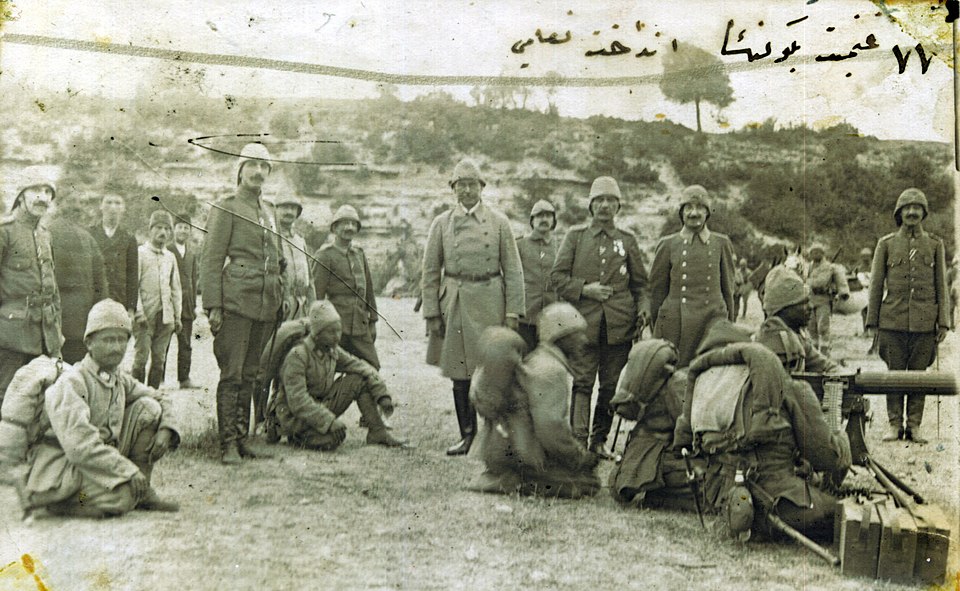
The shores of Gallipoli were never quiet again after the morning of April 25, 1915. As Allied troops landed under heavy fire, Ottoman defenders – many no older than twenty – found themselves thrust into the defining horror of their lives. Much of the Western world remembers the campaign through the eyes of ANZAC and British soldiers. But for the Ottomans – the so-called “Mehmets” – Gallipoli was a blood-soaked test of will, endurance, and unimaginable sacrifice in defence of their sovereignty.
Lieutenant Mehmed Fasih, a young officer at Lone Pine, described one such scene: “Dismembered… parts of their bodies are intermingled. Chests and arms look like wax. Some bones have been stripped of flesh… Pitch black.”
This was not just a military campaign. For the Ottoman defenders, it was a brutal baptism into modern warfare – fought in muddy trenches, under relentless bombardment, with no escape. This is their story, in their own words.
The Landing and Chaos:

The sun had barely risen over the Dardanelles when the first Allied boats began to approach the shores of Gallipoli. For the Ottoman soldiers stationed at Anzac Cove and Cape Helles, the sight was staggering: dozens of warships, landing craft, and men pouring out onto the beaches. Though the Ottomans had anticipated an invasion, the sheer scale and coordination of the landing sent waves of panic and confusion through the trenches.
Lieutenant Mehmed Fasih, positioned at Lone Pine, later wrote of those opening moments:
“As if tossed in by hand, an enemy shell penetrated the position… The carnage it caused is awful. Six dead lie there. Dismembered, parts of their bodies are intermingled… Some bones have been stripped of flesh.”
The Ottomans, many of whom were conscripts with minimal training, scrambled to hold their lines. The chaos was not only tactical, but emotional. Across the front, soldiers reported watching their comrades die in seconds, their bodies mangled by machine-gun fire or crushed under artillery. Communication broke down, and for many officers, the battlefield became a blur of smoke, shouts, and blood.
One unnamed Ottoman soldier recalled:
“By day, our armies fight each other with rifles and bombs. At night, we sneak out and stab each other in the dark. Death never rests.”
Despite the confusion, Ottoman resistance stiffened. Makeshift counterattacks, directed by commanders like Mustafa Kemal, began to slow the Allied advance. The battle lines soon congealed into the brutal stalemate that would define the next eight months. But for those who survived that first day, the memories remained scorched into their minds – not of victory or strategy, but of terror, chaos, and loss.
Trench Life and Daily Horror:

As the initial chaos of the landings faded, a new and more grinding horror set in: the trench war. For Ottoman soldiers, life in the trenches at Gallipoli was a daily battle not just against the enemy, but against the elements, hunger, disease, and despair.
Many of the trenches were dug hastily into dry, rocky soil, offering little protection from the relentless artillery that pounded the peninsula day and night. Supplies were scarce. Fresh water had to be carried in from great distances, often under fire. Rations were minimal – stale bread, olives, and boiled wheat when available. Medical support was nearly non-existent.
One soldier, quoted in a Turkish army collection, wrote:
“We have no medical supplies left. We take bloody bandages from the corpses… and use them over and over again.”
Death was constant. In the blistering heat of summer, corpses rotted in no-man’s-land between the trenches. The stench was overpowering. Ottoman soldiers wrote of using bayonets to swat away the flies that covered their faces. They were not afraid of dying – most had accepted that – but the manner of death, slow and suffocating in the filth of the trenches, haunted them.
Another soldier recalled:
“We can see the vultures heading down to our brothers’ bodies. We want to shoot them but fear giving our positions away.”
And yet, even amid the decay, a strange rhythm developed. Soldiers recited poetry, carved names into the trench walls, and prayed under the stars. Others sang quietly, especially at night, songs of their hometowns and the lives they had left behind.
Lieutenant Mehmed Fasih captured the despair of this slow unravelling in a letter from November 1915:
“While we originally had 200 soldiers in each of our companies, we are now down to 50 or less apiece. The rest have been martyred… The majority of those singing folk songs now lie covered with earth.”
The horrors of Gallipoli were not always sudden. For many Ottoman soldiers, they came day by day, hour by hour, as the trenches became graves for the living long before they became graves for the dead.
Heroism and Sacrifice:

While Gallipoli was marked by despair and horror, it was also the crucible in which many acts of extraordinary heroism emerged – none more defining for the Ottoman memory than those of the 57th Infantry Regiment and its young commander, Mustafa Kemal.
As the Allied troops advanced inland on April 25, 1915, Kemal – then a lieutenant colonel – recognized the urgency of the moment. Without waiting for higher orders, he gathered scattered Ottoman forces and issued one of the most iconic battlefield commands in modern Turkish history:
“I do not order you to attack, I order you to die! In the time which passes until we die, other troops and commanders can take our place.”
The 57th Regiment obeyed without hesitation. They counterattacked and slowed the Anzac advance, buying time for the Ottomans to reinforce the front. The regiment was nearly annihilated, but their sacrifice is still remembered as a symbol of national valor. Not a single unit in the modern Turkish army bears the number “57” today, in eternal memory of their loss.
Yet the heroism of Gallipoli was not only in grand speeches or legendary stands. It was in the small, selfless acts of men who buried their comrades in silence, who gave up their last drops of water, who held the line despite bleeding and broken limbs.
A diary entry from one Ottoman soldier reflects this quiet bravery:
“My friend took a bullet for me. I was not worth saving. He smiled as he died and said, ‘Tell my mother I was brave.’”
Gallipoli forged myths, but behind the myth was real blood, real sacrifice. Ottoman heroism was not born of hatred – it was born of desperation, duty, and love for the homeland. Many died not knowing if their names would be remembered. Yet in moments like these, their courage was immortalized.
Aftermath and Memory:

By the end of 1915, Gallipoli had become a wasteland. Disease spread faster than bullets, the trenches were soaked with blood and rot, and the surviving Ottoman soldiers were shadows of the men who had first taken up arms in the spring. While the Allied forces evacuated in silence under the cover of darkness in December, the cost for the Ottomans had already been paid in full: over 80,000 dead, many more wounded or crippled for life.
But the physical toll was only part of the legacy. For the Ottoman soldiers who survived, Gallipoli left permanent scars – on their bodies, and in their minds. Letters from the front reveal not triumph, but exhaustion and grief. One wrote:
“We no longer rejoice at victory. Each success leaves fewer of us to remember it.”
Gallipoli also became the soil in which Turkish national identity began to take root. It was not just a battle – it was, for many, the first time men from across the empire had fought side by side as Turks, not just Arabs, Kurds, Albanians, or Anatolians. The heroism of the campaign, especially that of Mustafa Kemal, would later serve as a cornerstone of the Turkish Republic’s founding myth.
In later years, a message often attributed to Atatürk – though likely written by others – appeared on Gallipoli memorials:
“There is no difference between the Johnnies and the Mehmets… After having lost their lives on this land, they have become our sons as well.”
Regardless of its origin, the words reflect a quiet dignity born out of shared suffering. For the Ottomans, Gallipoli was not just a military victory. It was a graveyard of youth, a furnace of identity, and a testament to how much a nation can endure before it begins to rise from its own ashes.
Conclusion:
The story of Gallipoli has long been told through the voices of British and Anzac soldiers, whose diaries and letters shaped popular memory across the world. But on the other side of the trenches, Ottoman soldiers endured the same hunger, fear, grief, and horror – often with fewer resources and even less hope of survival.
They fought not for empire or glory, but because they were ordered to hold their ground. Many died in silence, nameless and unrecorded. Yet their voices, preserved in scraps of letters and fading diaries, still speak across time.
“Tell my mother I was brave,” one soldier said.
The Mehmets of Gallipoli did not vanish into history. They remain beneath the soil they defended, part of the landscape, part of the memory. And now, at last, part of the story.
Primary Sources:
- Lieutenant Mehmed Fasih’s Diary
- Fasih was an Ottoman officer stationed at Lone Pine during the Gallipoli campaign. His diary provides vivid descriptions of frontline combat, emotional reflections, and daily trench life. Source: Fasih, Mehmed. Gelibolu 1915: Bir Subayın Günlüğü. (English edition: Gallipoli 1915: The Diary of an Ottoman Officer).
- Letters and Testimonies from the Turkish General Staff Archives (ATASE)
- The Turkish military archive contains collected letters and oral accounts from Ottoman soldiers on the Gallipoli front. These include descriptions of medical shortages, daily conditions, and emotional tolls. Source: ATASE (Askeri Tarih ve Stratejik Etüt Başkanlığı), Çanakkale Cephesi’nden Mektuplar (Letters from the Gallipoli Front), Vol. 1-3.
- Mustafa Kemal’s Battlefield Orders and Writings
- Kemal’s legendary order to the 57th Regiment on April 25, 1915 – “I do not order you to attack, I order you to die” – is recorded in multiple military reports and memoirs. Source: Mustafa Kemal Atatürk, Nutuk (The Speech), and Ottoman War Ministry reports from the Gallipoli front.
- Anonymous Soldier Diaries and Memoirs
- Personal writings and oral testimonies of Ottoman soldiers preserved in local archives and museums describe everyday suffering, camaraderie, and sacrifice. Source: Çanakkale Şehitleri ve Gazileri Anlatıyor (Testimonies of the Gallipoli Martyrs and Veterans), Çanakkale Martyrs’ Memorial Museum collection.
- Commemorative Message Attributed to Atatürk
- A message often attributed to Mustafa Kemal appears on Gallipoli memorials, expressing reconciliation between fallen Ottoman and Allied soldiers. Source: Inscription on the Çanakkale Atatürk Memorial (Turkish Ministry of Culture and Tourism, 1934 dedication).
About the Author:
Deniz Gün Eraslan is an undergraduate student of Politics and International Relations at the University of Reading. His academic interests focus on the history of the Ottoman Empire, Middle Eastern politics, and the study of political memory. He is committed to presenting complex historical subjects in an accessible and thoughtful manner for a broader audience.
Leave a Reply