
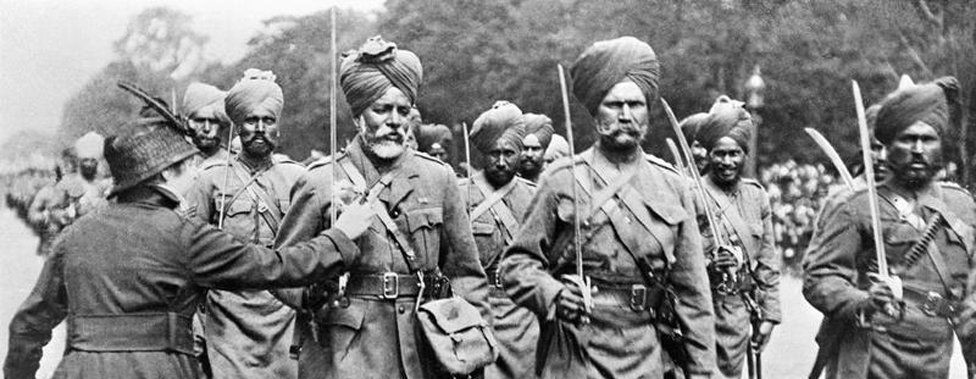
Introduction:

The study of modern wars, especially the two World Wars, is virtually impossible without the use and understanding of war diaries, regiment diaries, letters home and unit records. These resources have been made available to historians in the millions – in truth, there are more such records available for free on the internet alone than a human can reasonably read and understand in a lifetime. But, as with all good things, there is a caveat – these records almost exclusively cover the experiences of European and American soldiers. This is not by accident, nor is it a function of malicious intent.
War diaries and letters home are not a matter of public record. Unlike unit records (such as official divisional histories) or regiment diaries, they cannot be stored in national or local archives as a matter of course. They are the private property of whoever wrote them and the family that now holds them. Historians have put in painstaking work over the 20th century to hunt for these diaries and bundles of letters that languished in the attics of European and American family dwellings. There has been concerted and funded effort put into this endeavour by Western universities and museums with the express purpose of making this history as widely available as they can. In the case of Indian military history, there has been no such widespread concerted effort.
It is easy, therefore, to mistake the lack of any published Indian war diaries and letters as a lack of any war diaries and letters to publish. In recent years, this has been rectified as veterans have taken it upon themselves to publish their records – especially of the 1965 and 1971 wars with Pakistan. In fact, this website has accessed these records on a number of occasions, for instance Maj. Gen. Ian Cardozo’s compilation of Indian and Bangladeshi soldiers’ records from the 1971 war or Brigadier B. S. Mehta’s account of 45 Cavalry’s journey through Bangladesh in the same war. However, there still remains a gap in the publication of Indian soldiers’ accounts of the world wars. This article, made possible due to David Omissi’s efforts to publish as many such records as he could, seeks to shed light on some of those forgotten voices.
There now follow multiple letters that depict their lives in World War 1.
A Small Note:
These letters bear the distinction of not all being written by officers. As such, many of these letters have been translated into English and their phrasing may seem therefore strange. The “Other Ranks” almost wholly communicated in their regional languages, especially as most of these letters were being sent to their family or friends in villages. The officers, both Indian officers and British officers, communicated wholly in English and their letters may, as a consequence, seem easier to read.
Letter 1 – Subedar-Major Sardar Bahadur Gugan (6th Jats) to a friend, January 1915, Hindi to English
Brighton Hospital
We are in England. It is a very fine country. The inhabitants are very amiable and are very kind to us, so much so that our own people could not be as much so. The food, the clothes and the buildings are very fine. One should regard it as a fairyland. The heart cannot be satiated with seeing the sights, for there is no other place like this in the world. It is as if one were in the next world. It cannot be described. A motor car comes to take us out. The King and Queen talked with us for a long time. I have never been as happy in my life as I am here.

Comments:
The 6th Jats had been in the fighting on the Western Front since the beginning of the war. They had suffered heavy casualties and almost all their officers had been killed by December of 1914. In 1915, they were in England waiting to be replenished and having their wounded treated. I could not ascertain whether Subedar-Major Sardar Bahadur Gugan survived the war. It is unlikely that he did as the 6th Jats were later moved to the Mesopotamian Theatre which ended in disaster for the British Indian Army.
Letter 2 – An unknown Garhwali soldier to his father, 39th Garhwal Rifles, 14th January, 1915, Garhwali to English
France
It is very hard to endure the bombing, father. It will be difficult for anyone to survive and come back safe and sound from the war. The son who is very lucky will see his father and mother, otherwise who can do this? There is no confidence of survival. The bullets and cannon-balls come down like snow. The mud is up to a man’s waist. The distance between us and the enemy is fifty paces. Since I have been here the enemy has remained in his trenches and we in ours. Neither side has advanced at all. The Germans are very cunning. The numbers that have fallen cannot be counted.

Comments:
The 39th Garhwal Rifles were part of the Garhwal Brigade which consisted of two such Garhwali battalions. The Brigade itself was part of the 7th Indian Infantry Division. They were part of constant fighting in France from the start of the war in 1914 to the end of 1915, where they were shifted – after a short respite – the disastrous Mesopotamian Campaign. It is likely that this unknown soldier was writing to his father when the unit was briefly taken off the line in early 1915. The soldiers of the 39th Garhwal Rifles would win 3 Victoria Crosses in 1915 alone. It is unlikely that this unknown soldier survived the Mesopotamian Campaign.
Letter 3 – M. L. Tilhet, unit and rank unknown, to Pyari Lal Tilhet, February 1916, Urdu to English
New Milton, Officers’ Convalescent Home
Some time ago I received a letter form Lala Hira Lal in which he wrote something about my eating and drinking. There is no doubt that I had not practiced abstinence because I could not continue to remain hungry. Originally I certainly did try to abstain, but since I came here, I have ceased to do so – otherwise I could not have existed. In Egypt not only I but numbers of other Hindus – some of whom would, formerly, have rejected their food if only the shadow of an [untouchable caste] had fallen on it – have eaten from the hands of sweepers. Had we not done so there would have been no alternative but starvation which could not be tolerated. … I am not alone in having transgressed and I have no compunction. You too, I suppose, know that the youths who come here for education never abstain in any way. Thus I do not introduce any new fashion. Almost with me is a Lieutenant, by caste a Brahmin, who abstains from nothing. Moreover, if anyone tries to abstain, he advises them against doing so.

Comments:
In this period in India, there was a widespread campaign to reverse the many negative effects of the caste system. This article will dive into no great detail about it, except to say that the experiences of Hindu officers and men who had to walk back these practices in their individual lives in order to survive would likely have played a large part in the civil campaigns post-war. It must also be noted that it was not only Hindus who retired their religious practices for the duration of the war. For many Muslims, the month-long fast of Ramazan was now impossible, for instance. Zabu Shah of the 6th Cavalry, writing home to his mother in 1917, states that in the month of Ramazan he and his fellow Muslims fasted only for 1 day and that if they had fasted for the whole month, they would not have had the energy for the battle. He too, like Tilhet, is unrepentant of his religious transgression and cares little about what those at home might think of this.
Letter 4 – Risaldar-Major Amar Singh Bahadur to Dafadar Lal Singh, 38th Central India Horse, July 1917, translated Gurumukhi verse
France
What news can I give you but the following:
Many bridegrooms whose thoughts were with their brides have passed away.
Many other men have struggled with death like fluttering pigeons.
Their widows are weeping, since nothing but sorrow remains.
Many who were met by the canon’s blast have passed silently beyond as though sailing away in a ship.

Comments:
The English translation of this verse does not do it justice. Many soldiers who survived the war turned to writing poetry or literature as a release for, what we now understand to be, PTSD. Most famous of these is J. R. R. Tolkein who turned his experiences in the trenches of World War 1 into one of the most famous media-spanning fictional universes of our time.
Conclusions:
David Omissi’s work is filled with hundreds of letters covering every Indian unit, every caste, every religion, every rank and every front. The letters I have mentioned here do no justice to the monolithic compilation. A full conclusion to these letters will be produced later as many letters I am yet to cover and comment on. For further reading, see; David Omissi (ed.), Indian Voices of the Great War: Soldiers’ Letters, 1914-18 (MacMillan; London, 1999)
Leave a Reply