
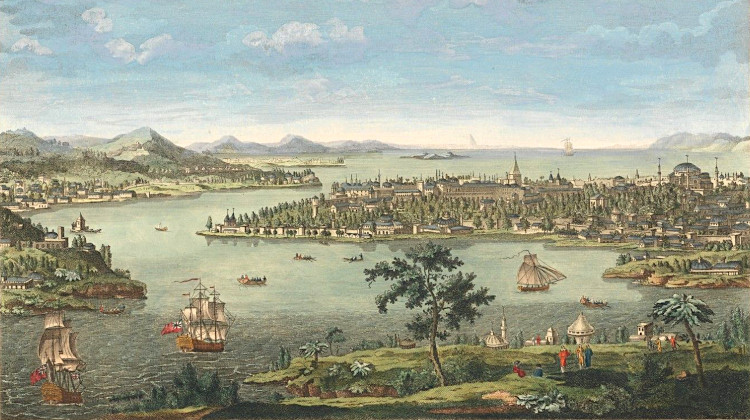
What was the Levant Company?
If you are a regular reader of this blog or are a person who is well-read in the history of the Indian Sub-Continent, you know of the East India Company. In fact, most people you’ll meet are well aware of the East India Company and its half a century of tyranny in South Asia. But almost nobody remembers the East India Company’s older brother – the Levant Company. Like the East India Company, the Levant Company was created to trade in spices, gold, silk and especially currants and coffee. Also like the East India Company, the Levant Company was named after the area where it conducted its business – the Levant. The Levant, as can be seen in the below map, is best defined as the countries that comprise the Eastern Mediterranean. In the following article, we will be looking at the rise of the Levant Company and its early days and understand the war that – very unintentionally – killed this behemoth.

So, who did the Levant Company conduct business with? Formed in 1592 by a Royal Charter given by Queen Elizabeth I, they had one goal (also given to them by the Queen): maintain trade, diplomatic and military relations with the Ottoman Empire.
Their founding, as it turns out, is rooted in 16th Century geo-politics that are not so simple to understand.
The Foundations:

It is the late 16th Century. Britain’s access to foreign markets is in danger. Britain’s number one export, cloth, is not in demand and its access to spices and other exotic goods is being slowly limited. Before the 1580s, the British relied on two great trading powers to help it export and import – the Portuguese and the Venetian Republic.
However, 50 years of constant warfare with the Ottoman Empire for control over the Mediterranean has left the Venetian Republic skint broke and unable to maintain a trade monopoly in the region. In 1580, the much more powerful Spanish absorbed the Portuguese wholly and completely into their Empire. This meant that in the final decades of the 16th Century, British trade was languishing and they had no domestic trading company to boost it back up.
That’s why, again by Royal Charter, in 1581 and 1583 the Turkey Company and the Venice Company were created. In 1592, as a part of Queen Elizabeth I’s diplomatic overtures towards the Ottomans, the two were merged into what was the Levant Company. It really is quite unfortunate the Levant Company has disappeared from the eye of public history because, for the majority of its existence, it was far more successful and famous than the East India Company.
The Early Days – 1585-1604:
In the early days, the Levant Company – its two predecessors as well – faced great danger. The danger was not economic or political. But mortal.
The two predecessor Companies, soon after their establishment, quickly became caught up in the 1585-1604 Anglo-Spanish War. Their bountiful ships became a particularly favourite target of the famous Barbary Pirates – a loose band of very successful North African Muslim pirates that raided merchant ships with the goal of selling the survivors as slaves and keeping all the wealth they took for themselves.
It quickly became apparent that the Levant Company could not afford to maintain unarmed ships and as a result, their convoys of trading vessels soon became armed to the teeth. They ordered larger and sturdier ships, fitted with as many cannons as the hulls could take. Their convoys were ordered to sail in fleets that became too costly for the Barbary Pirates to attack. And, by the end of the war in 1604, the Levant Company had a secure and – relatively – harmless trade route running from the Levant to England.

At this point, I suppose, it must be noted that the Levant Company never had colonial ambitions. In its early days, neither did the East India Company. But unlike India which became subject to dozens of wars between 1615 and 1818 that progressively weakened Indian Empires allowing the EIC to develop colonial ambitions, the Ottomans remained unified and strong. In their dealings with the Levant Company, they managed to dominate in trade and diplomacy, much like the Mughals did up until the death of Emperor Aurungzeb.
At any rate, by 1604, the Levant Company had become immensely successful and had established factories (contrary to the modern definition, a factory of the time was more akin to a trading post or embassy) up and down the Levantine Coast.
1756 – The “First” World War and the Decline of the Levant Company:
For over a century, the Company enjoyed a total monopoly over trade with the Ottomans. They suffered almost no taxes and experienced ever-growing profits. It appeared that nothing could go wrong!
In contrast, its brother, the East India Company, was suffering set-back after set-back in India. The French solidified their control over port cities in modern-day Karnataka (known then as the Carnatic), the Portuguese too maintained a healthy share in the trade with India. Moreover, the diplomatic, economic and military power of the Mughals kept the Company from expanding and – most embarrassingly – the tiny Maratha Navy had forced the East India Company into paying huge taxes at ports up and down India’s Western Coast. The EIC was unable to reverse any of this while under increasing pressure from home to make more money!
But then, in 1756 a war broke out – sometimes called the “first” world war – that changed everything and flipped the Companies upside down. The 7 Years War (1756-1763) had arrived.
By 1757, the two greatest and most direct impediments to Company domination over India were removed. The Battle of Plassey saw the dissolution of Mughal Bengal and the domination of EIC over Bengal – which was then the richest part of India. The Siege of Vijaydurg, conducted by the British alongside the Maratha Army (which hated the influence of the Maratha Navy), saw the destruction of the Maratha Navy’s HQ, the beheading of its chain of command and – subsequently and obviously – the end of its domination in the Arabian Sea.

The East India Company saw more successes! With the outbreak of the 7 Years War, they were now free to attack French holdings in India. The French didn’t really stand a chance and their regional capitals of Pondicherry and Chandernagore (modern Chandannagar) were captured quickly, being released only in 1763 at the end of the war and the signing of the Treaty of Paris. French ports were blockaded and their trade cut off.
In fact, the East India Company profited so much from the Third Carnatic War and the 7 Years War, that when the two wars ended the Company lent the British government money to rebuild from the war.
By contrast, the Levant Company languished. Though the Ottoman Empire was neutral in the war and no fighting reached its shores, it was not spared the effects of the shift in power that followed the War. At the end of the war, for various reasons not important to this article, the Ottomans were not as rich, as powerful or as secure as they were at the start of the 18th Century.
Their condition was worsened by numerous and devastating waves of the Bubonic Plague (aka Black Death) that struck its people throughout the 1750s and 1760s.
At the end of the war, the East India Company’s position, power and wealth was so elevated that investing in the Levant Company was now simply a bad idea. The problem was worsened by the Levant Company’s inflexibility and reliance on a century old bureaucratic system, old-fashioned regulation and – possibly most importantly – the increasing taxes levied by the Ottomans.
By the end of the 18th Century, the Levant Company, which was once the star of the mercantile world, would be a shadow of its former self. By 1825, it would go completely defunct. By contrast, by 1825, the EIC would be ruling over almost the whole of India.
Sources:
M. Epstein, The Early History of the Levant Company (Routledge; 1908)
J. T. Bent, “The English in the Levant”, The English Historical Review, 5:20 (Oct, 1890), pp. 654-664
S. Lusk, “The Strange Death of the Levant Company”, Historia Magazine (June, 2022)
S. Searight, “The Turkey Merchants: Life in the Levant Company”, History Today, 16:6 (1966)
Leave a Reply