
This article has been written for Easy History by Powee Celdran.
Introduction:
The island of Crete, which is the largest of the Greek islands, has a very rich history given its central location in the Mediterranean Sea. Although Crete is best remembered as the land of the Ancient Minoan Civilization which flourished from 2700 BC to 1420 BC, it continued to play an important part in history far after the end of that civilisation. The island later fell under the rule of mainland Greeks, and later other Greek powers including the Ptolemaic Kingdom of Egypt. Following that, under the Roman Empire, Crete was part of the joint province of Crete and Cyrenaica. However, after the the final division of the Roman Empire in 395AD, Crete became part of the Eastern Roman Empire, also known as the “Byzantine Empire”, and would be under Byzantine rule until its conquest in the 820s AD by Muslim Andalusian pirates, who established the Emirate of Crete. During its century of Arab rule, the island gained a prominent place in the Mediterranean world as a haven for pirates. The Byzantines made several attempts to reclaim the island but all failed. It was only from 960-961 where Byzantine forces under the command of General Nikephoros Phokas succeeded in retaking the island. after the siege of the Arabs’ capital of Chandax (today’s Heraklion) which ended with the Byzantines massacring the city’s Muslim population. This was one of the bloodiest massacres in medieval history.
Crete under the Byzantines:

Under Roman rule, Crete was part of the joint province of Crete and Cyrenaica – that is, until the Roman emperor Diocletian (r. 284-305) made Crete its own province. With the change of the Roman administrative system of the provinces, Emperor Constantine I the Great (r. 306-337) put Crete under the Diocese of Moesiae which was under the Praetorian Prefecture of Illyricum. In late antiquity, Crete was a relatively peaceful and prosperous province, although at the same time it was a rather provincial backwater and was barely mentioned by contemporary sources from the 4th to 9th centuries. The only significant events that took place in Crete were the great earthquake of 365 which damaged most of the island and an attack by the Vandals of North Africa in 457. In the 6th century, according to a Byzantine geographic text known as the Synecdemus, Crete was governed by a provincial governor known as a consularis, its capital was the city of Gortyn, it had up to 22 cities, and an overall population of 250,000 who were almost exclusively Christian with a Jewish minority.
Things however changed for Crete in the 7th century with the rise of the Arab and Slavic conquests. First, in 623, the Slavs from Eastern Europe raided the island while in 654 and in the 670s, it was the Arabs who raided as part of the early Muslim conquests. In the early 8th century, the Arabs now as the Umayyad Caliphate under Caliph Al-Walid I (r. 705-715) continued raiding the island in a larger scale. Crete returned to relative peace and prosperity under the rule of Byzantine emperor Leo III the Isaurian (717-741). In around 767 during the reign of Leo III’s son Constantine V (741-775), Crete became a Theme or Byzantine military province as suggested by the presence of a Strategos or military governor in the island.
The Arab Conquest of Crete:

For the Arabs, the island of Crete has never been a priority for conquest due to its distance from the Arab naval bases in the Levant, however this was not to be the case by the 820s. In around 818, a revolt against the rule of Al-Hakam I (r. 796-822), the Emir of Cordoba in Spain was defeated. The survivors of the failed revolt thus escaped Spain with some settling in Morocco and the rest which numbered up to 10,000 turned to piracy and later took the city of Alexandria in Egypt. These Andalusian pirate exiles however were expelled from Alexandria in 827 by the forces of the Abbasid Caliphate. The date of when these Arab pirates arrived in Crete is not clear but according to Muslim sources, it was most likely 827, the same year they were expelled from Alexandria. Byzantine sources however date the Arabs’ arrival in Crete much earlier to 824 following the emperor Michael II’s (r. 820-829) victory over the rebel general Thomas the Slav. Whether it was 824 or 827, the Arabs still settled in Crete and leading them was a certain Abu Hafs who arrived in the island with 40 ships and according to modern day historian Warren Treadgold, Abu Hafs brought with him to Crete 12,000 people in which 3,000 of them were fighting men.
Byzantine sources meanwhile say that the Arab pirates from Andalusia were already familiar with Crete as they had already raided it in the past. Byzantine sources too claim that the attack on Crete in 827 was initially supposed to be a raid but eventually transformed into a conquest when Abu Hafs set fire to his ships – which may have been a modern invention – which meant that he and his people had to stay. It is also important to mention that these Arabs brought their families along as well, lending further credibility to this theory. The island of Crete on the other hand was poorly defended by the Byzantine army and navy as prior to the Arabs’ arrival, the Byzantines were in the middle of a devastating civil war between the emperor Michael II and his rival to the throne, the general Thomas the Slav who led a massive rebellion from 821-823 and even attempted to besiege Constantinople but failed. Although the civil war ended with Thomas executed and Michael II victorious, most of the Byzantine navy had been destroyed because of civil war while it too killed many of the empire’s soldiers. Because of this, the frontiers of the empire which included Crete ended up poorly defended.

As soon as the Arab pirates arrived in Crete, they took over the entire island quickly, eventually making the city of Heraklion – renamed as Rabd al-Handaq in Arabic (Chandax in Greek) – their capital. Michael II, however, responded to this rather quickly by sending expeditions to retake the entire island. The first expedition in 827 led by Photeinos, the Strategos of the Anatolic Theme in Asia Minor and the “Count of the Stable” Damian, however was defeated in battle by the Arabs with Damian killed. Michael II then sent another expedition in 828 to reclaim the island, this time consisting of 70 ships under Krateros, the Strategos of the Cibyrrhaeots Theme (the naval Theme) which was initially victorious until the Byzantine troops were routed in a night attack. Michael II then died in 829 unable to retake Crete from the Arabs whereas Abu Hafs after taking control of the entire island would become the first Emir of Crete ruling until his death in 855. Although Abu Hafs was to be an independent prince or emir, he still recognized the suzerainty of the Abbasid caliph in Baghdad.
Byzantine Attempts to Retake Crete:

As soon as the island of Crete fell under the rule of the Arab pirates, the Arabs slowly began taking control of other Aegean islands such as the Cyclades. Before Michael II’s death in 829 however, another expedition to expel the Arabs from Crete was launched with newly constructed ships placed under the command of Admiral Ooryphas. Although this expedition succeeded in evicting the Arabs from the Aegean islands, it still failed to recapture Crete as the Byzantine fleet was defeated by the Arabs at the Battle of Thasos. Due to this victory, the Arab pirates once again continued their raids on the Aegean islands as well as on the coastal areas of Asia Minor wherein monasteries were their primary target due to the riches they possessed. During the reign of Michael II’s son Emperor Theophilos (829-842), the Arab pirates from Crete attacked the Greek islands of Lesbos and Euboea, however Theophilos still attempted to retake Crete even attempting to form an alliance with the Emir of Cordoba Abd ar-Rahman II (r. 822-852), but this alliance never materialized.
Following Theophilos’ death in 842, the regency that ruled for his young son Michael III (r. 842-867) headed by the late emperor’s wife Empress Theodora and the eunuch minister Theoktistos established the naval Theme of the Aegean in 843 to deal with the pirate raids from Crete. In 843 as well, Theoktistos led an expedition to recapture Crete and almost succeeded by confining the Arabs to their capital Chandax. However, Theoktistos abandoned the campaign when hearing rumors from Constantinople that he was to be overthrown, these rumors though were false while the Byzantine forces left behind in Crete were slaughtered by the Arabs after Theoktistos left. Theoktistos in 853 once again tried to reclaim Crete, this time by attacking other Arab naval bases that would assist the Emirate of Crete. Here, Theoktistos led a fleet that attacked the Arab held port of Damietta in Egypt to weaken naval assistance for Crete, however Crete itself was spared from Byzantine attacks. The Cretan Arabs thus resumed their raids into the Byzantine held Peloponnese, Cyclades, and even Mt. Athos in the 860s. In 866, the Caesar Bardas- brother of the Empress Theodora and uncle of Michael III- who had taken over the empire’s administration planned another large-scale naval expedition to reclaim Crete. However, the emperor Michael III now falling under the influence of a new favorite, the courtier Basil the Macedonian was convinced that his uncle Bardas was plotting against him. Michael III then ordered Bardas’ death which was carried out by Basil, and thus with Bardas’ death, the expedition to reclaim Crete was cancelled.
With the Byzantine expedition to recapture Crete in 866 cancelled, the Cretan Arabs once again continued their raids into Byzantine territory, this time reaching new heights. In one instance, the Arab fleet went as far as raiding Byzantine Dalmatia while in 873 during the reign of Basil I the Macedonian (r. 867-886), the Arab fleet this time led by the Byzantine renegade Photios even penetrated into the Sea of Marmara with the intention to attack Constantinople itself. This Arab fleet however was defeated by the Byzantine admiral Niketas Ooryphas at the Battle of Kardia and again at the Gulf of Corinth wherein many Arab prisoners were taken and brutally tortured by Ooryphas in revenge for their raids. In the latter part of the 9th century, due to the defeats the Cretan Arabs suffered to the Byzantines, their threat in the Aegean was seemingly over and thus a truce was made between Byzantium under Basil I and the Emirate of Crete under Emir Shu’ayb ibn Umar (r. 855-880).

At the beginning of the 10th century however, the Arabs of Crete once again resumed their raids into Byzantine territory, this time assisted by the other Arab pirate emirates such as that of Leo of Tripoli who sacked Thessaloniki, the Byzantine Empire’s second city in 904. By this time, the Emirate of Crete’s control reached as far as the islands of Kythera, Aegina, and Naxos while even Athens was briefly occupied by them from 896-902. The people conquered by the Arab pirates too were now forced to pay the jizya tax which were paid by non-Muslim subjects to Muslim rulers. In response to the return of the pirate raids from Crete, Byzantine emperor Leo VI the Wise (r. 886-912) in 911 organized an expedition with 177 ships to recapture Crete led by Admiral Himerios. Although this expedition was initially a success, it was still forced out of Crete by the Arabs while the Byzantine fleet was later destroyed off the coast of Chios by the Arab pirates of Leo of Tripoli.

As the 10th century progressed, the Arab pirates of Crete continued their raids into Byzantine Greece, again reaching new heights. The Byzantines on the other hand could not entirely focus on the Cretan threat at this time due to their wars against Bulgaria in the north and the Arabs in the east. It was only in 949 when the Byzantines again turned to the Cretan threat when Leo VI’s son Emperor Constantine VII (r. 913-959) organized another expedition. Leading this expedition was the eunuch court official Constantine Gongyles which consisted of 128 ships and again it was initially a success landing in Crete but Gongyles’ incompetence according to Byzantine sources led to the Byzantines’ total defeat as the Byzantine forces were surrounded by the Arabs in a night attack. Constantine VII however did not give up on his intentions to reclaim Crete and thus in the last years of his reign, he once again planned another expedition which however never materialized due to his death in 959. This new expedition to reclaim Crete though would be carried out by Constantine VII’s son the new emperor Romanos II (r. 959-963).
The Reconquest of Crete:

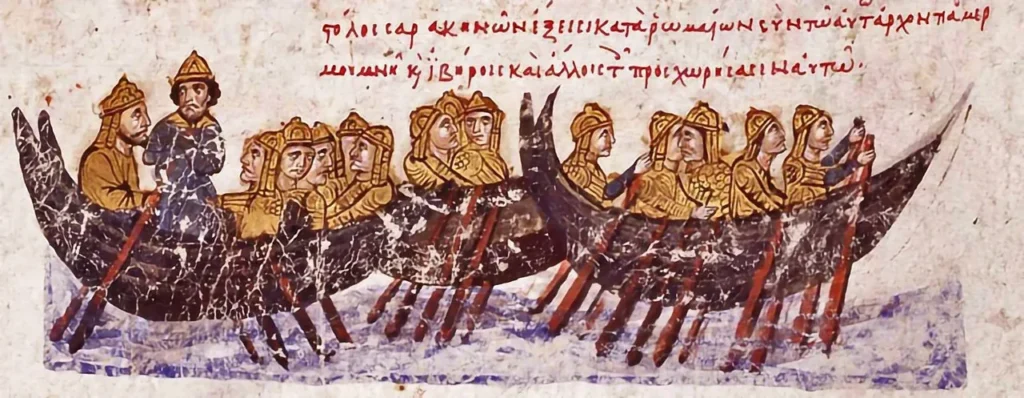
The new Byzantine emperor Romanos II although inheriting a strong and stable empire at his father’s death in 959 was more interested in partying, hunting, and playing polo than in the affairs of state. In this case, he left the management of the empire to his top minister the eunuch Joseph Bringas. Both Romanos II and Bringas too continued the late Constantine VII’s project of the Reconquest of Crete and placed in command of the expedition was the powerful and capable general Nikephoros Phokas who already had a great amount of experience against the Arabs in Byzantium’s eastern frontier. The expedition assembled near Ephesus in Asia Minor in 960 and although it is not clear how many troops and ships were deployed, it was the largest recorded Byzantine expedition to recapture Crete in terms of troops and ships. There were possibly 50,000 troops in the expedition with a contingent of Scandinavian and Russian (Varangian) warriors included and around 700 ships; according to 10th century Byzantine historian Leo the Deacon, the fleet included many dromons (warships) equipped with Greek Fire, the Byzantines’ secret super-weapon.
The Byzantine fleet transporting the troops arrived in Crete in July of 960 wherein the ships included the innovation of ramps which allowed the Byzantine troops to disembark on the island without difficulty. As soon as the Byzantine army landed on the island, according to Leo the Deacon, they quickly annihilated the Arabs in the beach thanks to Nikephoros Phokas’ strategy of dividing the army- mostly consisting of the elite cataphract cavalry- into 3 sections. The surviving Arabs then fled to the fortress of Chandax which Phokas later put under siege blockading it both by land and sea. While Chandax was under blockade, Phokas ordered his subordinate general Nikephoros Pastilas with a small detachment to raid the Cretan countryside to scout the situation and gather supplies. Pastilas and his men seeing no threat roamed the countryside carelessly while also indulging on food and wine which thus allowed them to be ambushed by the Arabs who hid in the hills. In this skirmish, majority of the Byzantine detachment was slain including Pastilas while only a few made it back to the main army under Phokas.
Nikephoros Phokas meanwhile inspected the walls of Chandax finding out that they were too strong, thus he ordered his men to begin constructing a circumvallation around the city from coast to coast. After taking a few Arab prisoners, Phokas learned of a relief force coming from the nearby hills that were planning to attack the Byzantine encampment. To catch the relief force by surprise, Phokas ordered his men to attack them at night while they were sleeping. With the Arab relief force annihilated, Phokas ordered the heads of the slain Arab soldiers decapitated and in an act of psychological warfare, Phokas had some of the heads impaled in view of the city wall and some heads catapulted into the city in order to strike fear into the inhabitants considering that some of those decapitated heads belonged to relatives and friends of those in the city. Chandax though continued to hold out against the Byzantines’ attacks for the next few months despite Phokas employing different tactics against the walls. The Byzantines though temporarily lifted their siege when winter came, though Chandax still remained under blockade.
During the winter of 960-961, the Emir of Crete Abd al-Aziz ibn Shu’ayb (r. 949-961)- known in Byzantine sources as Kouroupas- who was besieged within Chandax wrote to several rulers of the Islamic world asking for military assistance. These rulers Abd al-Aziz wrote to include the Ikhshidid ruler of Egypt, the Fatimid caliph in North Africa, and even the Abbasid caliph in Baghdad. None of these Islamic rulers though responded to Abd al-Aziz’s pleas. Finally, Abd al-Aziz even wrote to the Byzantine emperor Romanos II demanding that he pull his forces out of Crete, however the emperor too did not reply. Instead of pulling his forces out of Crete, the emperor sent a relief fleet in early 961 to resupply the Byzantine troops, both with weapons and food, thus allowing the Byzantines to continue their siege with more energy.

By March of 961, Nikephoros Phokas resumed the siege, this time using much more effective siege machines against Chandax, though the Byzantines were still unable to gain a foothold in the city. Phokas then employed the use of a battering ram on the walls, but this too was not successful as it was targeted by the Arab archers. At the same time though, Phokas employed another tactic, which was to have his men dig beneath the city’s walls and plant explosive and flammable materials underneath it for the walls to collapse. The latter tactic proved effective and thus when one section of Chandax’s wall collapsed on either March 6 or 7 of 961, Byzantine troops poured into Chandax. Arab forces within the city continued to resist, but at the end it was too late as they were all slaughtered by the Byzantines in their frenzy. With no more resistance left, the Byzantine troops pillaged the city for 3 days wherein they mindlessly and indiscriminately massacred the city’s population: men, women, children, and the elderly were all put to the sword. According to Leo the Deacon, Phokas tried to stop his men from these violent acts but failed to do so.
The Aftermath:

Following the Byzantines’ successful Siege of Chandax, the city then fell back under Byzantine hands, and so did the entire island of Crete afterwards. Nikephoros Phokas then ordered the walls of Chandax torn down as well as all the mosques in the island to erase any traces of the island’s Islamic rule. With the Byzantine Reconquest of Crete completed, Byzantine imperial authorities made an intensive effort to re-Christianize Crete’s population which were led by the monks John Xenos and Nikon the Metanoeite. Crete was thus reorganized once again into a Byzantine “Theme” with its own Strategos. Abd al-Aziz meanwhile as the last Emir of Crete was captured and brought to Constantinople wherein he together with his family were paraded in Phokas’ triumphal procession. Romanos II though allowed Abd al-Aziz to be spared and even given rich presents and an estate in Asia Minor to retire to and although Abd al-Aziz did not convert to Christianity, his son Al-Nu’man- known in Greek as Anemas- did and later became a general in the Byzantine army. Nikephoros Phokas immediately returned to campaigning against the Arabs in the east and just 2 years later, following Romanos II’s death, he succeeded him as Emperor Nikephoros II (r. 963-969).

With the entire island of Crete back under Byzantine hands, the Emirate of Crete which had existed for 134 years ceased to exist. With Emirate of Crete gone, Arab piracy was no longer a problem in the Byzantine Aegean and thus trade operations once again continued to resume there without difficulty. Back under Byzantine rule, Crete remained a relatively peaceful and prosperous province despite one instance of a failed revolt by its governor Karykes from 1092-1093 against the Byzantine emperor Alexios I Komnenos (r. 1081-1118). In the 12th century, Crete was placed under the overall control of the Megas Doux or the commander-in-chief of the Byzantine navy. Crete would then remain under Byzantine hands until 1204 when it fell under the Republic of Venice as a result of the Sack of Constantinople by the 4th Crusade, and as a Venetian colony, Crete became known as the “Kingdom of Candia”. Although Crete was under Venetian rule in the late Middle Ages, Byzantine Greek culture continued to flourish and part of this included the “Cretan School” of icon painting.
Sources:
- Car J. (2015), The Fighting Emperors of Byzantium
- Romane J. (2015), Byzantium Triumphant: The Military History of the Byzantines (959-1025)
- Kaldellis A. (2017), Streams of Gold, Rivers of Blood: The Rise and Fall of Byzantium
- Lygo K. (2022), The Emperors of Byzantium
Leave a Reply