
Introduction
Born in 1638, a 4 year old Louis XIV would ascend to the throne of France in 1643. Although he would not personally rule France until 1661, his reign was littered with wars of expansion, conquest and pacification. He oversaw the expansion and tightening of monarchical powers over all the institutions of France and turned the Kingdom into an absolute monarchy. But to understand why he did what he did and how his people both loved and hated him, one must understand how his reign began.
The Early Years
Louis XIII (d. 1643) had plunged France into the 30 Year’s War on the side of the Dutch and Swedes against the Habsburg Dynasty of Spain. And so when Louis XIV took the throne, his Kingdom was at war. He was too young to rule, of course. His regent, Queen Anne (his mother) with the help of her Chief Minister (Cardinal Mazarin) negotiated a peace with Spain and secured their objectives in the 30 Year’s War in 1648.
But that was not the end to the turmoil which shaped Louis XIV. Queen Anne and Cardinal Mazarin had one objective – that by the time Louis XIV was in the majority (i.e old enough to rule), he would have absolute power over the institutions of France. This was not a simple power grab. The 16th Century and much of the 17th Century had been categorised by an over-powerful French aristocracy and Catholic Church that led to constant political and religious civil wars. This “Absolutism” that Queen Anne subscribed to was – in their minds – the best path to ending this cycle of violence.

In their effort to establish this level of royal authority, they angered everyone – the aristocrats, the lawyers and judges and the common people of France. In a civil war (1648-1653) called “the Fronde”, all social classes of France pushed back against this perceived royal overreach. But it was to no avail. By 1653, the rebellion was crushed.
He was brought up believing that he deferred to no one. That he had been chosen by God to rule the people of France. And when he took personal control of the Government of France in 1661 (following the death of his mother and the end of her regency), he made a very public showing of this belief. He announced that he would rule France alone, without a Chief Minister. He cut down the number of ministers and advisors from whom he took counsel. He truly believed that his absolute rule, the absolute rule of the monarchy, was the best and only path to lasting order and peace.
How He Ruled
In 1661, Louis XIV began to write his Mémoires – a manifesto which removes any doubt regarding his views on the authority of the monarchy.
“It must assuredly be agreed that as bad as a Prince [i.e Monarch] may be, the revolt of his subjects is always infinitely criminal. He [God] who has given Kings to Men has wanted them to be respected as His Lieutenants, reserving to Himself alone the right to examine their conduct. His will is that whoever is born subject must obey without qualification … this law is … beneficial to the very people on whom it is imposed”.
Mémoires
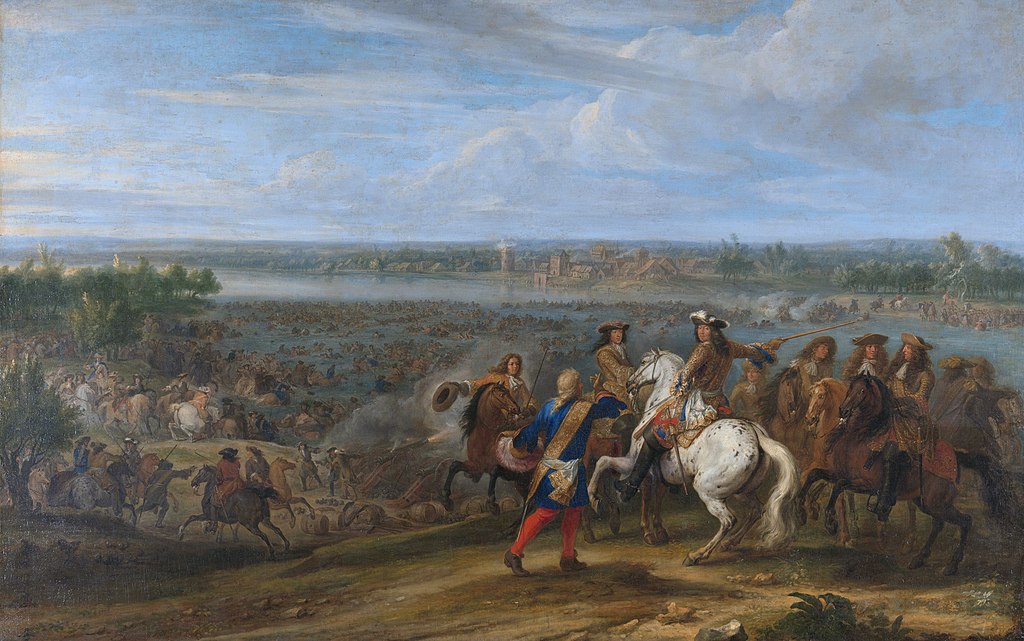
Joseph Klatz, a historian of Louis XIV’s propaganda had this to say about Louis XIV’s reign: “The man who wore the crown had to play the part of a demigod, and Louis XIV fulfilled the role brilliantly.” The cult of Louis XIV, staffed by skilled painters, writers and propagandists, turned Louis XIV from just another King, into the Most Christian King and the Sun King – the August Protector of the Citizens of France. It was a propaganda campaign conducted with genius which disarmed all opposition to the reign of Louis XIV. And for the first half of his reign, it worked perfectly.
But that was not to continue. For you see, Louis XIV viewed everything that a monarch could and should do the same way – a way to grow the image and glory of the monarch within the eyes of their subjects. This included war.
By the 1680s, Louis XIV had almost total authority over everything in France. And under him, French society, wealth and military was unmatched by anybody in Europe. However, it was all propped up on a house of cards – an inefficient financial and banking system that was hard-pressed to pay for the grandeur of Louis XIV’s reign. Despite this glaring weakness, in his reign, France would engage in 3 major (Franco-Dutch War, 9 Year’s War and War of the Spanish Succession) and 2 minor wars.
Though France emerged largely victorious in the wars, successfully conquering new territory and reconquering old territory that was lost, the weak financial system could not keep up with the expenses incurred in the business of warfare. Despite the fact that the wars never reached the French civilians in ways that previous wars had, civic and military morale crashed as money disappeared from the treasury. As the Controller-General of Finances worked hard to rectify the situation, Louis XIV and his propagandists launched another campaign to boost not only morale, but the glory of Louis XIV.
His Death

In the end, when Louis XIV died, he had been a king whose reign was marked by actions that divided. His rule, his absolute rule, had brought an end to the endless sectarian violence that had consumed France in the previous century but had simultaneously ruined the authorities and privileges of every institution apart from the monarchy. He had conducted several successful wars and conquered large swathes of territory but the financial system had almost collapsed and the people left to bear the burden.
But more than anything, the Sun King had been a performer – he always projected an image of an infallible demigod doing only what was best for his people and kingdom. Even in his final days – though he was suffering from diabetes, dental abscesses, boils, gouts, headaches and worsening gangrene (which is what ultimately killed him) – all his public appearances were of a man untouched by ailment and illness. A healthy and virile King.
In the end however, Louis XIV failed to forge a bond with his subjects. This was exemplified during his funeral – the French celebrated and mourned his death in equal measure. Many of his contemporaries sung and danced in the streets of Paris as the funeral procession passed. Many who came later (such as Napoleon) idolised him and his centralisation of the state.
The lack of communication and the increasing separation between the rulers and ruled that characterised Louis XIV’s rule would continue to plague the French Monarchy, until finally it culminated in the French Revolution of 1789. Though Louis XIV cannot directly be blamed for the war that would follow 80 years after his death, the reaction of the people to his passing was certainly symptomatic of what was to come.
Sources
Burgess, Glenn, “The Divine Right of Kings Reconsidered”, The English Historical Review, 107:425 (October, 1992), pp. 837-861
Fox, Paul, “Louis XIV and the theories of Absolutism and Divine Right”, Canadian Journal of Economics and Political Science, 26:1 (February, 1960), pp. 128-142
Mansfield, Andrew, Ideas of monarchical reform: Fénelon, Jacobitism, and the political works of the Chevalier Ramsay (Manchester University Press; Manchester, 2015)
Taylor, Philip, Munitions of the mind: A history of propaganda (Manchester University Press; Manchester, 2003)
Leave a Reply