
Introduction:
To get a sense of the political and military events that led to the November offensive, please read “To Break a State in Two“.
In November of 1971, India and Pakistan were preparing for war in East Pakistan. From the start, the Indian Army had most advantages – it had superior numbers, the IAF had air superiority, the Indian Navy’s blockade of East Pakistan was unopposed and the Mukti Bahini was wreaking havoc behind Pakistani lines. But Pakistan had one crucial advantage – the time to prepare an effective defence.
In the face of these defences, Lt. Gen. Jagjit Singh Aurora, the General Officer Commanding-in-Chief of the Indian Army’s Eastern Command and General Sam Manekshaw, the Indian Army’s Chief of Staff, realised that there was a crying need to ready the way for the Indian Army’s upcoming offensives by softening and capturing these defences. And so, two attacks were ordered – one on the village of Bogra, just South-East of the village of Hilli, and the second on the village of Garibpur.
Indian Army, Order of Battle, Battle of Garibpur:
Garibpur, a small village, straddled the highway from India to Jessore – a vital city in East Pakistan. To ensure the smooth sailing of the Indian Army’s armoured columns to Jessore, this village needed to be taken. The Order of Battle was thus:
- 14th Battalion, Punjab Regiment
- “C” Squadron, 45 Cavalry – PT-76 Light Tanks

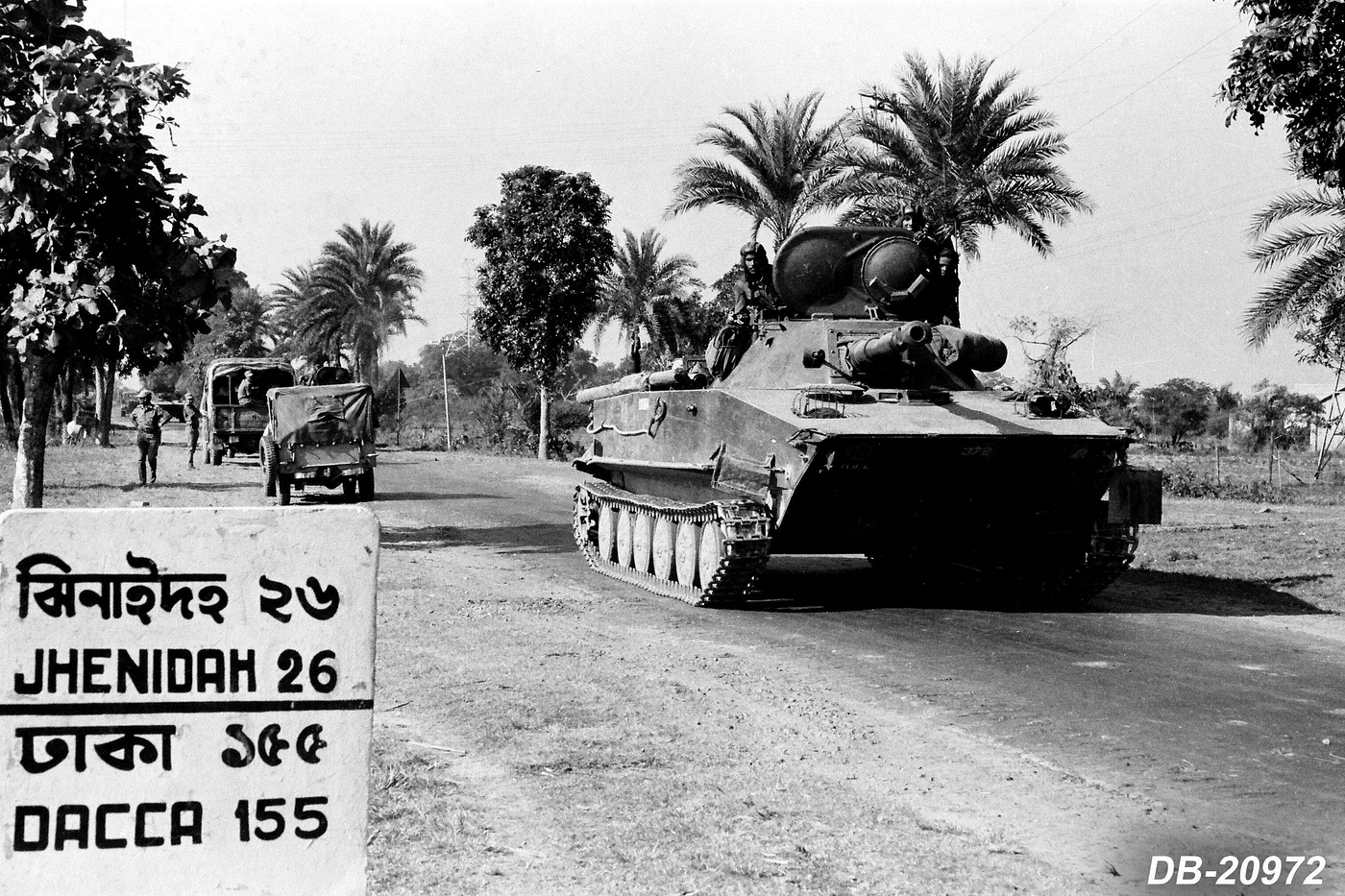
The PT-76 was a Soviet made amphibious light tank. It was perfect for the boggy marshlands that made up the terrain of Bangladesh.
Pictured here are PT-76s of “C” Squadron, 45 Cav with soldiers of 14 Punjab riding them crossing into Bangladesh in the early days of November, 1971, during the prelude to their attack on Garibpur.
Pakistan Army, Order of Battle, Battle of Garibpur:
Pakistani forces, unlike at Hilli, had failed to anticipate an attack on Garibpur. They had instead fortified a village north of Garibpur, Chaugacha. Their Order of Battle was thus:
107th Infantry Brigade:
- 6th Battalion, Punjab Regiment
- 21st Battalion, Punjab Regiment
- 22nd Battalion, Frontier Force
- 3rd (Independent) Armoured Squadron – M24 Chaffee Light Tanks
The Battle of Garibpur:
Despite the Indian attack on Garibpur starting on the 20th, the battle would only start on the 21st. This was because of the lack of Pakistani defences at Garibpur. In fact, 14 Punjab and 45 Cavalry had captured the village by the 20th of November. This was lightning fast – the deadline given for Garibpur’s capture was the 21st!
But such luck was not to last.
In the night of the 20th, Risaldar R. P. Sing of “C” Squadron, 45 Cavalry, along with a section of dismounted infantry from 14 Punjab, was on forward patrol north of the Indian positions at Garibpur. Around 0200hrs, he radioed Captain Mehta (2IC of “C” Squadron) that Pakistani infantry and armour were advancing to the Indian positions from Chaugacha. After confirming the number of tanks and infantry advancing and the axis of their advance, Major Daljit “Chiefi” Singh Narang left behind 14 Punjab in a defensive position with some 106mm Recoilless Rifles and ordered his squadron (14 tanks) of PT-76 light tanks into a horseshoe formation to ambush the Pakistani armoured column.
The night passed into day but the Pakistani forces did not attack.

during the battle
When the Pakistani forces did attack on the morning of the 21st, they had the advantage of numbers. The 3rd (Independent) Armoured Squadron was supported by 6 and 21 Punjab. The Pakistanis also fielded American made M24 Chaffee light tanks. However, in waiting for the night to pass, they had made a fatal error.
“C” Squadron and 14 Punjab, with the knowledge of the Pakistanis’ exact axis of advance had had time to prepare their defences and lay ambushes. Furthermore, as the night melted away, it gave way to a dense fog. And so the Pakistanis charged, blinded by fog, into well prepared Indian defences.
Despite Major Narang being killed early in the fighting, “C” Squadron would emerge victorious. The PT-76s quickly proved themselves to be far superior to the American made M24 Chaffees, with Indian tank crews outmanoeuvring and destroying Pakistani tanks one after the other.
With the Pakistani infantry having lost their armoured support and with Indian tanks turning their fire on the advancing Pakistani infantry, the attack quickly broke and they withdrew to their positions in Chaugacha. The 102nd Infantry Brigade, cut off from supplies by the Indian positions in Garibpur, launched no further attacks.
Conclusions:
The Battle of Garibpur was everything that the Battle of Hilli was not. It was fast paced and called more heavily on manoeuvre elements. The Indians also had the advantage of time in the preparation of their defence and knew exactly when and where to wait for the Pakistani forces. In the end, Garibpur would allow the Indian Army’s armoured columns to bypass the stronghold of Chaugacha and drive straight into the heart of East Pakistan.
Casualties:
Indian casualties were fairly light, whereas Pakistan suffered greatly.
“C” Squadron lost 2 tanks, one belonging to Major Narang and the other to Captain Mehta (though Captain Mehta and his crew were able to escape the tank unharmed and joined the fighting in the trenches). By comparison, the Pakistani 3rd (Independent) Armoured Squadron lost 13 of its 14 tanks, 6 of which were completely destroyed, 4 damaged and abandoned and 3 captured along with their crew.

14 Punjab suffered 28 killed and 42 wounded. Pakistani infantry casualties are unknown, however Col. Gidh estimates them to be around 300 killed and wounded.
Sources:
Brig B. S. Mehta, Burning Chaffees: A Soldier’s First-Hand Account of the 1971 War (Penguin; 2021)
Col. V. Y. Gidh, “The Unique Battle of Garibpur”, in The United Service Institution of India (October 2021), accessed at: https://usiofindia.org/publication/usi-journal/the-unique-battle-of-garibpur/
Col. V. Y. Gidh, “The Battle of Garibpur”, in Journal of Defence Studies, 15:24 (October; 2021), pp. 107-129

Leave a Reply