
Introduction:
To get a sense of the political and military events that led to the November offensive, please read “To Break a State in Two“.
In November of 1971, India and Pakistan were preparing for war in East Pakistan. From the start, the Indian Army had most advantages – it had superior numbers, the IAF had air superiority, the Indian Navy’s blockade of East Pakistan was unopposed and the Mukti Bahini was wreaking havoc behind Pakistani lines. But Pakistan had one crucial advantage – the time to prepare an effective defence.
In the face of these defences, Lt. Gen. Jagjit Singh Aurora, the General Officer Commanding-in-Chief of the Indian Army’s Eastern Command and General Sam Manekshaw, the Indian Army’s Chief of Staff, realised that there was a crying need to ready the way for the Indian Army’s upcoming offensives by softening and capturing these defences. And so, two attacks were ordered – one on the village of Bogra, just South-East of the village of Hilli, and the second on the village of Garibpur.
Indian Army, Order of Battle, First Battle of Hilli:
The Indian Army had given the job of capturing Bogra to the 202nd Mountain Brigade, under the 20th Mountain Division. The 202nd‘s Order of Battle was thus:
202nd Mountain Brigade
- 5th Battalion, Garwhal Rifles
- 8th Battalion, Guards
- 22nd Battalion, Maratha Light Infantry
- 37th Mountain Regiment (artillery)
- 38th Medium Regiment (artillery, understrength)
- 100th Mountain Regiment (artillery)
- 1 Squadron of T-55s detached from 63 Cavalry

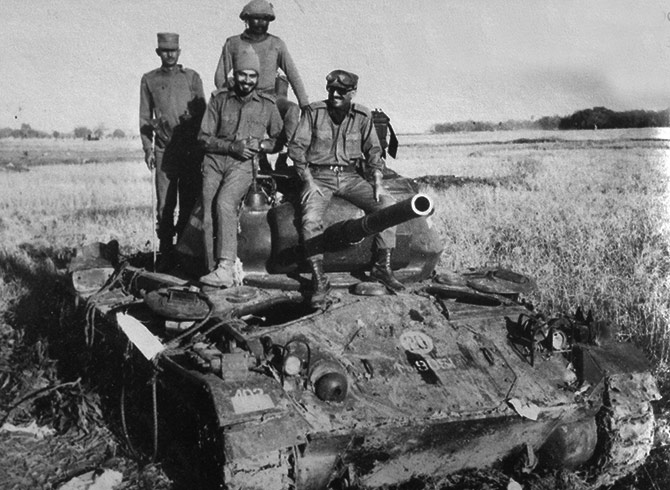
The T-54/55 was a series of Soviet Main Battle Tanks that were used extensively by the Indian Army.
Pictured here is a T-55 providing cover for Sappers (military engineers), during the Indian offensive into Bangladesh.
Despite the myth of Soviet weapons being generally inferior to NATO weaponry, the T-55s of the Indian Army proved far superior to the American made M48 Pattons of the Pakistan Army.
Pakistan Army, Order of Battle, First Battle of Hilli:
Defending Bogra was the Pakistan Army’s 205th Infantry Brigade. The 205th’s parent unit, the 16th Infantry Division, would be unable to reinforce the 205th. The 205th’s Order of Battle was thus:
205th Infantry Brigade:
- 3rd Battalion, Baluch Regiment
- 4th Battalion, Frontier Force – AKA 4FF, directly responsible for the defence of Hilli
- 32nd Battalion, Baluch Regiment
- 1 M24 Chaffee Squadron
- 1 artillery regiment

The M24 Chaffee was an American-made light tank. It first saw service in 1944 in World War 2, with the Western Allies. Intended to replace the out-gunned American M3 and M5 Stuart series of light tanks, it was a fantastic tank – for World War 2.
By 1971, the M24 Chaffee was dccades out of date and had received no meaningul upgrade. Pictured here is a Pakistani M24 Chaffee that has been captured by Indian troops during the Indian offensive into Bangladesh.
The Indian Plan of Attack:
To seize the town of Bogra, it was deemed necessary to seize the fortified village of Hilli, through which passed the road to Bogra. It was an important job and it was given to 8 Guards. North of Hilli, there was a small hamlet – Morapara. The capture of Morapara was vital for the capture of Hilli.
With H-Hour set for 0000hrs on the night of the 22nd and 23rd, the 202nd Mountain Brigade’s artillery began a barrage on the Pakistani defences at Hilli a full 12 hours earlier. 8 Guards split its companies and began its attack on midnight, as the artillery fire died away. “A” and “D” Companies of 8 Guards attacked Morapara from the West while “B” and “C” attacked the hamlet from the North. The Pakistani defence would prove to be murderous in its response.
The Pakistani Defences:
The Pakistani defences, consisting of well-dug trenches, bunkers, railway cars repurposed into firing positions, mines, booby-traps and barbed wire were set up for all-round defence of Hilli and covered all of the approaches to the village. Wet and soggy paddy fields, marshes and mud surrounded Hilli on all sides except Morapara, where they were patchy at best. Consequently, Morapara was the most well-defended angle of the entire complex and simultaneously the only one from which to attack. The Pakistani 4th Frontier Force (4FF), responsible for the defence of Hilli, had turned Morapara into a stronghold.
8 Guard Attacks:
22nd-23rd of November:
By 0100 hours, “B” and “C” Companies had secured two hamlets north of Morapara and “C” Company and began providing covering fire for “A” and “B” Company, which began the attack on the defenses at Morapara, with “D” Company being held in reserve.
There is a saying in military circles; officers don’t duck.
This proved to be very true in the First Battle of Hilli. The Company Commander (Coy. Cdr.) of “A” Company, Major Hemant Manjrekar, was killed almost instantly by machine-gun fire. In fact, “A” Company would – by the 23rd of November – lose all its officers, with all of them being found metres from the barbed wire or machine gun nests or trenches, having been killed in their attempt to get their men moving. The Coy. Cdr. of “B” Company, Major R. Nath, suffered the same fate and was killed very early on in the attack by MG fire. The two companies, having now lost the majority of their officers, would be led by Captain S.K. Bansal, Subedar Raj Bahadur Singh and Naib Subedar Mohammed Nayeem.
By now, it had become clear that unless reinforcements were sent – or the Pakistanis distracted – the attack would fail. As it stood, “A” and “B” Companies, despite the lack of officers, had captured portions of Morapara in the West. But they desperately needed reinforcements.
To this end, Brigadier Bhatti (the Commanding Officer of the 202nd) ordered 5 Garwhal to attack Basudeopur, a fortified hamlet adjacent to Morapara that was also firing on 8 Guards. Basudeopur fell fairly quickly to 5 Garwhal’s assault and opened the way for “D” Company of 8 Guards to reinforce the beleaguered “A” and “B” Companies.
“D” Company’s Coy. Cdr., leading by example, destroyed a machine-gun bunker – though he was struck by its fire and wounded. He repeatedly refused evacuation and continued to fight and inspire his men, until finally, he collapsed – dead. For this, he was posthumously awarded the Sena Medal. “D” Company would now be commanded by Captain V. Sharma – and he had a hard fight ahead.
Throughout the night, 4FF launched multiple counterattacks on 8 Guards – all of which were repelled. However, the situation was perilous. The 4 T-55s of 63 Cavalry had never arrived and the firepower required to break through the Pakistani defences was simply absent. The T-55s, unsuitable to the boggy terrain of Bangladesh, had gotten stuck in the mud over a kilometre away and were of no help.
And so, 8 Guards endured the night. By midday on the 23rd, Brigadier P. T. Ghogale (a veteran of the battle) recalls:
“… the situation was uncertain with “D” Company running out of ammunition and the enemy carrying out intense shelling. … Although there was a partial hold on Morapara, [elements] had to withdraw under intense fire and shelling… Throughout [the 23rd] a stalemate continued, characteristic of an infantry battle … The situation could have gone either way. … All attempts to breakthrough from the North and West failed.”
Brig. P. T. Ghogale
24th of November:
On the night of the 24th, there was salvation.
The remainder of “C” Company, previously unable to reinforce, reached the rest of the battalion and bolstered the perimeter.
2nd Lt. K. S. R. Jain of “C” Company was successful in leading a column of infantry silently through the Pakistani lines and securing a foothold in the east of Morapara, with the rest of “C” Company then immediately attacked and captured.
Through the night, 4 PT-76 light tanks – unbothered by the mud and sludge that had bogged down the T-55s – reached 8 Guard’s position. Then, in the morning, the reinforced 8 Guards, supported by tank and artillery fire, attacked 4FF’s lines in Morapara. By 1000hrs, Morapara had fallen and with it had ended the First Battle of Hilli.
Conclusions:
Despite 8 Guard’s success in capturing Morapara, the First Battle of Hilli was a stalemate – it can also perhaps be called an Indian defeat. The actual objective, Hilli, remained in Pakistani hands. In fact, Hilli would not be captured until the Second Battle of Hilli on the 10th-11th of December. This battle, and the immense rate of casualties the Indian forces incurred, assured the Indian Army that attacking Pakistani strong-points head-on was not a good idea and influenced the plan of the upcoming offensive. An offensive which focused on outmanoeuvring, surrounding and destroying Pakistani strongpoints.
Casualties:
The casualties were – for both sides – immense but, due to the nature of the battle, Indian forces suffered far more than Pakistani forces. India suffered 66 Killed in Action and 130 Wounded in Action, whereas Pakistan suffered a total of 80 Killed and Wounded.
As Brigadier P. T. Ghogale said simply: “The Battle of Hilli is the most … savagely fought battle of the Indo-Pak Conflict.”
Sources:
Brig. P. T. Ghogale, “The Battle of Hilli”, in Maj. Gen. Ian Cardozo, In Quest of Freedom: The War of 1971, Personal Accounts by Soldiers from India and Bangladesh (Centre for Land Warfare Studies; 2016), pp. 79-88
Chiber, Anuraag, “Tactical Lessons from the Battle of Hilli”, Scholar Warrior (2016), pp. 110-116
History Division, MoD, GOI, Official History of the 1971 India-Pakistan War – Chapter 12: All Out War in Bangladesh
Leave a Reply