
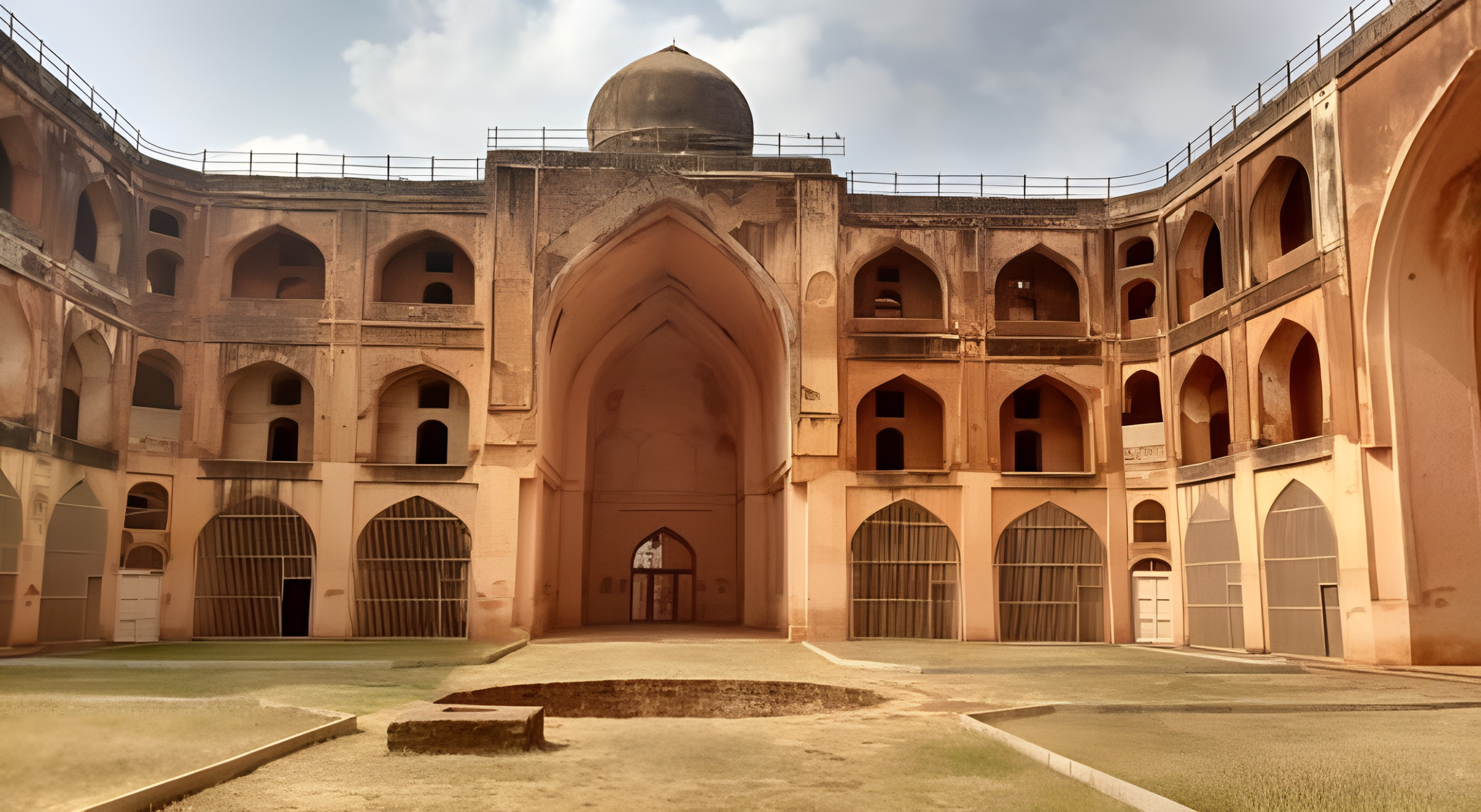
This article has been written for Easy History by Natalie Mallat. Natalie’s own work can be found at: https://bibliotecanatalie.com/
A Short Introduction:
Shortly after the death of Prophet Muhammad in 636 AD, the Arab Governor of Bahrain sent unsuccessful naval expeditions against Thana and Broach. In 712 AD, the Syrian Umayyads who had previously enjoyed significant military victories began their conquest of the Sindh. The 9th-century historian, Ahmad ibn Yahya Al Baladhuri, wrote that they went through Makran in Baluchistan in the South. This road into India was also confirmed later by the Fathnama-i Sindh also known as Chachnama by Ali bin Hamid bin Abu Bakr Al Kufi. However, the 10th-century polymath Al Biruni gave a different account where he mentioned that the Umayyad Military Commander, Muhammad ibn al Qasim al Thaqafi, son of the Governor of Basra, who was about 16 years old at that time, entered Sindh from the side of Sijistan in the North and then conquered the cities of Bahmanwa and Mulasthana, the former of which he called Al Mansura, the latter al Ma’mura.
The Umayyads had success against the Saurashtra port and the town of Barada or Balaba, identified with modern-day Vala or Valabhi. This marked the beginning of the Arab commercial dominance in Medieval India. In the same year, Arab navigators travelled up the Indus Delta and reached close to modern-day Karachi. They founded a port in present-day Bambhore and in 727 built the oldest mosque in the Indian subcontinent. The square plan of the mosque was identical to the Arab mosques of the period. It included a prayer hall with three aisles parallel to the qibla porch. Sources tell of fabulous cities founded in Medieval India by the Arabs, such as Al Mansura, the first splendid Arab metropolis in India. It was a great circular city that flourished in trade and knowledge and was even compared to Dar al Salam Baghdad, the seat of the Abbasid Caliphate.
Al Mansura, also known as Brahminabad, was established by the Umayyad governor Amr al Thaqafi, son of the Conquerer of Sindh, between 728 and 737 AD. Al Mansudi noted that the city was founded in the Umayyad period by Mansur ibn Jamhur al Kalbi. Al Baladhuri tells that this was during the reign of Caliph Hisham ibn Abdelmalek during the Governance of Hakam ibn Awanah al Kalbi. This is supported by Yaqubi, Ibn Khaldoun and Ibn al Athir. Based on Al Baladhuri, Hakam founded a city called Al Mahfuza (the protected) while Al Mansura was founded by Amr al Thaqafi. There is a view, supported by Al Idrisi and Ibn al Wardi, that the city’s name was derived from Abbasid Caliph Abu Jafar Al Mansur who founded Baghdad in Iraq. It was then named Al Mansuriya thani, meaning the Second Al Mansura.
However, Al Biruni and Abu al Fadl supported that the name comes from ‘Mansur’ Arabic for the victorious, from the root nasr meaning victory. According to Al Biryni, Yaqubi and Al Istakhri, Al Mansura was founded on the ancient site of Brahmanabad. Al Baladhuri notes that the new Arab city was built at a distance of about 6 miles from the latter. Archaeological evidence suggests that the site of Bhiro might be identified as Al Mansura.

Al Mansura continued to be a center of trade and commerce until its destruction in the mid-13th century earthquake. The layout of the city was similar to Baghdad’s internal streets and bazaars. By the 9th century, its ties with the Abbasid state were reduced and operated as an independent hereditary.

By the 10th century, the Arabs had settled in India in large numbers and carried out commercial activities on the coasts of Kutch, Saurashtra, and Gujarat. The earliest Arab acquisition in Kutch was Sindan. The 9th-century Arab historian Ahmad ibn Yahya Al Biladuri mentioned that Arabs built a Jama Mosque in that location. Slowly, they penetrated deeper into India to conduct trade and to collect goods and materials. The 10th-century Arab historian, Ali Ibn Hawkal, added more Jama Mosques in other locations including Saimur, Cambay, and Famhala (Anahivada). In the 12th century, the Arab historian Muhammad Al Idrisi mentioned more list of the towns where Muslim Arabs reached like Khabirum (Kapadvanj) and Asawal (Ahmedabad).
The Arabs and their Trade:
In the 7th century, with the rise of Islam, the Arab victories in the Near East caused them to dominate many of the important trade routes. Soon, the Arabs replaced the Persians in the Eastern oceanic trade and their merchants gradually spread throughout the Far East. Their resident trading settlements (akin to European “factories” in the 17th and 18th Centuries) spread over the whole sea route to China via Western India, Ceylon, and South-East Asia. The strong Arab merchantry presence can be taken from both Arab and Chinese accounts, as well as 13th-century inscriptions found in Western India. These revealed that Arab mariners and traders were stationed in large numbers throughout Asia and that they were unhindered in their exercise of commerce.

The Tarisappalli Copper Plates of 849 bear witness to Arab merchants and Muslim groups in different medieval port towns of modern-day Kerala. One plate includes in Kufic Arabic script the names of 11 Muslims including Maimun ibn Ibrahim, Muhammad ibn Main, Salih ibn Ali, Uthman ibn Ali MArziban, Muhammad ibn Yahya, Amr ibn Ibrahim, Ibrahim ibn al-Tayyi, Bakr ibn Mansur, Al Qasim ibn Hamid, Mansur ibn Isa and Ismail ibn Yaqub. Inscriptions from 1218 to 1291 were found in the coastal towns of Cambay, Prabhas Pattan, and in the inland towns of Junagadh and Anhilavada Pattan. These referred to 13th-century Arab and Muslim settlers who had commanding roles at India’s important ports. Prabundhachintamani mentioned that a certain Arab trader called Saida (Sayyad) was so powerful, that he could challenge the Vastupala, the governor of Cambay, in a naval fight.
Marco Polo described that Indian ships lagged behind in terms of speed when compared to contemporary Arab and Chinese ones. The decline of the Indian ship construction techniques and the superior navigation and naval Arab power caused the foreign trade to slip out of the hands of Indians and they became confined to internal trade or middlemen rather than foreign traders. This also led to the peaceful treatment of the Arabs who traded and settled in Indian regions.
Arab Settlements in India:
The efforts of the Abbasid caliphs allowed Baghdad’s libraries to be one of the finest and well-stocked in the world. Many of the Indian texts such as the astronomical Bahmagupta and medical treaties of Charaka and Susruta were translated into Arabic and studied by Muslim scholars. The Eastern links of the Abbasids allowed better relations with India and China.
The movement of the Arab armies and merchants to newly conquered cities in India set an atmosphere of stability. In the 8th century, the Sindhu-Arab culture fused Afghans, Baluch, and Indian Sindhs. This allowed the Arab sciences to move to the Far East after the establishment of madrasahs (schools) and universities along the Western and North-Western Indian borders. This influenced Indian scientific thought. The Arab rulers in India continued to patronize learning and sponsor scholars in the spirit of the Abbasid Caliphate.
Detailed Accounts of Arab Geographers
From the 8th century, many Arab travelers and geographers were enthusiastically writing about India. These include Sulayman the merchant who came to India in the mid-9th century. His account is one of the earliest among Arab writers in Kerala. Also, the 9th-century high-ranked Abbasid bureaucrat Abu al Qassim Ubaid Allah ibn Abdullah bin Khurdadba, known as Ibn Khurdadba, who was the Head of the Post and Intelligence Department during the reign of Caliph Ahmad ibn Jafar Al Mutamid. His work Kitab al Masalik wal Mamalik (Book of Roads and Kingdoms) contains information about India. Ali ibn Al Husayn Al Masudi visited India in 985 AD and lived there from 941 AD to 943 AD. His 30-volume book Kitab Akbar al-Zaman (History of Time) is considered one of the most authentic sources in world history. Al Baruni, a contemporary of Mahmud Ghaznavi wrote about India and even translated many texts from Sanskrit language to Arabic.

Other important accounts include those of Abu Zayd al Sirafi who sailed from the ports of Iraq through the coasts and islands of India for trade purposes, Rashid al-din Al Hamadani author of Jami’ al Tawarikh (Compendium of Chronicles) which is considered to be the first World history book written in the year 1310, and Ahmad bin Yaqub bin Jafar, known as al Yaqubi, an officer in the Diwan al Insha (Department of Correspondences) under the Abbasids. He traveled through the Islamic world and India. His geography book Kitab al-Buldan (Book of Countries) includes a section on India. Another Mukhtasar Kitab al Buldan (Summarized Book of Countries) was written by the 10th-century geographer Ahmad ibn Muhammad al-Faqih.
More accounts were given by Yaqut al Hamawi who traveled extensively and summarized Medieval knowledge in a vast encyclopedia of geography called Mu’jam al Buldan (Dictionary of Countries), Al Biruni who visited India and had a book Kitab al Tahqiq al Hindi (Researches on India) where he included details on Medieval India’s culture as well as religious, scientific, and social history as well as geographical details. Also, the 13th-century traveler and poet Misa’rbin Muhalhil Abu Dulaf Misa’rbin Muhalhil Al Khazraji Al Yanbu’i, known as Abu Dulaf, who visited Kollam in India and included details about it in his book First Risala (Letter).
Other Arab geographers who wrote about Kollam were Ibn Said al Andalusi in his book Al Atwal, Zakariya al Qazwini in his account of the travelogue called Atharu al Bilad, Ismail ibn Ali Abulfeda in his book Taqwim al Belad (A Sketch of the Countries), Muhammad Al Idrisi, Al Qazwini and Al Ansari Al Dimashqi.
Sources:
Hassan, J., Manu T., Kumaradas, S. & Ampotti, A. K. (2020). Arab Accounts of Malabar History: The Early Episodes
I. G. Khan (1980). On the Transmission of Graeco Muslim Sciences to Medieval India. Proceedings of the Indian History Congress, 41, 395-404.
M. S. Khan. (1976). Al Biruni and the Political History of India. Oriens, 25/26, 86-115.
Mozzati, L. Islamic Art.
Rajput, S. A. (2015). Significance of Al Mansurah in the Context of Arab’s and Muslim’s History of Science. Asia Pacific Journals, 1(2), 77-97.
S. Jabir Raza. (2007). Mansurah: A City in the Age of Urban Decline, Proceedings of the Indian History Congress, 68, 276-285.
V. K. Jain. (1978). The Role of the Arab Traders in Western India During Early Medieval Period. Proceedings of the Indian History Congress, 39(1), 285-295.
Leave a Reply