Blog

  • Child’s War: Sir John Child, Emperor Aurungzeb and the 1689 Siege of British Bombay

    Child’s War: Sir John Child, Emperor Aurungzeb and the 1689 Siege of British Bombay

    Articles Previously Written that Inform the Content in this Article:

    The information imparted in these articles will provide great context and specific details that I will not mention in this article. It is not critical to read these articles before you read this one, however!

    Introduction

    I have spoken at length about the Mughal siege of English Bombay (1689-1690) in a previous article. However, since that article was written, I have had the luxury of being able to conduct detailed research. Most importantly, I’ve been afforded the privilege of being granted nearly unlimited access to the India Office Records held at the British Library. This has given me the ability to uncover evidence that has been buried by centuries of archival material and (re)discover hitherto forgotten knowledge regarding the Siege.

    First, a short background on the 1686-1690 Anglo-Mughal War.

    The War was begun far East of Bombay – in the swamps of Bengal. Given that Bengal was the richest province in the world at the time, the English East India Company – for a variety of reasons too complicated to go into now – decided to launch a military campaign with the goal of securing lower taxes and better trade agreements with the Mughal Nawab of Bengal. This campaign was launched in 1686 when 400 English troops raided the town of Hooghly. The Mughal Army was 900,000 strong. By 1687, the English had been kicked out of Bengal. This, though it seemed like failure, was in fact a brilliant stroke of diplomacy by the “Generall of all English Forces in India, by Land or Sea” – Sir John Child. The Mughal Emperor, Aurungzeb, was ready to expel the British in their entirety from India as punishment for their misadventure in Bengal. However, Child was able to negotiate with the Emperor and it was decided that only the Bengal Factories [Factories at the time meant trade and diplomacy outposts, not factories in the modern sense] would be disbanded and the English expelled from there.

    This did not end the troubles faced by the English, however. With the cessation of fighting in Bengal and along the Eastern Coast in 1687, a spat now developed between the English in their Factory in Surat and the Mughal Governor of Surat, Mukhtar Khan. Mukhtar Khan – for reasons unknown – began to periodically conduct Tax and Customs raids on the Factory at Surat in 1688. In an inventory created in 1691, the English estimated that throughout 1688, Mukhtar Khan stole over items and currency totalling over 300,000 Mughal “rupiyas” (worth over 30 million USD in 2024, based on some rough calculations). By late 1688 (the exact date is unclear, though some time in November), Mukhtar Khan seized the Factory at Surat, imprisoned (though he did not harm in any way) all Englishmen in Surat and seized all goods – including 22 gold ingots and 60,000 “rupiyas” in coins.

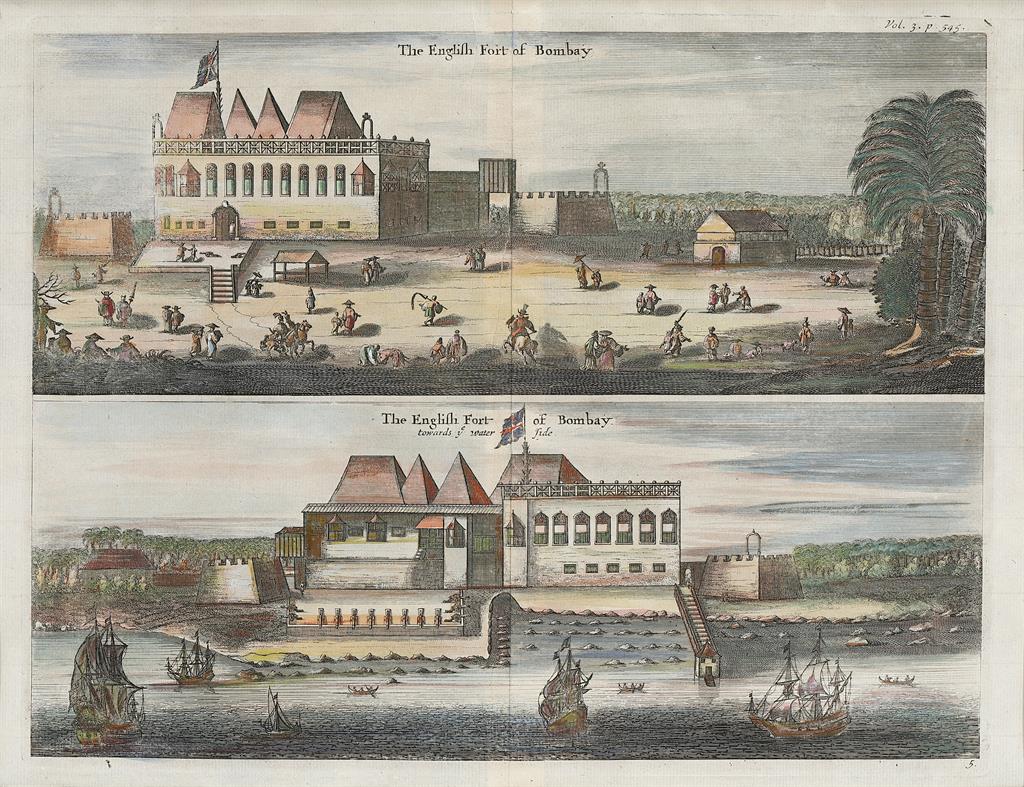
    Read more about this map (and others in my collection) in this article!

    When negotiations – with the Mughal Emperor and with Mukhtar Khan – broke down completely in December of 1688, with Child point blank refusing to agree to any terms the Mughals put forward that involved the Company being fined, Sir John Child gave a fateful order. On January 20th, 1689, 2 East India Company “Men-of-War”, the Emerald Frigot and Worcester ambushed a Mughal convoy sailing from Surat to the Deccan. The English were infinitely better sailors than the Mughals and had much, much better ships and crew. As a result, the Emerald Frigot and Worcester managed to capture 36 large freight ships, after destroying or driving away their escort. But what the Mughal Navy lacked in capability, the Mughal Army more than made up for.

    On the 15th of February, an army 14-20,000 strong (estimates vary and Mughal sources have not yet been translated or researched) led by Admiral (Sidi) Yakut Khan besieged Bombay. By May of 1690, when the siege was ended and a peace concluded, over 90% of the city’s population and 95% of its Garrison had been killed (according to research conducted by Margaret Hunt and Philip Stern). The terms of the peace humiliated the Company. They had to pay a fine of 150,000 “rupiyas”, agree to disband all armed units for a year, Child had to be expelled (he’d died in February of 1690 but this was not known to the Mughals), they had to pay a 4% tax on all goods (the previous was 2%) and had to follow Aurungzeb’s orders. In return, the Surat Factory would be returned to them and all imprisoned Englishmen released and they would be allowed to reoccupy their Bengal Factories. The English agreed to these terms without negotiation.

    In 1689, however, Child had tried – in the middle of being beaten by the Mughals – to negotiate a much more lenient peace for the EIC. Transcribed below are the terms he proposed. I’ve also included some other documents that you, the reader, might find interesting! Note: I have, in most places, edited the spelling to how the words would be spelt today. I have not edited the grammar, which may seem very archaic to a modern reader.

    Document 1: Ships Dispatched by the EIC and Placed Under Child’s Command

    Source: LB8 IOR/E/3/91, East India Company in London to President and Council at Surat [I.E John Child], 31st March, 1686 fol. 98.

    Ship’s Under John Child’s Command
    ShipCaptainTonnageCrewNo. of Guns
    Ship’s in Bombay and Western India
    Charles the SecondCaptain Jonathan Andrewes77515460
    MadonnaCaptain William Wildy77515460
    WorcesterCaptain Edward Keling2204420
    NathanielCaptain John Mason55010950
    EmeraldCaptain Charles Hayward
    Ruby FrigotCaptain Giles Hill802516
    Baudon
    RosoCaptain Thomas Lucao120
    Tonqueen MerchantCaptain Robert Knox1603014
    Ships’ in Bengal and South India
    BeaufortCaptain John Nicholson77515460
    RochesterCaptain John Brownwell77515460
    Royal JamesCaptain John Wotwang65012950
    PryamanCaptain Jonathan Unkettle1503020
    RainbowCaptain Benjamin Boole2505024
    HerbertCaptain Henry Uelall75015046
    Loyal CaptaineCaptain Francis Eletrod1502720
    CortanaCaptain Anthony Waltdon1402726
    RebeccaCaptain Thomas Batton1703320
    Saphire FrigotCaptain Stephen Bradley802516
    DyamondCaptain Thomas Woodcock802516
    PearlCaptain James Perryman802516
    A Dutch Man-of-War, late 17th-Century.

    Document 2: Petition of Sir John Child to Emperor Aurungzeb, late 1688

    Source: IOR/E/3/47/2, fol. 224

    To Aurungzeb the Great Mughal,
    From Bombay Castle

    The Petition of the least of your servants Sr. John Child General of the English Nation like a grain of sand, and with the greatest regard to your Majesty’s person, amber-like in fairness, Lord of beneficence and-liberality, Solomon like throne, Epitome of Priest-Hood, Sikanderbeg [Alexander] like wisdom, Heavenly judgement, Potentate of the World, Centre of Serenity, Emperor Of the World and of the Age, object of all sublime things, the Divine Shadow of the Holy Prophet Mohammad, Aurungzeb whose person and kingdom the Divine Powers long prosper and Continue that his righteousness and justice may spread over the whole world and everlastingly continue for the benefit of its Inhabitants. Represented after due recommendation of servitude and vassalage with humility and lowliness of mind likening the floor of all servile offices with lips of respect and obsequiousness and with a head bowed down to your Fame and Greatness, know that-

    I humbly addressed my (letter) to your Majesties by the way of Mukhtar Khan Governor of Surat more than a year ago and then gave in a particular account of the great Grievances my nation lay under was in hopes long abfore this to have had redress from your Majesties Justice to all but Mukhtar Khan as he upset everybody so hath deceived and abused me bare & did much with him, but lately his covetousness and naughtiness has Exceeded humane patience and I well know much contrary to your Majesties Royall Will and Pleasure. Having contrary to his cool imprisoned my people and seized a great estate in money and goods and having Endeavoured always under the Sun for peace to no purpose as is well

    [NEXT PAGE]

    Well known to many. Thousands at Surat and other places places I have now no way in appearance but to fly immediately to your Majesties whose wisdom and justice exceeds your greatness being placed by the almighty’s providence to govern a great part of the world. I have sent my grievances in a paper apart and humbly leave all to your Majesties pleasure not desiring the harm of any, my only hope is I may be righted where wronged and enjoy for the future your Majesties gracious firman and that my nation may enjoy the privileges they have had for many years in all parts of Your Dominions and not be imposed on and abused by any hereafter and the peace may be lasting that your Majesties would be pleased to order whom you shall think fit about your person to receive any future complaints from any of my nation and see they be righted, justable to your Majesties great Justice that makes you as glorious as you are Great in the World. I have this opportunity given by Mahmed Raizah God Preserve Your Majesty.

    [Continued]

    Mukhtar Khan pretending to make peace I went hence To Swally [modern Suvali], delivered up to him up to him 5 ships and 20 vessels laden & instead of seeing I had justice clapped a guard on my Factory imprisoned my Englishmen and other servants for some days and having done me great mischeifs by that & forced away from my people 140,000 rupees then set all at Liberty & pretended to make peace again.

    From the severall merchants & owners of the ships I delivered up to his order he forced 10% for his own self on the value of their goods.

    The season of the year bring harr [I.E monsoon] expended & the weather would not permit my longer lying at Surat I came away hither with Mukhtar Khan’s leave who advised me to keep all the Mocha ships & goods till a Phirmand [Firman] came from your Majestie and my bussiness was done.

    This monsoon he sent for me again advising me he had a Phirmand for my nation and he would see my business done according to right & to my full satisfaction I on this went up and stayed at Swally near 4 months at loss instead of making peace as he promised as a sudden he seized and imprisoned all My people at Surat & a great estate was trusted In his hands on his Cole & then sent me word that there Should be no peace without I would give him 5 lacks Of rupees. That in all places of thy King’s Dominions we enjoy our privileges and not by any be imposed on in the least.

    Document 3: Heads of a Firman to be Procured from the Great Mughal Aurungzeb, sent on December 6th 1689

    Source: IOR/E/3/48/1, fol. 77

    Note: The original document contains a long list of demands supported by arguments in favour of them explaining why they should be granted by Aurungzeb. Transcribed here are only the demands.

    Heads of a Phirmand to be procured from the Great Mogull Orung Zeb, drawn out by the Generall & Council of Bombay, December the 4th, 1689

    1st – That we have Free Trade in all the Great Mughal’s Dominions and not be forced or imposed upon by any Governors and or Officers

    2nd – Our Custom [I.E Custom’s Tax] at Surat and all ports on this side of India to be but 2% for goods on the true value of the goods not to be overrated by the Governor or Customs [officers]

    3rd – That all English be under our order and government and that the Governor at no time upon any pretence what-ever protect them from us but deliver them [I.E all Englishmen imprisoned to be released from Mughal imprisonment]

    4th – That no Custom be paid for any goods that may require us to land [at Mughal controlled ports] for convenience’s sake, being such goods as we bring to the King’s Ports not for sale but to sail to England

    5th – That for all sorts of Provisions [I.E goods brought into India for use by the EIC’s Factors and that are not for sale] … to be cut free [of Custom’s Tax] both at import and export and that we be not hindered at any time in shipping of Provisions

    6th – That whatever goods or moneys may be robbed from any of our People in the King’s Dominions that satisfaction be made by that Government in whose indiscretion we were robbed

    7th – That we have a place assigned us in the Mint Houses at the several places where we may be that the Governor nor any Officers of the King’s may have any Command over it

    8th – That we have a warehouse allowed to us at the waterside near the Custom’s House into which we may immediately load our goods for the greater security of them

    9th – That the several goods which we provided at the several inland places in the King’s Dominions be not stopped at the places they set out at or any other places under any pretences but permitted freely to pass down to such ports as we shall order

    10th – That our several boats and vessels that come up to the Custom’s House with our goods be immediately unladed & cleared out of hand.

    11th – That all people that are [indebted to us] the Government of the place [where the indebted people live] force them out of hand to pay us or allow the debt out of the allotted Custom [I.E cancel Custom’s Tax equal to the amount of debt unpaid]

    12th – That what horses we bring to his Majesty’s ports may freely pass to our stables free of all duties

    13th – That no Governor or Officer send to our warehouses or brokersfor goods to our great trouble and loss [I.E seizure of the EIC’s goods by Mughal officials to be disallowed]

    14th – That a convenient bunder [Persian/Hindi word “Bandar” meaning port/dock/jetty] be allowed us at the several ports of the King’s Dominions for our ships & vessels to go and repair at

    15thLARGELY ILLEGIBLE

    16thA long and convoluted paragraph where Child demands that the privileges enjoyed by the Company and the privileges asked for here be also granted in all territory that the Mughal Empire may conquer in the future

    17th – That we enjoy the same privilegesin all the Towns and Places of the King’s Dominions of the Bay of Bengal as formerly [I.E the same rights as before the EIC was expelled in 1687]

    18th – That no Governor or Officer in any port of the King’s Dominions give any hindrance to any Merchant or others [in this case Indian merchants] but permit them freely to trade with us

    19th[In case of the break out of sickness or plague in an English Factory] then the Governor of the place make an exact account … of [all personal effects of any deceased] & secure them to be safely delivered up to the English that may come to demand them

    … 20th – That if at any time a difference should fall out between the English and the Mughal’s Governor or people in any port or town of his Dominions that shall not cause a difference between the King [I.E Mughal Emperor] & [the English nation] in all [I.E any] parts of his Dominions

  • The Graveyard of Empires, Vol. II: From Defeat to Destruction – The Grand Army of the Indus and the British-Indian Retreat from Kabul

    The Graveyard of Empires, Vol. II: From Defeat to Destruction – The Grand Army of the Indus and the British-Indian Retreat from Kabul

     “The good management, for which the [British rule] is so celebrated, seems to have left the heads of … the commanders.
    – Subedar Sita Ram

    Introduction:

    It is perhaps a lie, or at the very least a fib, to title this article “from defeat to destruction” – given that the British faced very little resistance in Afghanistan during their first year in the country. If you have read my previous article in the series, you will know this – the British took virtually every objective they needed to without so much as firing a shot. Also described in that previous article, however, is the less than stellar levels of planning and preparedness of the British and Indian force that had mounted this invasion. If you are interested in the long list of planning errors made by the British – an exceedingly rare misstep in their otherwise exceptional record – please consult my previous article here.

    Despite these planning errors, objectives such as Kandahar or Gazni or even Kabul fell to the advancing British-Indian forces with little to no resistance. However, in the face of this success, the soldiers on the march suffered – and they began to do so long before they reached Afghanistan. And when they left the country, they would suffer still more – especially those soldiers that were part of the Kabul Garrison. This article tells that story; the story of the common soldier, fighting and dying in the dry, blistering heat and cold, frigid temperatures of Afghanistan.

    For a more in-depth discussion about the source I will be using for the narration, please consult my previous article! In short, the source is “From Sepoy to Subedar”, a chronicle of Subedar Sita Ram’s experiences in the Bengal Presidency Army of the East India Company in the first half of the 19th Century. He partook in many noteworthy campaigns (such as the invasion of Afghanistan) and those that have become footnotes in public memory (such as the 2 Gurkha Wars), before being sold into slavery by Afghan fighters after he was captured during the Retreat from Kabul. He would be rescued by a British raiding party in 1846, after which he would continue his enlistment (though, by then, he’d been made an officer and conferred the rank of subedar) and serve until the 1850s, retiring some time just before the Indian Rebellion/Mutiny of 1857.

    A Short Introduction to the Grand Army of the Indus:

    A soldier from the Bombay Native Infantry, ca. 1800

    Before consulting the monumental work that is “From Sepoy to Subedar”, it is worth understanding the force of which Subedar Sita Ram was a part. Modern scholarship has delved deep into the history of this force – titled by the British the “Grand Army of the Indus” – and provides the contemporary reader with much more detailed information on the Army’s composition than one would imagine. Works such as William Dalrymple’s The Return of a King or articles written during the 2nd half of the 20th century (such as, notably, Louis Dupree’s “The First Anglo-Afghan War [etc]”) paint a vibrant image of the Grand Army of the Indus.

    The Grand Army of the Indus was made of 3 “divisions”. 2 of these were British-Indian and the other Afghani.[1] To understand this make-up of forces, it is critical to understand a man called Shah Shuja and why the British supported him. To cut a very long and very complex story, very short:

    • The British were convinced the Russians were going to invade Afghanistan and then India, with the help of Dost Mohammad Khan the Emir of Kabul
    • To pre-empt this, they provided unconditional support to Mohammad Khan’s rival and claimant to the Emirate of Kabul, Shah Shuja, a deeply unpopular figure in Afghanistan
    • In 1838, Lord Auckland – the Governor General of India – announced the Simla Proclamation, in which the British accused Dost Mohammad Khan of attacking the Sikh Empire (at that time a British ally), proclaimed support for Shah Shuja and declared war on the Emirate of Kabul (which was, in fact, receiving no support from the Russians)
    • Part of the Simla Proclamation was that Shah Shuja would return to Afghanistan and retake Kabul with an army made up entirely of Afghanis

    With this background, the Grand Army of the Indus was gathered in Bombay in the monsoon of 1838. The 3 divisions were built up as follows:

    The Bombay “Bombay Ducks” Division:

    By every margin, this was the smallest division in the force and was made up of regiments from the Bombay Presidency Army. Its 5,600 fighting men were divided into the following British and Indian regiments:

    Soldier from the 27th Bombay Native Infantry, 19th Century
    • 19th Bombay Native Infantry (Disbanded in 1895 when the Bombay Army was folded into the newly formed British Indian Army)
    • Poona Local Horse (now serving as the 17th Horse – Poona Horse, an armoured regiment of the Indian Army)
    • 2nd Queen’s Regiment (British Army regiment, disbanded before World War 1)
    • 17th Lincolnshire Regiment (British Army regiment, disbanded 1960)
    • 4th Dragoons (British Army, a descendant of the regiment forms part of the Royal Dragoon Guards, an armoured regiment of the British Army)

    The Bengal Division:

    The Bengal Division was the largest division in the Grand Army of the Indus and the most well trained, drilled and most experienced. Its 9,500 fighting men (one of them being Subedar Sita Ram) were organised into the following British and Indian regiments (it is here important to note that Poona Horse was moved from the Bombay to the Bengal Division right before the Retreat from Kabul):

    • Skinner’s Horse (now serving as 1st Horse (Skinner’s Horse), an armoured regiment of the Indian Army)
    • 2nd Light Cavalry (disbanded in 1895, replaced by 2nd Lancers (Gardner’s Horse) which continues to serve as an armoured regiment in the Indian Army)
    • 5th Bengal Light Cavalry (disarmed and disbanded in 1857 during the Rebellion)[2]
    • 5th Bengal Native Infantry (BNI) (rebelled in 1857 and was subsequently destroyed)
    • 37th BNI (same fate)
    • 43rd BNI (now serving as the 1st Battalion, Jat Regiment, Indian Army which has since become 2nd Battalion of the Mechanised Infantry Regiment)
    • 54th BNI (rebelled in 1857 and was subsequently destroyed)
    • 16th Lancers (British regiment, disbanded in 1993)
    • 13th Somersetshire Light Infantry (British regiment, disbanded in 1959)
    • 44th Regiment of Foot (British regiment, disbanded 1881)

    Shah Shuja’s Levy:

    The Afghani force, known officially as Shah Shuja’s Levy, was not a professional army. It was about 6,000 strong and made up of Afghanis, Baluchis and Pashtuns loyal to Shah Shuja. It had more in common with the armies of Feudal Europe in its structure than the rest of the Grand Army of the Indus. Its 6,000 men – though officered by the British – were not well trained and were badly equipped. It was not formally organised into regiments or battalions, and – as Subedar Sita Ram notes – the largest organised units in the Levy were groups of friends and most soldiers tended to fight as individuals.

    Subedar Sita Ram’s Account of the Expedition:

    The British-Indain Garrison at Kandahar

    A quick note: we cannot be sure of the exact regiment that Subedar Sita Ram served under, though it is likely the 43rd BNI, – this is for various reasons discussed in my previous article.

    The British demonstrated their only good planning at the start of the campaign by avoiding entering Afghanistan through the Khyber Pass, which had been fortified by the armies of the Emirate of Kabul. They chose instead to ride across the dry heat of the plains that constitute modern-day Pakistan (but was then the Sikh Empire) and cross into Afghanistan at Quetta. Until the Retreat from Kabul, this was the worst part of the expedition for the troops. Subedar Sita Ram recounts:

    Our march was in the middle of the cold weather [i.e when it would have been monsoon in India, as this was in the middle of August] and yet the heat was such that numbers of European soldiers and sepoys died from the effects; on one day thirty-five men fell victim to it. At this stage the sepoy army had almost determined to return to India and there were signs of mutiny in all three armies [i.e divisions]. … We went through one valley called Dadhar which was the mouth of hell. It was low-lying and surrounded by hills so that no air ever came there.[3]… Then we came to the Bolan Pass and here many people [referring to local civilians] were killed by the tribesmen [Baluchis]. They murdered everyone whenever they had the opportunity, and rolled large boulders down the mountain sides. The watercourses were all blocked, and the wells were filled with pilu wood [a poisonous tree bark that grows in Afghanistan that causes dysentery] that made the water stink, so as to make one sick even when approaching the well.”

    Soon after this, the Grand Army of the Indus reached the safety of Quetta where they could rest and refit – but not for long. They were on the march again before the Army could have any meaningful rest and they marched for Kandahar. By now, they’d crossed into Afghanistan.

    The hill men do not like venturing far into the plains and seldom leave their homes for more than a few miles to raid a village or attack a caravan. They are very formidable behind their rocks from where they can fire their long jezails [an outdated musket design local to Afghanistan] that throw a ball three times the size of a musket-ball with accuracy at 400 yards, but they could never withstand a volley of our musketry at close quarters. They fight as individuals, and not in formed bodies like the Company’s troops. … These hill tribes are supposedly subject to the ruler of Kabul, and Shah Shujah sent frequently to inform them that the English were his friends. However, this made no difference—they fired at, and attacked, the Shah’s soldiers just as much as the Sirkar’s [i.e the British]. Truly they were a lawless set of bloodthirsty savages.

    It was during this march of unheard of hardship that I saw, for the first time in my service, dissensions arise among the officers. The Bombay Commander-in-Chief and the Bengal general quarrelled.2? The former thought his army the best. All the Bombay officers looked with contempt on the Bengal Army, and we were much abused by the regular sepoys who called us ‘irregulars’.[4] ‘Lad Kain’ [i.e Lt. Gen. Sir John Keane, GOC the expedition and an officer of the Bombay Army] sahib was of higher rank than our general and he gave orders for some of the force to be left behind in Sind. The good management, for which the Sirkar is so celebrated, seems to have left the heads of both the commanders. As we approached Kandahar the truth began to dawn on us that despite all the assurances Shah Shujah had given us in Hindustan, that the Afghans were longing for his return, in reality they did not want him as their ruler.

    Keane rested his army for 2 months in Kandahar and left behind a small garrison under the flag of the Bengal Army. Then, they marched on Ghazni and Kabul. The force besieged Ghazni for about a week before it fell with little fighting.

    The leading citizens and the women all came out and begged protection from the English General sahib. The [Afghan] Governor [of Gazni] could nowhere be found and no-one knew whether he had been killed or not. After looking for him all over the place an officer found him hiding in a house. He was just about to fire at him when the man called out that he was Hyder Ali. He was taken to the General who treated him very kindly. This man spoke out very boldly to the Commander-in-Chief. He said he was fighting for his country and his amir. The Afghans had never annoyed the British; why, therefore, had they come into his country to set up a king whom they all hated? They had brought death and desolation into many Afghan families. He ended by saying—‘kill me if you like, but if you let me go, I shall ever be found as your enemy, and do all in my power to excite the people against you, and drive you all out of Kabul!’

    The General sahib was not angry. He told Hyder Ali that he was a brave man and that he respected his feelings. But he, the General, was acting under the orders of his Government, whose servant he was. Once again I saw here the curious customs in war of the English. Had this man said half as much before a rajah or nawab, he would have been cut to pieces on the spot. And yet, in this instance, and in open durbar, the very sahibs who had fought against him cried out Barekilla! Barekilla! (Bravo! Bravo!). This was wonderful! Why do they fight? Not to kill their enemies but to have the pleasure of capturing them and then letting them go! Truly, their ways are unaccountable. It was also very odd that this man so brave in speech was found in hiding after the battle!”

    After the fall of Ghazni, the force marched on Kabul. On the march to Kabul, they were met by many messengers sent by Dost Mohammad Khan and the message was, on each occasion, the same – the Emir of Kabul was ordering the British to leave his country. The British ignored these messages and, when they reached Kabul, they found it undefended and took it without much fighting. Dost Mohammad Khan had fled north, to the mountains. Here, Shah Shuja was proclaimed the new Emir, but as Subedar Sita Ram records:

    The army entered Kabul without any fighting and the Shah was proclaimed king. But here, as at Kandahar, the people took no part in the rejoicings; these were all made by the Shah’s own soldiers and his court. The hearts of the people were with the Amir, and not with Shah Shujah.

    Now, the army garrisoned Kabul. As was the custom in the British Army and the Presidency Armies at the time, the garrison – or cantonment – was established outside the city limits, though a few officers did choose to live within Kabul. This meant that when the Afghans – in 1841 – rebelled against Shah Shuja and the few British officers within Kabul, the army was nowhere nearby to help. In November of 1841, as Sita Ram records, ‘misfortune and calamity came upon the English’.

    About two years after the English first came to Kabul a rebellion broke out in the city itself. At the beginning only a few discontented Afghans were involved but they surrounded the house of [Alexander] Burnes sahib, the political officer, and set it on fire.[5] As Burnes was escaping through the garden by a small door, he was cut down by his Afghan servant. Two or three other English officers were also killed. Once the report got around that Burnes sahib had been murdered the mob joined in the rioting and fighting took place all over the city. The outburst was so sudden that our officers were taken by surprise. Some of them lived in the city, and others near the king’s garden, two miles away. However the English still held their own, but every day tribes came to join in the rebellion, and treachery showed itself in the Shah’s court.

    Now came misfortune and calamity upon the English. All their stores were looted or burnt by the enemy and the spirits of the army were much depressed. The cold was so intense that it rendered the sepoy portion of the army next to useless. It was soon rumoured that Akbar Khan, son of Dost Mohammed, had arrived with many troops and that he commanded in person. There was fighting every day, and because there was no good food for the European soldiers, they lost spirit and did not fight as well as they used to do. There were enemies on all sides.

    We were annoyed day and night in the cantonment by cannon fire. The enemy seemed to increase by thousands and their long matchlocks outranged our muskets. Although they would never withstand a regular charge, so long as they could find cover behind walls, houses, etc., their fire was very distressing. We repeatedly drove the Afghans from the hills round Kabul but they re-occupied them in even greater strength as soon as we withdrew. The Afghans wore sheepskin coats, called nimchees or poshteens, and these often turned sword cuts and even musket balls. The general opinion was that some of them were invulnerable, and especially a tribe called Bedouranis. On one occasion I saw a party of their horsemen approach within twenty paces of a ravine where a regiment of ours was concealed. The officers made their men reserve their fire and then the whole regiment sprang up and opened fire. However, not more than three or four horses went away without riders. This dispirited the sepoy army very much and, as the cold increased, we became helpless. Men lost the use of their fingers and toes which fell off after great suffering. The whole English army was in a miserable plight, since the men were worn out by continual fighting, guard duties, and bad food.

    By December, the British-Indian Garrison at Kabul had lost all its General Officers; Alexander Burnes had been killed, more junior General Officers had perished either in combat or to disease and Maj. Gen. William Elphinstone – who was already elderly and unfit for leadership – the commander of the Garrison had been grievously injured after being thrown from his horse. The most senior man left in the Garrison was a civil servant by the name of William Hay Macnaghten. Macnaghten, advised by the wounded Elphinstone, sought to negotiate with the Afghans the peaceful withdrawal of the beleaguered Garrison – it was clear that the Garrison, should they be besieged throughout an Afghani winter, would have been destroyed. Akbar Khan, son of Dost Mohammad Khan, agreed to such a withdrawal. However, when Macnaghten travelled to Akbar Khan’s camp to finalise the agreement, he – and his party – were executed by Akbar Khan.

    Both the senior political officers [Burnes and Macnaghten] had now been murdered. The General sahib [Elphinstone] was going to take vengeance on the city, but the officers [of the regiments] represented that their men were too weak to take the offensive. Nevertheless it would have been better to have died fighting than massacred in the retreat which followed. Wisdom seemed to have departed from everyone. The usual energy of the English officers had vanished. They had suffered such severe trials that their spirits had been depressed by misfortune. There wererumouts that Shah Shujah had joined the Sirdars against the English; now that things were going so badly, he was afraid of being thought their friend.

    The retreat of our army, in the middle of the winter and with the snow four feet deep, now began.

    The retreat to Jalalabad was chaos and an ill-disguised massacre of British and Indian troops and civilians.

    They fired into us from the hills and we were as helpless as a handcuffed prisoner. Akbar Khan himself was following us. When we complained of this treachery, he swore that it was happening against his will, and that he could not control the Ghilzais [a hill tribe]. He demanded more officers be given up as hostages. I do not know why this was agreed, apart from the fact that sense had left the brains of everyone, as I have already said. Once the enemy had the officers in their power, our army was deprived of leaders. Every sahib taken away was as bad as two hundred men lost. At last the Afghans said they would only protect the English army on condition that the General was given up. To everyone’s amazement, he agreed to go, but with the example of Burnes and ‘Macnaten’ before him, what could he expect?

    When the General sahib left all discipline fell away. As a result the Afghans were able to annoy us the more and cut off more men than ever. A number of sepoys and followers went over to the enemy in an effort to save their lives. My regiment had disappeared and I attached myself to the remnants of a European regiment. I thought that by sticking to them I might have some chance of getting away from that detestable country. But alas! alas! Who can withstand fate? We went on fighting and losing men at every step of the road. We were attacked in front, in the rear, and from the tops of hills. In truth it was hell itself. I cannot describe the horrors. At last we came upon a high wall of stones that blocked the road; in trying to force this, our whole party was destroyed. The men fought like gods, not men, but numbers prevailed against them.

    I was struck down by a jezail ball on the side of my head. After this I knew nothing until I found myself tied crossways upon a horse which was being led rapidly away from the fighting towards Kabul. I now learned that I was being taken there to be sold as a slave. I begged to be shot, or have my throat cut, and abused the Afghans in Pushtu and in my own language. Many a knife shook in its sheath, but my captor could not prevent me speaking, and as the fear of death had no effect on me he threatened to make me a Moslem on the spot if I did not keep quiet.

    What dreadful carnage I saw along the road—legs and arms protruding from the snow, Europeans and Hindustanis half buried, horses and camels all dead! It was a sight I shall never forget as long as I live. My captor, seeing that I desired death above anything else, became more merciful. I was taken from the horse and tied in a camel pannier. This, bad as it was, was better than hanging downwards from a pony. The Afghan rubbed my wound with snow which took away the pain; the ball had only ploughed up the skin where it had grazed my skull. In four or five days we reached Kabul where I was clothed in Afghan garments and sold in the market place as a slave. Rich Afghans valued Hindustanis as servants and employed many of them. I was a fine-looking, strong man, and I fetched 240 rupees. One Osman Beg purchased me. At the same time as I was sold, there were several other sepoys, and also a few Europeans for sale. The latter were intended to be used as instructors for the Afghan Army, and since they were supplied with some skins of Shiraz wine, they did not appear to lament their fate as we did.

    I saw one sahib [i.e officer] among the Europeans; he belonged to the Company Bahadur’s [?] army. He spoke to me and said that the Sirkar would send a large army and re-conquer the country; if our lives were spared we should all be rescued.”

    This European officer, identified to be Robert Waller (who was enslaved, along with his wife, though they would both survive slavery) of the Bengal Artillery, seemed to have been a soothsayer. In March of 1842, barely a few months after the remainder of the Kabul Garrison had reached Jalalabad, the British organised a fearsome force known as the Army of Retribution. The Army of Retribution was officered by Major Generals George Pollock, William Nott and Robert Sale – the only truly competent officers in the entire British Indian force in Afghanistan. And the Army of Retribution truly lived up to its name, ravaging the forces of Dost Mohammad Khan, taking no prisoners and burning villages to the ground. They rescued the vast majority of Indians and Britons enslaved by the Afghans, however by the time they returned in October, they had not found Sita Ram who – with his master – had relocated into the Hindu Kush Mountains to wait out the Army of Retribution. He would return to India in 1846 by getting himself sold to a convoy of merchants travelling to Delhi, where he met officers of his regiment and had the convoy arrested for slavery (which was, by now, illegal in all parts of the British Empire).


    [1] The EIC maintained 3 standing armies in India; the Bombay Presidency Army, the Bengal Presidency Army and the Madras Presidency Army.

    [2] There were 8 Bengal Light Cavalry regiments. All 8 were disbanded. Many of the British officers of the 8 regiments also resigned their commission as they believed their unit(s) to be loyal and would not serve without their men.

    [3] The Dadhar valley is equated to the closest manifestation of Hell on Earth by locals and is hot for the majority of the year.

    [4] The Bombay Army was staffed with more upper class officers, all of whom were generally more incompetent than the Bengal Army officers.

    [5] I have narrated the story of Alexander Burnes in my previous article.