
This article has been written for Easy History by Eddie Monkman.
Introduction:
The surrealist filmmaker Luis Buneul once wrote that, whilst he would not like to live forever, he would quite like to be woken every 10 years in order to check the papers. The stories of our time would doubtless interest him. If we were to narrow down the selection of stories to those of geopolitical issues, then two would likely dominate the pages that Buneul were to read: The Russian invasion of Ukraine and the Israeli occupation of the Gaza strip. These two stories have dominated headlines, fractured societies and become imprinted across the collective consciousness of the western world. They have affected policies, elections and economics across the world. There is no reason that they shouldn’t have. They are major global conflicts with serious economic, political and moral consequences and it is understandable as to why societies thousands of miles away have felt so strongly about them. However, there has been a third conflict in the past few years that has demonstrated brutality and immorality that is worthy of international outrage and engagement. Since April 2023, Sudan has been embroiled in a bloody civil war that has upended what was until recently a fledgling democracy and peaceful country.
Over the last couple of weeks, Sudan has been garnering a little more attention from western news media, especially as a result of the national military regaining key sites in the capital of Khartoum from the rebel Rapid Support Force (RSF) group. However, the civil war – which has been described by the United Nations as the world’s worst humanitarian crisis – is soon to enter its second year and despite advances by the military, there are still no signs that the conflict will cease any time soon. The conflict broke out on the 15th of April 2023 in Khartoum. Two factions of the military led government led by General Abdel Fattah al-Burhan (the de-facto leader of Sudan) and General Mohamed Hamdan Dagalo (the leader of the RSF) became embroiled in street fighting in the capital as the coalition collapsed. Despite assumptions from civilians and journalists that the fighting would be brief, it quickly escalated and spread across the entire country. Within weeks, Sudan was plunged into civil war.
The roots of the conflict:
Sudan has faced numerous civil wars and political conflicts since gaining its independence from British-Egyptian rule in 1956. The country was led by a variety of groups and suffered a series of conflicts up until 1989, when President Omar-al Bashir led a successful military coup and appointed himself leader of the country. His reign was brutal and he often used the RSF (formerly the Janjaweed) in order to brutally enforce his rule. During his leadership, South Sudan gained its independence from the central government in Khartoum and President Bashir’s popularity continued to decline over the following decade.
In 2019, the two men at the centre of the current conflict, General el-Burhan and General Daglo, were working together in order to depose President Bashir. After 30 years in power, Bashir’s reign finally ended after pro-democracy protests led to civilian uprisings and an eventual coup led by the country’s largest military groups: The army and the RSF. After successfully ousting Bashir, Sudan enjoyed a two-year period of fledgling democracy and functioning governance. However, in 2021, General el-Burhan assumed power. Backed by civilian politicians and the military, General el-Burhan managed to prevent the RSF integrating into the national army and prevented General Daglo from increasing his influence over Sudan.
But it wasn’t long before General Daglo and the RSF reacted. Hopes of a short-term, democratic future were scuppered as Daglo refused to cooperate on deals that would implement the democratic infrastructure Sudan needed. Rather than appease, Daglo chose to act in opposition to General el-Burhan and the civilian politicians. The RSF began to take control of regions of Sudan following the outbreak of gunfire in the capital on 15th April 2023. They seized control of parts of Darfur and Kordofan state through brutal military campaigns and managed to sweep through the capital and take control of key landmarks.
Who are the RSF rebels?
The RSF began life as a group called the Janjaweed in 2003, when the Sudanese government used the paramilitary group to commit acts of systemic violence against minority, non-Arab groups in the Darfur region in the west of the country. The conflict in Darfur was responsible for
the deaths of an estimated 300,000 people. RSF soldiers and leadership were accused of committing crimes against humanity in the conflict. General Daglo was their leader back then just as he is today over 20 years later.
It wasn’t until 2013 that the Janjaweed rebranded themselves as the RSF and began to reassert themselves in Sudanese life. They were initially used as border guards by the government, selected for their ability to enforce security whilst the country sent troops to fight in Yemen alongside Saudi and Emirati soldiers. In the process, the group were legitimised in Sudanese law, eventually granting them ‘regular force’ status in 2013 and formal recognition as an independent security force in 2017. However, it wasn’t until 2019, when the RSF combined with the military, led by General al-Burhan enacted a coup against President Bashir, ending his 30 year reign as leader of Sudan.
Within less than 20 years, General Daglo had raised the RSF from being a small militia group responsible for committing atrocities for President Bashir to becoming a serious, organised force capable of being part of a coup which saw them enter into office. Daglo is ambitious and ruthless and the RSF have committed some of the worst atrocities in modern history under his leadership. In 2015, Human Rights Watch termed the group “men with no mercy.” Ten years on they have done nothing to dispel that accusation and plenty to support it. Despite entering into a “pro- democracy” coalition with the military, a series of attempted coups, disputes and arguments over the integration of the RSF into the nations regular armed forces led to the dissolution of a working, democratic government and eventually led to civil war breaking out in April 2023.
The cost to human life:
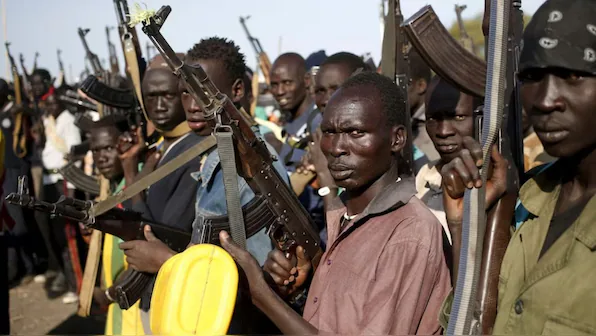
The humanitarian crisis in Sudan is now considered the worst in the world today. Both the Sudanese Armed Forces (SAF) and the Rapid Support Forces (RSF) have been accused of committing war crimes. Yet it is the RSF, and the militias aligned with them, who stand most clearly accused of orchestrating a campaign of mass atrocities that includes systematic sexual violence, the forced starvation of civilian populations, and ethnic cleansing. The United Nations estimates that nearly 25 million people – more than half of Sudan’s population – need humanitarian assistance. Famine, displacement, and disease threaten to kill many more than the bombs and bullets.
Nowhere is the brutality more visible than in the western region of Darfur. The name has become synonymous with genocide since 2003, back when the RSF were still known as the Janjaweed and were working under President Omar al-Bashir to violently suppress rebellion. During the conflict, more than 300,000 people were killed and millions displaced, many of them non-Arab ethnic groups targeted by the Arab-dominated militias. Two decades later, the RSF have returned, repeating the same tactics across the region. Satellite imagery has confirmed the destruction of homes, schools, and markets across West Darfur. In the city of El Geneina, thousands have been killed in what survivors describe as ethnically targeted massacres. Men have been executed in the streets, women and girls abducted and raped, homes looted and burned. Eyewitness accounts recall stories of RSF fighters going door to door, selecting victims based on their tribal affiliation.
These crimes are not random or isolated but instead appear deliberate and systematic. Aid workers and international observers have accused the RSF of intentionally obstructing humanitarian access, using starvation as a weapon of war. The SAF, for its part, has bombed densely populated areas and disrupted aid corridors, making it nearly impossible for relief agencies to operate safely. Despite the severe cost to human life, major world powers remain fixated on other geopolitical crises. Humanitarian appeals remain underfunded and recent cuts to USAID have threatened to plunge even greater numbers into famine conditions. And as Sudan’s infrastructure collapses, millions are forced to flee to neighbouring countries, many of which are themselves in fragile political and economic condition.
Conclusion:
As Sudan’s civil war approaches its second anniversary, the conflict remains one of the most severe yet underreported crises in the world. Despite the scale and shocking nature of the violence and displacement, international attention has been limited, and meaningful intervention
has yet to materialise and is in fact regressing from the US. The war has not generated the same level of media coverage or diplomatic urgency as other global conflicts, despite the fact that the humanitarian toll continues to grow at an alarming rate.
This disparity in attention reflects a broader pattern in how the international community engages with crises. Conflicts that lack immediate geopolitical implications or strategic interest often struggle to attract sustained focus. Sudan’s war, complex and politically and culturally alien to many in the west, has largely remained outside the spotlight, even as it has produced some of the worst atrocities in recent memory.
While humanitarian organisations continue to operate under extremely difficult conditions, they do so without the full backing or resources of the global community. Funding shortfalls and security risks have severely limited the capacity to respond to the scale of need. As the situation on the ground deteriorates further, the risk is not just ongoing violence, but long-term destabilisation across the region as the conflict threatens to spread. Without coordinated diplomatic and humanitarian engagement, the war in Sudan may become another prolonged and forgotten regional conflict – one where the costs are borne almost entirely by the civilian population.
About the Author:
Eddie is a freelance writer and journalist based in London. In June 2024 he graduated from the University of Southampton with a degree in Political Science and since then has gained experience writing on European, American and North African politics as well as on contemporary art and culture.
- Threads: @eddiemonkman
- Bluesky: @eddiemonkman.bsky.social
Leave a Reply