Blog

  • The Horrors of World War 1, Vol. III: The Voices of the Forgotten – Indian Soldiers’ Letters Home

    The Horrors of World War 1, Vol. III: The Voices of the Forgotten – Indian Soldiers’ Letters Home

    Introduction:

    1st Gorkha Rifles during a trench raid drill in France.

    The study of modern wars, especially the two World Wars, is virtually impossible without the use and understanding of war diaries, regiment diaries, letters home and unit records. These resources have been made available to historians in the millions – in truth, there are more such records available for free on the internet alone than a human can reasonably read and understand in a lifetime. But, as with all good things, there is a caveat – these records almost exclusively cover the experiences of European and American soldiers. This is not by accident, nor is it a function of malicious intent.

    War diaries and letters home are not a matter of public record. Unlike unit records (such as official divisional histories) or regiment diaries, they cannot be stored in national or local archives as a matter of course. They are the private property of whoever wrote them and the family that now holds them. Historians have put in painstaking work over the 20th century to hunt for these diaries and bundles of letters that languished in the attics of European and American family dwellings. There has been concerted and funded effort put into this endeavour by Western universities and museums with the express purpose of making this history as widely available as they can. In the case of Indian military history, there has been no such widespread concerted effort.

    It is easy, therefore, to mistake the lack of any published Indian war diaries and letters as a lack of any war diaries and letters to publish. In recent years, this has been rectified as veterans have taken it upon themselves to publish their records – especially of the 1965 and 1971 wars with Pakistan. In fact, this website has accessed these records on a number of occasions, for instance Maj. Gen. Ian Cardozo’s compilation of Indian and Bangladeshi soldiers’ records from the 1971 war or Brigadier B. S. Mehta’s account of 45 Cavalry’s journey through Bangladesh in the same war. However, there still remains a gap in the publication of Indian soldiers’ accounts of the world wars. This article, made possible due to David Omissi’s efforts to publish as many such records as he could, seeks to shed light on some of those forgotten voices.

    There now follow multiple letters that depict their lives in World War 1.

    A Small Note:

    These letters bear the distinction of not all being written by officers. As such, many of these letters have been translated into English and their phrasing may seem therefore strange. The “Other Ranks” almost wholly communicated in their regional languages, especially as most of these letters were being sent to their family or friends in villages. The officers, both Indian officers and British officers, communicated wholly in English and their letters may, as a consequence, seem easier to read.

    Letter 1 – Subedar-Major Sardar Bahadur Gugan (6th Jats) to a friend, January 1915, Hindi to English

    Brighton Hospital

    We are in England. It is a very fine country. The inhabitants are very amiable and are very kind to us, so much so that our own people could not be as much so. The food, the clothes and the buildings are very fine. One should regard it as a fairyland. The heart cannot be satiated with seeing the sights, for there is no other place like this in the world. It is as if one were in the next world. It cannot be described. A motor car comes to take us out. The King and Queen talked with us for a long time. I have never been as happy in my life as I am here.

    Officers and men from 6th Jat, 2nd Gorkha and 9th Gorkha. Of the 3 Jat officers, one is a white man. While white British officers were commonplace in Indian regiments, they would rarely convert religions, unlike this officer. For instance, none of the white Gorkha officers appear to have converted.

    Comments:
    The 6th Jats had been in the fighting on the Western Front since the beginning of the war. They had suffered heavy casualties and almost all their officers had been killed by December of 1914. In 1915, they were in England waiting to be replenished and having their wounded treated. I could not ascertain whether Subedar-Major Sardar Bahadur Gugan survived the war. It is unlikely that he did as the 6th Jats were later moved to the Mesopotamian Theatre which ended in disaster for the British Indian Army.

    Letter 2 – An unknown Garhwali soldier to his father, 39th Garhwal Rifles, 14th January, 1915, Garhwali to English

    France

    It is very hard to endure the bombing, father. It will be difficult for anyone to survive and come back safe and sound from the war. The son who is very lucky will see his father and mother, otherwise who can do this? There is no confidence of survival. The bullets and cannon-balls come down like snow. The mud is up to a man’s waist. The distance between us and the enemy is fifty paces. Since I have been here the enemy has remained in his trenches and we in ours. Neither side has advanced at all. The Germans are very cunning. The numbers that have fallen cannot be counted.

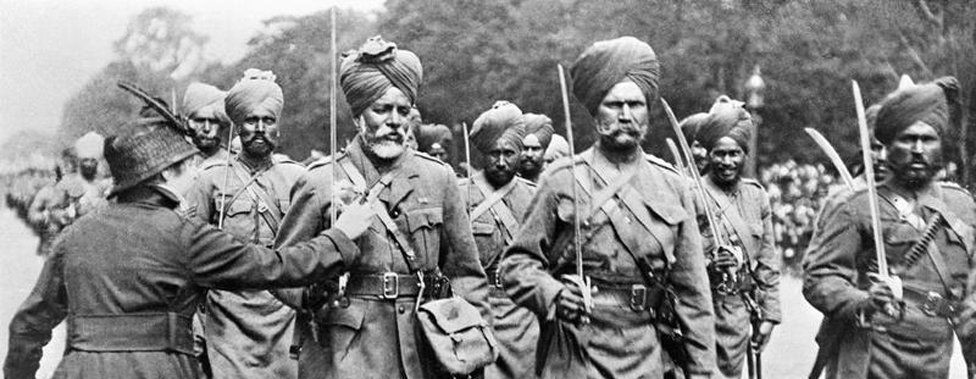
    39th Garhwal Rifles on the march in France

    Comments:
    The 39th Garhwal Rifles were part of the Garhwal Brigade which consisted of two such Garhwali battalions. The Brigade itself was part of the 7th Indian Infantry Division. They were part of constant fighting in France from the start of the war in 1914 to the end of 1915, where they were shifted – after a short respite – the disastrous Mesopotamian Campaign. It is likely that this unknown soldier was writing to his father when the unit was briefly taken off the line in early 1915. The soldiers of the 39th Garhwal Rifles would win 3 Victoria Crosses in 1915 alone. It is unlikely that this unknown soldier survived the Mesopotamian Campaign.

    Letter 3 – M. L. Tilhet, unit and rank unknown, to Pyari Lal Tilhet, February 1916, Urdu to English

    New Milton, Officers’ Convalescent Home

    Some time ago I received a letter form Lala Hira Lal in which he wrote something about my eating and drinking. There is no doubt that I had not practiced abstinence because I could not continue to remain hungry. Originally I certainly did try to abstain, but since I came here, I have ceased to do so – otherwise I could not have existed. In Egypt not only I but numbers of other Hindus – some of whom would, formerly, have rejected their food if only the shadow of an [untouchable caste] had fallen on it – have eaten from the hands of sweepers. Had we not done so there would have been no alternative but starvation which could not be tolerated. … I am not alone in having transgressed and I have no compunction. You too, I suppose, know that the youths who come here for education never abstain in any way. Thus I do not introduce any new fashion. Almost with me is a Lieutenant, by caste a Brahmin, who abstains from nothing. Moreover, if anyone tries to abstain, he advises them against doing so.

    The officers’ convalescent home in New Milton from where M. L. Tilhet would have been writing.

    Comments:
    In this period in India, there was a widespread campaign to reverse the many negative effects of the caste system. This article will dive into no great detail about it, except to say that the experiences of Hindu officers and men who had to walk back these practices in their individual lives in order to survive would likely have played a large part in the civil campaigns post-war. It must also be noted that it was not only Hindus who retired their religious practices for the duration of the war. For many Muslims, the month-long fast of Ramazan was now impossible, for instance. Zabu Shah of the 6th Cavalry, writing home to his mother in 1917, states that in the month of Ramazan he and his fellow Muslims fasted only for 1 day and that if they had fasted for the whole month, they would not have had the energy for the battle. He too, like Tilhet, is unrepentant of his religious transgression and cares little about what those at home might think of this.

    Letter 4 – Risaldar-Major Amar Singh Bahadur to Dafadar Lal Singh, 38th Central India Horse, July 1917, translated Gurumukhi verse

    France

    What news can I give you but the following:

    Many bridegrooms whose thoughts were with their brides have passed away.
    Many other men have struggled with death like fluttering pigeons.
    Their widows are weeping, since nothing but sorrow remains.
    Many who were met by the canon’s blast have passed silently beyond as though sailing away in a ship.

    Soldiers of 4th (Central India) Hodson’s Horse regiment during the Battle of Cambrai, 1917. It still serves the Indian Army as 4th Horse (Hodson’s Horse) and is one of the most decorated armoured regiments of the Indian Army.

    Comments:
    The English translation of this verse does not do it justice. Many soldiers who survived the war turned to writing poetry or literature as a release for, what we now understand to be, PTSD. Most famous of these is J. R. R. Tolkein who turned his experiences in the trenches of World War 1 into one of the most famous media-spanning fictional universes of our time.

    Conclusions:

    David Omissi’s work is filled with hundreds of letters covering every Indian unit, every caste, every religion, every rank and every front. The letters I have mentioned here do no justice to the monolithic compilation. A full conclusion to these letters will be produced later as many letters I am yet to cover and comment on. For further reading, see; David Omissi (ed.), Indian Voices of the Great War: Soldiers’ Letters, 1914-18 (MacMillan; London, 1999)

  • The Seven Years’ War, Vol. III: The “Allies” – Prussia and Russia and their Objectives

    The Seven Years’ War, Vol. III: The “Allies” – Prussia and Russia and their Objectives

    Introduction:

    As we saw in the first article, the Seven Years’ War – when it began in 1756 – ended up consuming Europe, North America, India and South East Asia. It involved, in one capacity or another, dozens of nations – both large and small, powerful and weak – across the world. The French, the British, the Prussians, the Russians, the Spanish, the Portuguese, the Mughals, various Native American tribes, various smaller German Kingdoms – everyone was drawn in. But, in this war, 4 nations played the most significant parts and these 4 nations are our focus over the next two articles: the Bourbon Kingdom of France, the Kingdom of Great Britain (not to be confused with the modern United Kingdom), the Kingdom of Prussia and the Russian Empire.

    In the previous article, we explored the objectives, strategies and aims of the “Principal Nations”, that is Britain and France. In this article, we will explore the British and French Allies’ (Prussia and Russia respectively) objectives for the war and how they intended to fight it, given that they commanded, like the British and the French, forces with marked differences in fighting style combined with the obvious advantages and disadvantages of how their militaries were organised. Over the coming articles, we will focus on other nations and other theatres of war – but for now, our focus remains squarely on Europe and – the centre of attention early in the war – North America.

    The Kingdom of Prussia and the Empire of Russia:

    The goals of Prussia and Russia can best be understood by first understanding the political outcome of the Seven Years War. The war would turn Europe on its head. Before the war, Prussia and Russia were regarded as second-rate powers and inferior in every way to the might of France and Austria. Despite the fact that France allied herself with the Russians, this thinking still dominated the minds of her commanders and leaders until the war was concluded. This was because the European Heads of State believed that there were only 3 nations in Europe at the time that could claim the moniker of “Great Power”. A “Great Power” for the European nations was equal to what we in the 21st Century call a Superpower – in military practice there is no difference between Britain in the 18th or 19th Centuries and America today.

    These 3 nations were; Great Britain, France and Habsburg Austria. The Russian Empire was considered too peripheral to Europe and too politically divided to ever be able to claim this moniker. The Kingdom of Prussia was deemed too weak, far too badly led and without the skill required to command a military force of any serious capability to ever be able to claim this moniker. In a sense, it can be argued that the Prussians and Russians went to war to reverse this image and to claim their place on the European stage – and this would be a partially sound assessment. However, there are many nuances left still to explore.

    Prussian Grenadiers advancing against Austrian Forces in the Seven Years War

    As we saw in the previous article, the Seven Years War for Britain and France was a war over their colonial possessions, beginning first in North America but eventually spreading to all corners of their new Empires. By contrast, the war for Prussia and Russia was a European War. Prussia found itself surrounded by a coalition set on destroying it – Russia to the East, Austria to the South, and France to the West. As if that were not enough, King Frederick II of Prussia, harboured ambitions of expanding the might and territorial extent of the Kingdom of Prussia. For Prussia, then, it was a war of survival while simultaneously being a war of expansion.

    Russian infantryman of the war.

    For Russia, things were much simpler. Since the reign of Peter I, known also as Peter the Great, in the late 1600s, Russia had been expanding West – towards Europe. Under Peter, the Russian Empire reached the Pacific Ocean in the East, the Caucasus Mountains in the South (modern-day Armenia, Georgia and Azerbaijan) and the Baltic Sea in the North West (modern day Estonia, Latvia and Lithuania). Now, Russia was ruled by Elizaveta Petrovna – one of the most beloved leaders in Russian history – and she was not about to give up on her father’s goals of expanding further into Europe. After the War of the Austrian Succession ended in 1748, the Russians found that those who had been their enemies in that war, the Austrians, harboured a deep hatred for the Prussians after they lost multiple provinces to them. A hatred the Russians shared. They entered into a secret treaty with the Austrians – should Prussia attack either Russia or Austria, the other nation would leap to the defence of the victim. In the end, when war began in 1756 with the Prussian invasion of France, Russia cared for little apart from the expansion of the Russian Empire, the annexation of East Prussia into Poland (a client state of the Russian Empire) and the total destruction of the Kingdom of Prussia.

    Their Strategies for War:

    A painting depicting the battle of Rossbach, a significant Prussian victory against the French in 1757

    It should not come as a surprise that the Prussian strategy for the war was predicated on countering the massive French Army. They knew they would be unable to meet the French in open battle. They also knew they would be unable to defend successfully against a French thrust. They had neither the men nor the materiel for this. But what they did have was British money. William Pitt, the then Prime Minister, had agreed to subsidise the Prussian Army with a whopping 100,000 pounds in 1756 (equivalent to 30 million USD or 27 million GBP in 2023) with which Frederick II could raise and train a modern army. His goal was to use this army to strike straight at France and paralyse them into indecision. Strangely enough, his strategy and tactics were influenced directly by the French. Frederick had spent the interregnum between the War of the Austrian Succession and the Seven Years War studying French tactics and strategy and had decided to fight fire with fire.

    For the Seven Years War, he decided to settle on an entirely offensive war plan, made up of quick thrusts, withdrawals and manoeuvres designed to out-pace the large French Army. He believed in “short and lively wars”, where he would quickly take territory, hold it and force the enemy to sue for a peace that favoured the Prussians and allowed them to hold on to what they had captured. This he did quite successfully when he took Silesia from Austria in the War of the Austrian Succession – the reason that the Austrians developed a burning hatred for the Prussians. And it was this strategy again that he would call on. For the defence of Prussia against the inevitable Russian and Austrian onslaught, he raised smaller armies but mostly he relied on the Kingdom of Hanover, who was also being subsidised by the British. This strategy would see Prussia force France into conceding far more land than they had imagined they would lose in Europe.

    Russian soldiers in Berlin, 1760

    For Russia, the strategy – like their objective – was simple. Some military historians focused on Russia may say that their strategy has always been simple. They would simply march across Europe with their massive army and swallow up Prussia – or at least, they planned to. With the Austrians attacking from the South and the Imperial Russian Army coming from the East, they imagined it would be impossible for the Prussians to resist. And they were right. The Imperial Russian Army succeeded in taking Berlin and much of East Prussia. By 1762, it looked as if the Russians had successfully beaten the Prussians in the East, despite Prussian successes in the West. However, in 1762, Elisaveta Petrovna – the Empress of Russia – would die and the new Tsar – Peter III – would undo everything she’d worked so hard to achieve. But more on that, very, very soon.

    Sources:

    Col. Holabird (tr.), General Baron Antoine Henri de Jomini, Treatise On Grand Military Operations: Or A Critical And Military History Of The Wars Of Frederick The Great – Vol. I (Normanby; 2013).

    Adam Storring, “‘The Age of Louis XIV’: Frederick the Great and French Ways of War”, in German History, 38:1, pp. 24-46

    H. M. Scott, The Emergence of the Eastern Powers; 1756-1775 (Cambridge University Press; 2009)

    M. Persson, “Mediating the Enemy: Prussian representations of Austria, France and Sweden during the Seven Years War”, in German History, 32:2, 181-200

    Daniel Baugh, The Global Seven Years War 1754–1763; Britain and France in a Great Power Contest (Routledge; 2021)