This article has been written for Easy History by Shubham Pawaskar.
Introduction:

On the 2nd April 2025, US President Donald Trump announced wide-ranging tariffs as a part of his “Liberation Day” announcement. This move had baffled experts and economists, many of whom consider the United States to be the bastion of freedom and free trade. This protectionist tilt of the United States was further compounded by additional restrictions imposed on the H1B visa (used by graduate students to work and live in the country) applied on the 21st of September 2025. While the impact of this sea change in American immigration and trade policy on the economy is yet to be seen, we can take some hint from the role played by insecurity and protectionism in the journey taken by another great state, albeit one that existed about half a millennium ago, thousands of miles away from the United States.
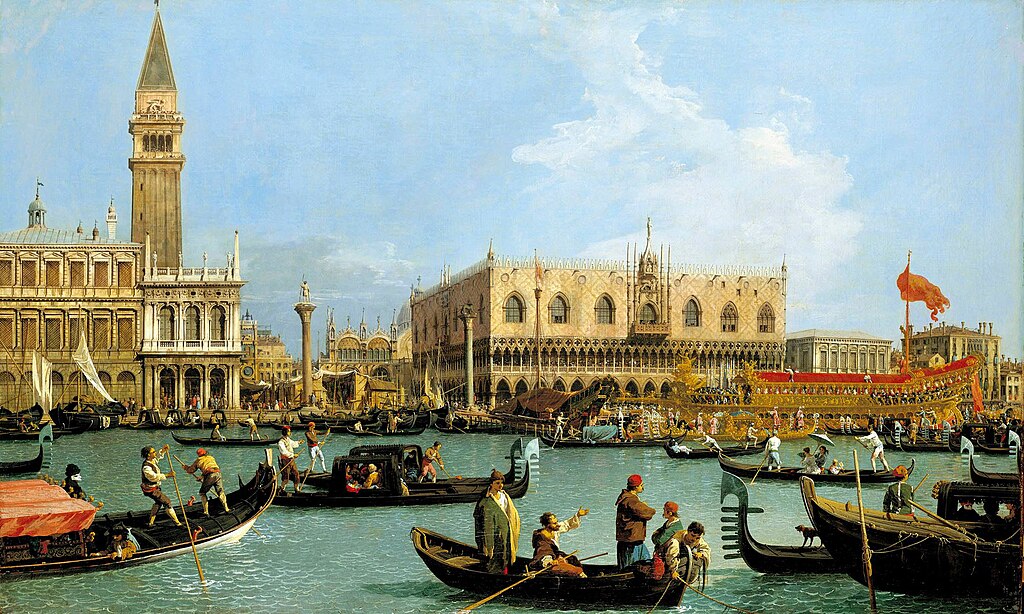
When we think about Venice, we think about the city, the art, the gondolas, and Jeff Bezos’ wedding. But where did all this glamour originate? The city we now call Venice was once the centre of a maritime empire styling itself as a Republic- or rather Serenissima Repubblica di Venezia, “The most Serene Republic of Venice.” This is a worthy cognomen as anyone who has been to Venice can testify after partaking in the splendours of St Mark’s Cathedral and Palazzo Ducale. This prosperity was built on the backs of their merchant navy that held a near monopoly on maritime trade in the Mediterranean. It is estimated that at its heyday, the Venetian Republic controlled almost half of all Mediterranean maritime trade. This is quite impressive considering its population of just 100000. However, with the discovery of new trade routes by the Portuguese and Spanish in the 16th century, it began to lose its competitive advantage. But the fact that Venice failed to capitalize on these discoveries and innovations suggests a deeper structural reason behind the eventual decline of Venetian naval supremacy. This article, hence, seeks to throw light on the institutional changes that took place in Venice that led to its eventual decline.
The Rise of Venice:

To tell the story of Venice is to tell the story of maritime trade in the Mediterranean. In this, Venice found itself in the right place at the right time. Situated at a crossroads between east and west, with cultural roots to the Byzantine Empire, Venice was well located to regulate trade between Asia and Europe, having access to key shipping lanes, ports, rivers, and inland markets in Europe. In 1082, an insecure Alexios Kommnenos (Byzantine Emperor), seeking naval support against the Normans, issued the Golden Bull of 1082, exempting Venice from customs duties in the empire, granting it an effective trading monopoly in the Mediterranean. This was further strengthened when Pope Urban gave the call for the 1st Crusade, with Venetian ships maintaining supply lines and assisting in the capture of key port cities in the Levant. Venice was hence given a seat at the table when Jerusalem fell in 1099, extending further privileges and trading rights in the newly formed Outremer or Crusader States. While geography and historical contingency make for convenient expositions, to gauge the source of Venetian naval supremacy, we must turn to the institutions that enabled Venice to harness its natural advantages. In short, we must answer the question: What made Venice “great”?
For an economy built by maritime trade, most of the institutions responsible for Venetian prosperity were made for and centred around the expansion of this trade and included innovations in business, finance, and law, as well as systems of political representation and decentralization of power.
The Colleganza:
At the heart of Venetian maritime trade was the Colleganza. An early form of limited liability joint stock company, the Colleganza was a contract between two parties. A sedentary merchant or merchants-Stans who provided the investment, and the travelling merchant, the Tractator,responsible for travelling with the investment and carrying out trade. The names of the parties involved, nature of investment and goods, specific instructions, and the terms of the contract were all well specified, as was the distribution of any profits, with the sedentary merchant usually keeping 75% of the profits and the Tractator keeping the rest. As an institution, the Colleganza was designed to suit the needs and demands of long-distance maritime trade. This trade was expensive, requiring massive financial investment with little in the way of collateral, and also came with security risks as the investment was out of sight, making it an issue of faith between all parties involved. This trade was also time-bound, where a few months’ delay could mean the difference between profit and ruin. The colleganza allowed investors to pool their resources and share profits accordingly. Losses were limited by the initial investment and were borne by the sedentary merchant(s), while any debts beyond the capital invested would be the responsibility of the travelling merchant, thereby distributing potential liability.
The hallmark of the Colleganza was its inclusive nature. There were few restrictions on who could partake in a maritime expedition in Colleganza with the Stans. The system allowed enterprising and ambitious young men of limited means and humble familial standing with few connections to enter into partnership with a wealthy investor. This facilitated incredible social mobility with newer, outsider families generating wealth to challenge existing class structures. Over time, this financial power translated into political power, preventing any one family or group from concentrating too much power. This volatility and rapid social advancement played a key role in shaping the political institutions of the Venetian Republic for the better.
Political Structures and Institutions:
The Doge and the Ducal Council

While Venice styled itself a Republic, the reality was not so romantic. The Doge or Duke (the Roman Dux) was the executive head of the Venetian Government with control over foreign policy, administration, and the navy. Despite being an elected position, in the early years of the republic, the Dogeship was effectively hereditary, with three families, the Participazios, Candianos, and Orseolos, having a monopoly on executive power. With the growing importance of long-distance maritime trade, however, this equation began to come under pressure. In 976, Doge Candiano IV was killed in a riot for diplomatically aligning the Republic with the Holy Roman Empire and away from its usual partner in trade, the Byzantine Empire. This represented the growing influence of merchants who depended on Mediterranean trade. 1032 marked a watershed moment in the political development of Venice when Domenico Flabanico was elected as the first Doge to not belong to a political dynasty. This ended the era of the hereditary dogeship and the opening up of the political institutions. The new Doge set to work passing new laws to limit the powers of the Doge against the creation of a hereditary monarchy and banning the appointment of co-doges who would often become successors. These reforms would be supplemented by further checks on the power of the Doge, with the institution of a consultative Ducal Council that would serve as a cabinet and powerful counterweight to the Doge’s authority. This system of checks and balances on the power of the executive, brought about by the rising influence of the newly established merchant families, decentralized political power, and can be seen repeated throughout history, especially in the case of the United States and its limitations on Presidential authority.
For the People: The Great Council and Council of Forty

Being ever suspicious of the hereditary concentration of power in the hands of the Doge, the merchant class was not finished with its attempts to check Ducal Power. Despite the reforms of Flabanico, the traditional elite continued to dominate the Dogeship, treating it as their hereditary right. In 1171, Doge Vitale II Michiel, who had become unpopular for his disagreements with the Ducal Council, led an armada to blockade Constantinople in response to Emperor Manuel Kommnenos’ arrest of Venetian merchants in the capital. The failure of this expedition and the outbreak of plague in Venice culminated in the assassination of Doge Vitale in 1172. The merchant class was quick to use this power vacuum to expand the constraints on the Doge and further their power. To that end, they created a legislative body called the Great Council (Maggior Consiglio), responsible for electing the Doge and holding him and the Ducal Council to account. This new Assembly had more than 400 members from across the 6 districts of Venice. It also had the power to appoint naval commanders and captains as well as territorial governors. Another body established by these reforms was the Council of Forty-Quarantia which acted as a regulatory board for nominations to the Dogeship and Great Council and served as a supreme court.
While still dominated by the aristocratic class, membership in the Great Council was open to all male citizens of Venice, regardless of their familial ties, meaning anyone with enough wealth and renown could be elected to serve on the Council. With the rise of contracting institutions like the Colleganza, wealth flowed into the hands of outsiders and commoner families with no hereditary ties to the traditional aristocracy. When coupled with the relatively open membership to the Great Council, these newer families saw their representation on the Council increase in the century following the reforms of 1172. The result was a society where wealth and business acumen formed the basis of political power instead of ancestral ties and birth. Another by-product of these reforms was the increasing volatility in Venetian society as newer families displaced more established ones on the Great Council, with research showing that the share of seats held by the 50 most influential families declined from 75% to 65% in the span of just 3 decades between 1261 and 1295.
This political and social mobility can be elucidated by the life of Zaccaria Stagnario whose grandfather was a freed Croatian slave and father was a helmsman. In 1199, Zaccaria travelled in Colleganza to Constantinople as a Tractator. By 1206, he held office as a councillor and was rich enough to be a sedentary merchant in two Colleganzas for the large sum of 200 Byzantine hyperpeppers, an amount higher than the salary of some provincial governors. Upon his return to Venice, Stagnario was welcomed into the ruling elite, and his descendants served in the Great Council.

Such a society, where wealth and not inheritance mattered, would be mirrored in an industrializing United States where people like John D Rockefeller, Andrew Carnegie, and Thomas Edison, who came from humble and sometimes immigrant backgrounds, made their fortunes by innovating technology and business practices.
The Virtuous Cycle
The consequence of having inclusive institutions and a permeable society where advancement was based on capability and merit was the decentralization of power and technological and financial innovations. This kept a check on the Doge and prevented him from becoming a tyrant, as was the norm in most medieval cities. The easy social mobility led to increased competition and a willingness to innovate and adopt new naval technologies and financial institutions to make Mediterranean trade more efficient and profitable. The expansion of institutions to support this trade led to the creeation of a formidable professional navy with officers selected on merit, easy access to credit via banking and insurance, and the standardization of shipbuilding that gave the Arsenal shipyard its fame. It was this virtuous cycle that enabled Venice to maintain its dominance over Mediterranean trade routes and expand its maritime empire to include Croatia, Crete, and Corfu.
The insecurities of the elite: The Serrata
The social and political upheaval brought about by the redistribution of power to newer merchant families (popolo grasso) made the traditional aristocracy of Venice fearful of a loss of status. The Venetian aristocracy sought to consolidate power and restrict access to the levers of economic progress. Starting in 1297, they passed a series of legislation collectively known as the Serrata del Maggior Consiglio or Lockout of the Great Council. These laws made membership in the Great Council a hereditary right enjoyed exclusively by the nobility. They also changed the nomination process, increasing the threshold of Quarantia votes required to be elected to the Great Council. This made the nobility dominated Quarantia, the gatekeeper to the Great Council, with the power to reject anyone who disagreed with or threatened the power of the nobility.
These reforms were bitterly contested by commoners and the lesser nobility, who were excluded from the levers of power. The decade following the initial Serrata would be characterized by coups and revolts led by commoners and aristocratic factions. The nobility responded to this instability by co-opting the most significant of the omitted parties into the Great Council by doubling its size while using repression to clamp down on the rest. It was in this period that power was increasingly concentrated in the hands of a Council of Ten with broad jurisdiction over internal security and a license to crush any uprisings.
With the closure of the political system, the nobles now sought to attack the source of economic mobility as well to prevent newcomers from ever challenging their authority again. After the Serrata, the Republic instituted crippling regulations on privately owned ships, eventually nationalizing maritime trade and the Arsenal in 1325. These publicly owned vessels were auctioned off to private operators who were usually members of the elite. They were protected from competition from privately owned ships, thereby turning maritime trade into an effective monopoly of the aristocracy.
In 1324, the Republic introduced the Capitulare Navigantum, a law that forbade merchants from shipping goods with a value greater than their net worth. The capital-intensive nature of trade meant that only the rich could now engage in maritime trade, hence putting the final nail in the coffin for the Colleganza. The exclusion of the poor and commoner classes from trade and economic mobility led to growing inequality and the closing of a once-open system.
The Aftermath:
While the aggressive oligarchization and exclusion of the outsider and commoner classes did not have an immediate impact on Venetian prosperity, the Republic would see its power slowly wane. While having control over the Arsenal and maritime trade made the aristocrats fabulously wealthy, Venice was slow and averse to adopting the latest naval technology, and lagged in the modernization required to take advantage of the Age of Discovery. The monopolization of banking and finance meant that easy access to credit was a privilege only enjoyed by the rich, leading to fewer risk takers and innovators. Venice’s domination of the Mediterranean increasingly came to be challenged by states such as Genoa and the Ottoman Empire. Their declining naval power was a result of aristocratic interference in the hiring of naval officers, preventing the formation of a professional navy and merit-based bureaucracy. The result was the loss of Venice’s Croatian colonies by 1358. The restrictions on the Colleganza meant that the institutional development required for the formation of trading companies like the East India Company never took place in Venice. The economic and political closures associated with the Serrata brought an end to the institutional dynamism that had been the reason behind Venetian prosperity in the first place.
History repeats itself – Parallels to American protectionism:
The economic supremacy of the United States was built on the availability of easy credit and a reasonably fair justice system that upheld property rights and patents that incentivized innovators to take risks. This fuelled the rapid industrialization of cities and the mechanization of farms to feed a growing population. America was also among the first countries to embrace the explosion of computer technology in the 80s and 90s, with American companies like Apple, Google, and Microsoft leading the shift towards a service-dominated economy. This was possible thanks to a relatively open economic environment where skilled immigrants from across the world were welcome based on their merit rather than birth. Central to this system is the H1B work visa, allowing foreigners to work in the US. The futurist Michio Kaku has called the H1B program America’s secret weapon, enabling it to attract the brightest minds from around the world, hence contributing to American technological dominance. Most economists view the H-1B program as a net positive for the U.S. economy, citing its role in innovation and growth. Highly skilled immigrant workers are known to boost job growth in the United States either through innovations and setting up businesses or by spending and investing their wages in the U.S. economy, increasing consumer demand, and creating new jobs. Furthermore, an increase in graduate immigration is closely correlated with an increase in patenting, productivity, and ultimately wages for the average American worker. In this sense, the H1B visa resembles the Colleganza contract that enabled enterprising outsiders and commoners to earn and invest in Venice.
Despite the economic benefits to the country, just like the Venetian nobility, parts of the American political class have always found the allure of nativism and protectionism to be persuasive. Seeking to close down avenues to working and living in the US, the Trump administration’s restriction on H1B visas, especially the hiking of the application fee to $100000, can be seen as an effective Serrata of the American education and economic system. While this fee will make many companies think twice before sponsoring H1B visas, it tilts the playing field in favour of larger corporations who can afford this fee, adversely impacting the access smaller firms and startups have to the best global talent. Parallels can be drawn to the Capitulare Navigantum and its wealth limitations, skewing maritime trade in favour of those who could afford it. Furthermore, restrictions on H1B visas in the past, while reducing competition for native born workers, do little to increase jobs in the United States. When H-1B visas were capped in 2004, firms that were dependent on high-skilled foreign workers responded by simply outsourcing jobs, increasing employment at foreign affiliates 27 percent more than less-dependent firms. The fact that the Trump administration has now walked back many of these restrictions harkens back to the co-opting and enlargement of the Great Council that drove a wedge through organized opposition, firmly demarcating which people could access Venetian institutions.
Conclusion:
Venice, like America, was built by immigrants and refugees. It thrived off its uniquely inclusive institutions to create a dynamic and prosperous society. However, the insecurity of its elites and fear of competition led to the rise of protectionist tendencies. While the Venetian economy continued to grow in the immediate aftermath of the Serrata, much of this growth was concentrated at the top. The long-term consequences of rampant inequality were the decline of Venetian competitiveness and innovation. The Venetian elite traded social mobility and dynamism for security and their own narrow self-interest. The liberation day tariffs and H1B restrictions have likewise yet to impact the US economy positively, with companies choosing to outsource jobs permanently, or countries implementing retaliatory tariffs. The example of Venice’s dalliance with protectionism is a sharp reminder of how once inclusive institutions can degrade into exclusive ones that can lead to the decline and fall of superpowers. Whether the American people will succeed in resisting these impulses is yet to be seen.
References:
- Diego Puga & Daniel Trefler, International Trade and Institutional Change: Medieval Venice’s Response to Globalization. NBER WORKING PAPER SERIES
- Daron Acemoglu and James Robinson, “Why Nations Fail?”
- Frederic C. Lane, Venice: A Maritime Republic, THE JOHNS HOPKINS UNIVERSITY PRESS
- John Bound, Gaurav Khanna, Nicolas Morales, UNDERSTANDING THE ECONOMIC IMPACT OF THE H-1B PROGRAM ON THE U.S. NBER WORKING PAPER SERIES
- Britta Glennon, HOW DO RESTRICTIONS ON HIGH-SKILLED IMMIGRATION AFFECT OFFSHORING? EVIDENCE FROM THE H-1B PROGRAM. NBER WORKING PAPER SERIES,
- Alex Nowrasteh, Don’t Ban H-1B Workers: They Are Worth Their Weight in Innovation. Cato Institute
About the Author:
Shubham Pawaskar is a software developer who works in Ai. His first love was history with a particular affinity towards Ancient Rome and modern political history. He was the Editor-in-Chief of his college magazine and has written about pop-culture and literature. He spends his leisure time writing poems and articles and reading fiction and fantasy.


